
Anal fistula is a condition that does not heal on its own and requires specialist surgical treatment. Anal fistulas do not heal on their own. Without treatment, they cause ongoing discharge, discomfort, and recurrent infections. With the right surgical treatment, most fistulas can be permanently resolved.
I’m Professor Dr. Antonio Privitera, a consultant colorectal surgeon with fellowship training at the Mayo Clinic and European Board Certification in Colorectal Surgery. I treat simple and complex anal fistulas in Dubai and Abu Dhabi, using the technique that gives the best outcome for each patient’s anatomy. Treatment must be tailored to the type and complexity of the fistula to achieve cure while preserving continence.
What Is an Anal Fistula?
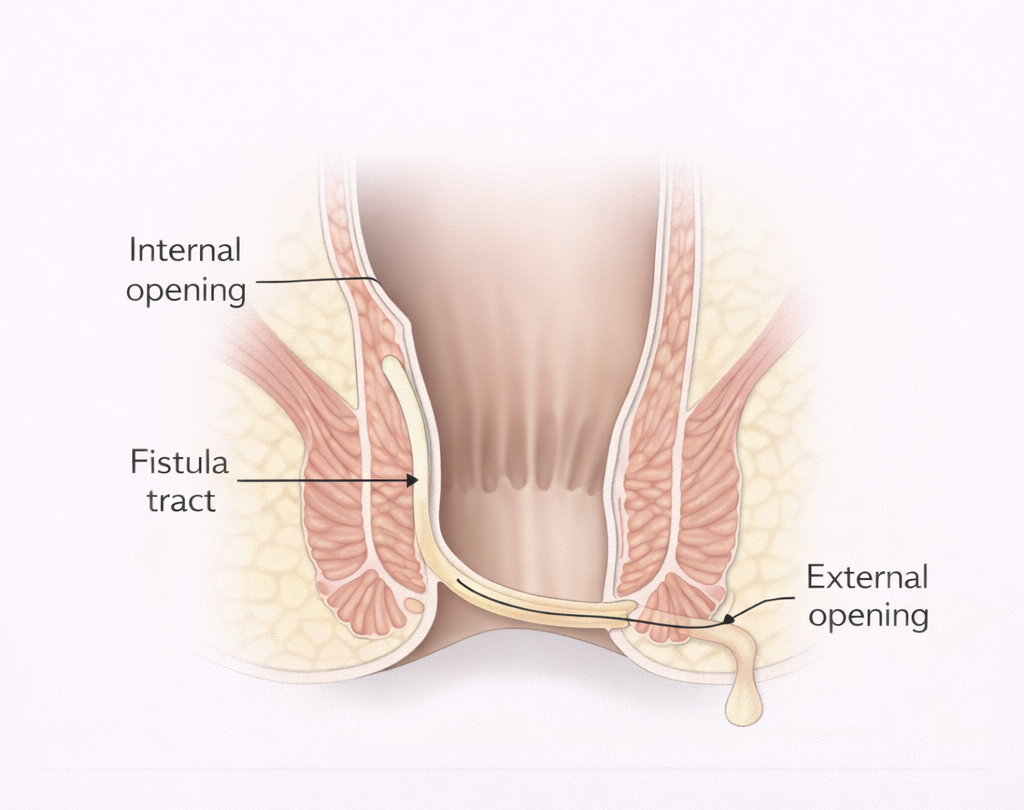
An anal fistula is a tract a tunnel that runs from an internal opening inside the anal canal (usually at an infected anal gland) through the surrounding tissue to an external opening on the perianal skin. Discharge (pus, blood, mucus) travels through this tract.
How Do Fistulas Form?
The vast majority of anal fistulas begin with an anal abscess: an infection of one of the small anal glands (cryptoglandular infection). The abscess either drains spontaneously or is surgically drained but in about 50% of cases, a persistent tract (fistula) remains.
Types of Anal Fistula
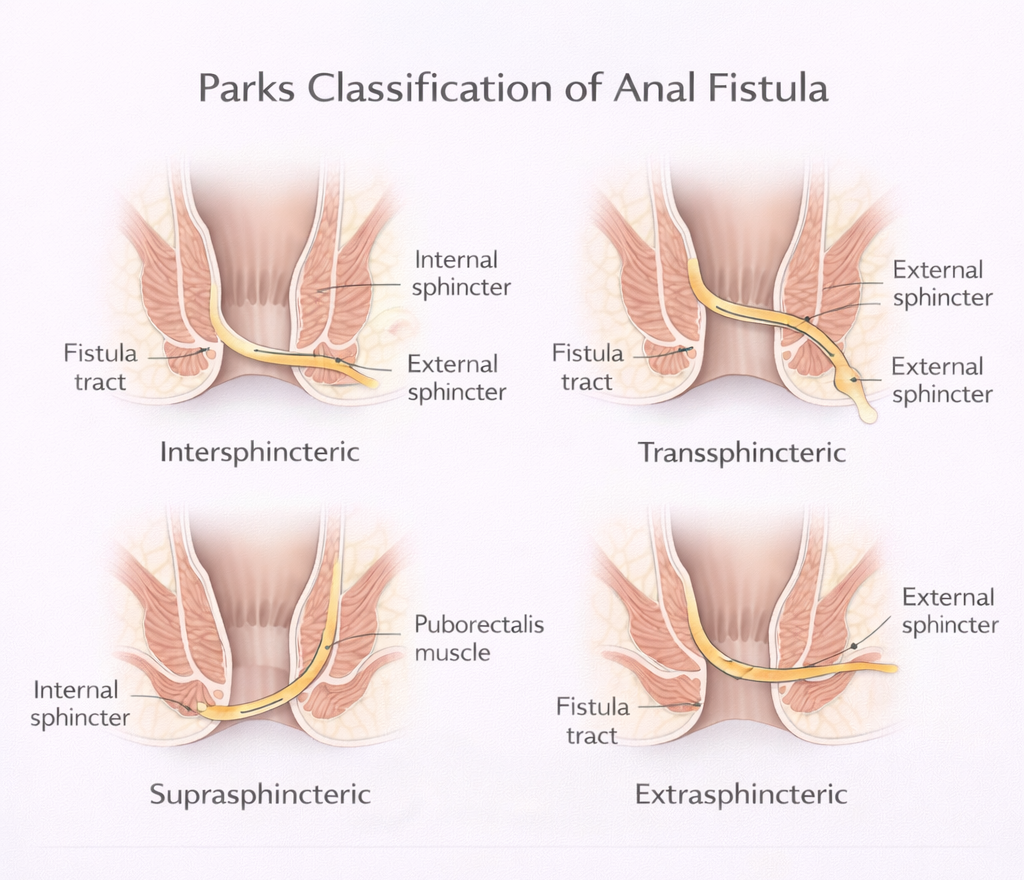
- Intersphincteric: Tract passes through the internal sphincter only. Most common type. Lowest risk during surgery.
- Transsphincteric: Tract passes through both internal and external sphincters. Second most common. Surgical technique depends on how much sphincter is involved.
- Suprasphincteric: Tract passes over the top of the puborectalis muscle Complex.
- Extrasphincteric: Tract bypasses the sphincter complex entirely. Rare. May be related to Crohn’s disease, trauma, or malignancy.
Symptoms
- Persistent discharge from a small opening on the skin near the anus (pus, blood, or mucus)
- Itching, irritation, and skin excoriation around the opening
- Intermittent pain or swelling – particularly when the external opening closes and the tract fills with pus
- History of previous perianal abscess
- Soiling of underwear
Diagnosis
Diagnosis is clinical examination typically reveals the external opening and may identify the tract. Additional investigations:
- MRI pelvis for anal fistula in Dubai: The gold standard for complex fistulas – defines the tract in relation to the sphincter muscles and identifies secondary tracts or abscesses.
- Endoanal ultrasound: Useful for simple fistulas and sphincter assessment.
- Examination under anesthesia (EUA): Sometimes required to fully assess a complex fistula.
Treatment Options
Fistulotomy – Laying Open the Tract
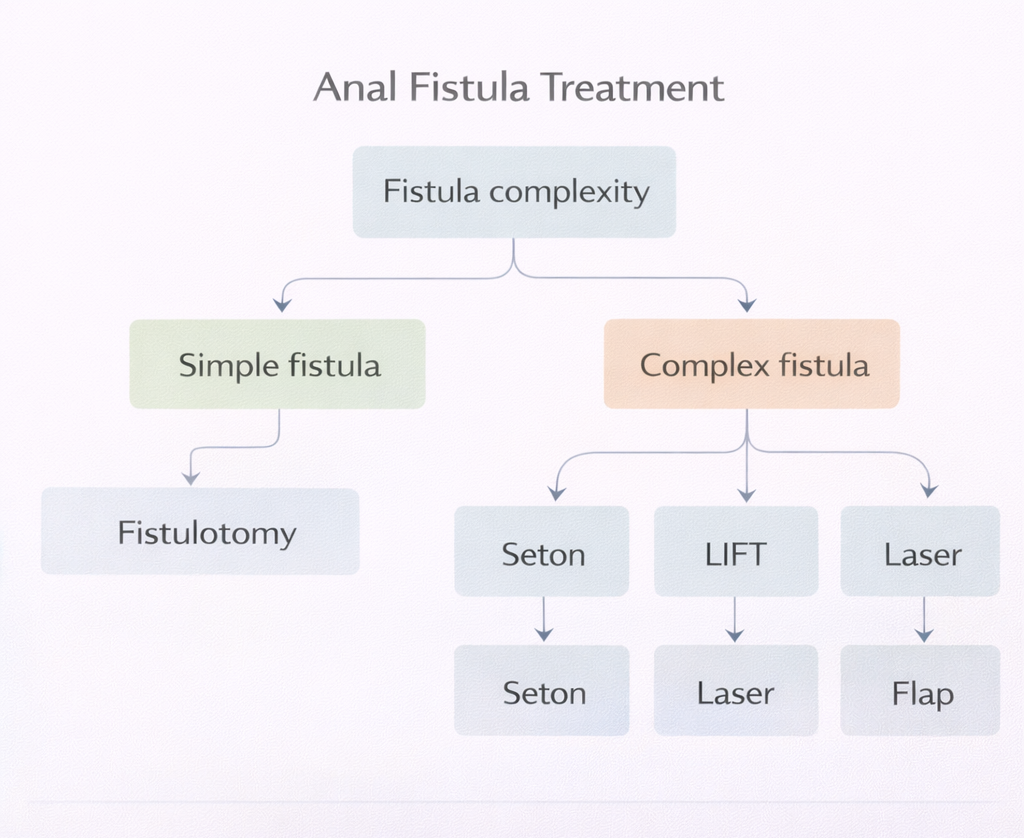
Laying open the fistula tract (fistulotomy) in Dubai is the standard treatment for simple fistulas (intersphincteric and low transsphincteric) that involve little or no sphincter. The tract is opened, cleaned, and allowed to heal from the base. Cure rate: 90% for simple fistulas.
Seton Placement
A seton for anal fistula in Dubai is a thread or suture passed through the fistula tract. Used for complex fistulas involving significant sphincter muscle. Can be used as a draining seton (to control sepsis and allow safe definitive repair later) or a cutting seton (gradually cutting through the sphincter while allowing fibrosis less common now).
LIFT Procedure (Ligation of Intersphincteric Fistula Tract)
The tract is ligated (tied off) within the intersphincteric space. A sphincter-sparing option for transsphincteric fistulas. Cure rate: 60-80%.
Laser Treatment for Anal Fistula
Laser Fistula Treatment Dubai FiLaC (Fistula Laser Closure): A laser fiber is passed through the tract and destroys the epithelium. Sphincter-sparing. Success rate: 60-70% for simple fistulas. Best for low, simple tracts.
Advancement Flap
A flap of rectal mucosa is used to close the internal opening. Sphincter-sparing. Used for complex transsphincteric fistulas. Cure rate: 60-80%.
Fibrin Glue / Bioprosthetic Plug
Filling the tract with fibrin glue or a bioabsorbable plug. Minimal morbidity but lower success rates (25-50%). Used for selected patients where avoiding sphincter risk is paramount.
Simple vs Complex Fistula: Why It Matters
Simple fistulas involve little or no sphincter muscle and can be safely laid open without risk of incontinence. Complex fistulas involve significant sphincter muscle laying them open would cause fecal incontinence. Complex fistulas require sphincter-sparing techniques.
When to See a Specialist
- Persistent discharge from a small opening near your anus
- History of perianal abscess (drained or spontaneous)
- Intermittent swelling or pain near the anus that comes and goes
- Known Crohn’s disease with perianal symptoms
References
- National Institute for Health and Care Excellence (NICE). Anal fistula. 2021.
- Steele SR et al. Practice parameters for the management of perianal abscess and fistula-in-ano. Dis Colon Rectum. 2011.
Need expert treatment for hemorrhoids, anal fissure, or anal fistula? Book a consultation with Dr. Antonio Privitera in Dubai or Abu Dhabi.
📱 WhatsApp: +971 55 318 8469
📞 Phone: +971 55 318 8469
AUTHOR AUTHORITY BLOCK
Fellowship-trained at Mayo Clinic (USA) and the Royal College of Surgeons (UK). Member of the Royal College of Surgeons of Edinburgh. Certified in General Surgery by the Italian Medical Council.
About the Author