
If your surgeon recommends a seton for your anal fistula, you probably have a complex fistula – one involving enough sphincter muscle that laying it open directly would risk incontinence. For full management strategy, see anal fistula treatment in Dubai. A seton is not a cure in itself. It is a first stage in a planned treatment strategy.
This guide explains exactly what a seton is, why it is used, and what to expect while you have one in place.
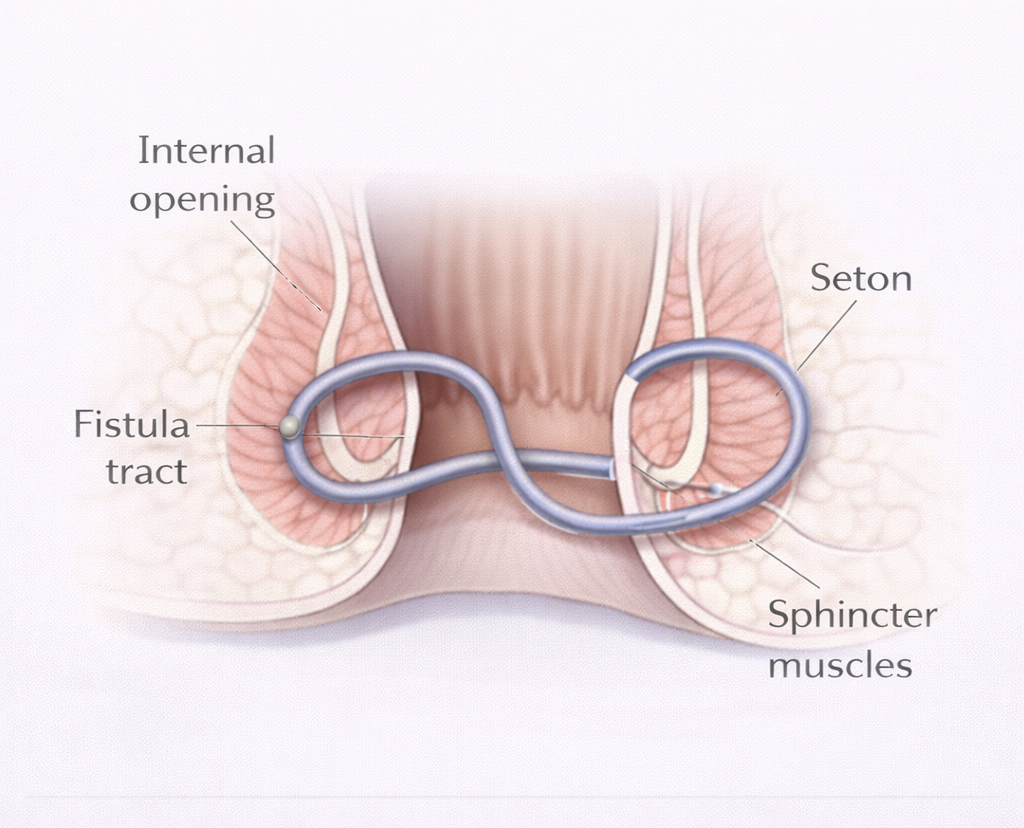
What Is a Seton?
A seton is a thread usually silicone, rubber, or suture material that is passed through the fistula tract, with both ends tied together to form a loose loop around the sphincter muscle involved in the fistula.
There are two types of seton:
Draining (Loose) Seton
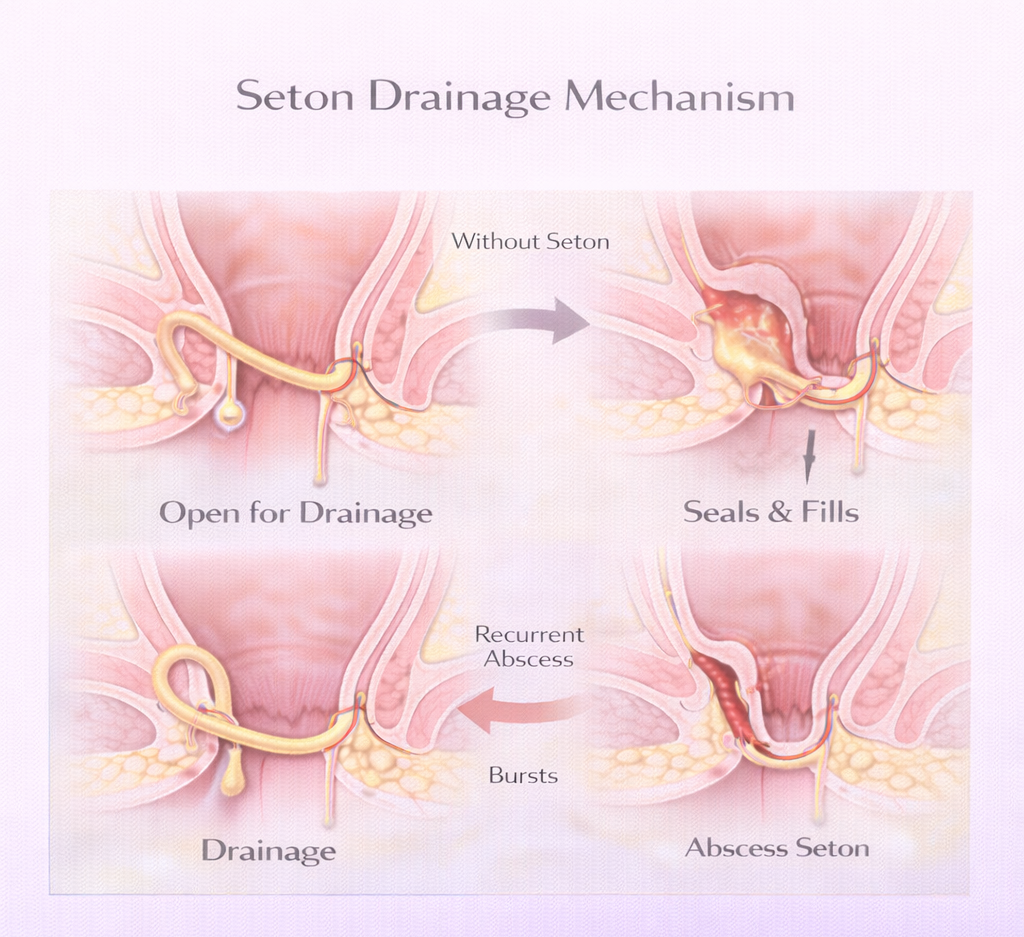
The most commonly used type. The seton is placed loosely it does not cut through tissue. Its purposes:
- Controls sepsis: Keeps the tract open so that pus and infected material can drain continuously. This eliminates the cycle of the tract sealing, filling with pus, and causing pain.
- Promotes fibrosis: The chronic foreign body stimulus causes gradual fibrosis around the sphincter, stiffening it so that if it is later divided (by the cutting seton or fistulotomy), it does not retract and separate.
- Allows assessment: With the acute infection resolved and the tract drained, the anatomy can be reassessed often with MRI for anal fistula before planning definitive repair.
Cutting (Tight) Seton
The seton is placed tightly or progressively tightened at clinic visits, gradually cutting through the sphincter over weeks to months. The fibrosis that develops around the seton prevents the sphincter from retracting. Less commonly used now – largely replaced by LIFT, advancement flap, and other sphincter-sparing techniques.
When Is a Seton Used?
- High transsphincteric fistula: Too much sphincter is involved for immediate fistulotomy
- Suprasphincteric fistula
- Complex fistula with active sepsis: The seton drains the infection before definitive repair
- Crohn’s fistula: Long-term draining seton may be the definitive treatment aiming for quality of life rather than cure
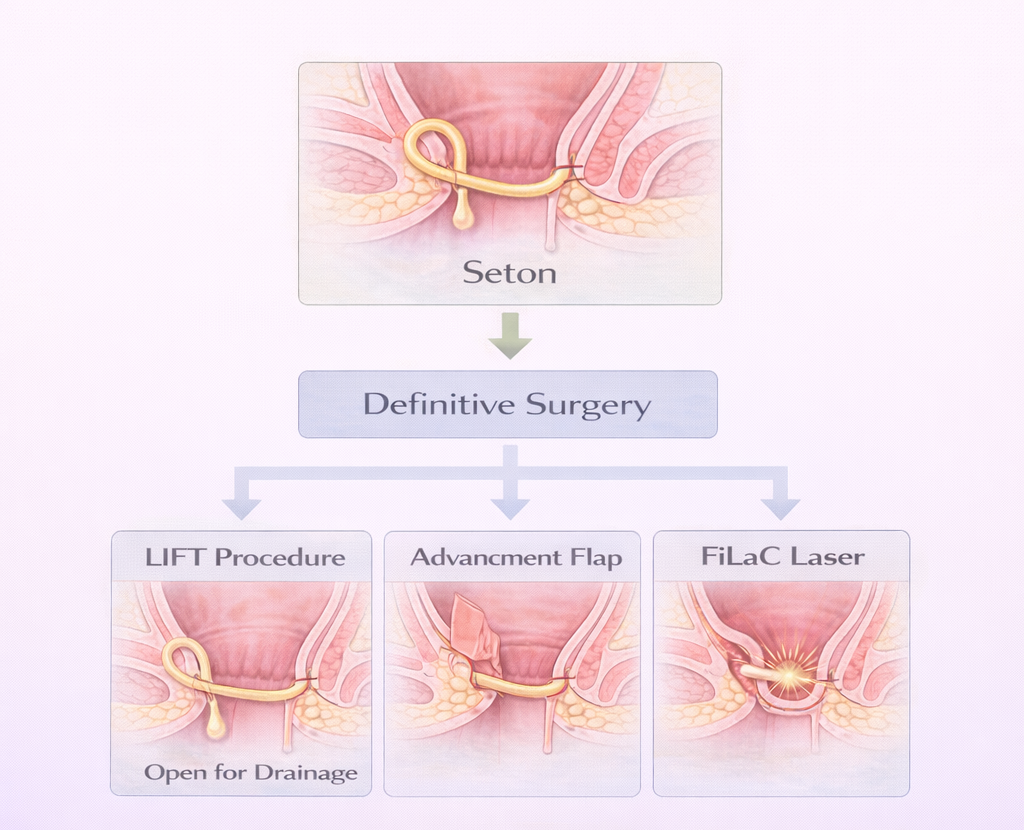
- First stage before LIFT, advancement flap, or FiLaC
Having a Seton: What Life Is Like
- The seton is a visible loop of thread at the anal opening you will be able to feel it and see it
- Most patients tolerate setons well after the first few weeks
- Some minor mucus or blood-stained discharge this is the fistula draining, which is the purpose of the seton
- Hygiene: Clean the area after bowel movements showers are easier than toilet paper
- The seton must be kept in place until your surgeon removes it or performs the next stage of surgery
Duration
A draining seton is typically in place for 6-12 weeks before the next stage of surgery. In Crohn’s fistulas, a long-term seton may be maintained indefinitely.
Recovery After Seton Placement Surgery
- Day-case or short-stay procedure
- Mild discomfort for a few days after insertion
- Return to desk work: 3-7 days
- Normal activities: Within 1-2 weeks
Next Steps After a Draining Seton
After the seton has controlled sepsis and allowed MRI reassessment, the next stage is definitive repair most commonly:
- Complex Anal Fistula Treatment Dubai LIFT procedure (ligation of intersphincteric fistula tract)
- Mucosal advancement flap
- FiLaC laser closure
- Rarely, cutting seton or staged fistulotomy
Need expert treatment for hemorrhoids, anal fissure, or anal fistula? Book a consultation with Dr. Antonio Privitera in Dubai or Abu Dhabi.
📱 WhatsApp: +971 55 318 8469
📞 Phone: +971 55 318 8469
AUTHOR AUTHORITY BLOCK
Fellowship-trained at Mayo Clinic (USA) and the Royal College of Surgeons (UK). Member of the Royal College of Surgeons of Edinburgh. Certified in General Surgery by the Italian Medical Council.
About the Author