
Laser treatment for anal fistula is one of the most searched topics in UAE colorectal surgery – and one of the most misunderstood. Marketed as ‘minimally invasive’ and ‘no scar’, it attracts patients who understandably want to avoid surgery. For full comparison, see anal fistula treatment in Dubai. This guide gives you an honest assessment of what laser can and cannot do.
What Is FiLaC (Fistula Laser Closure)?
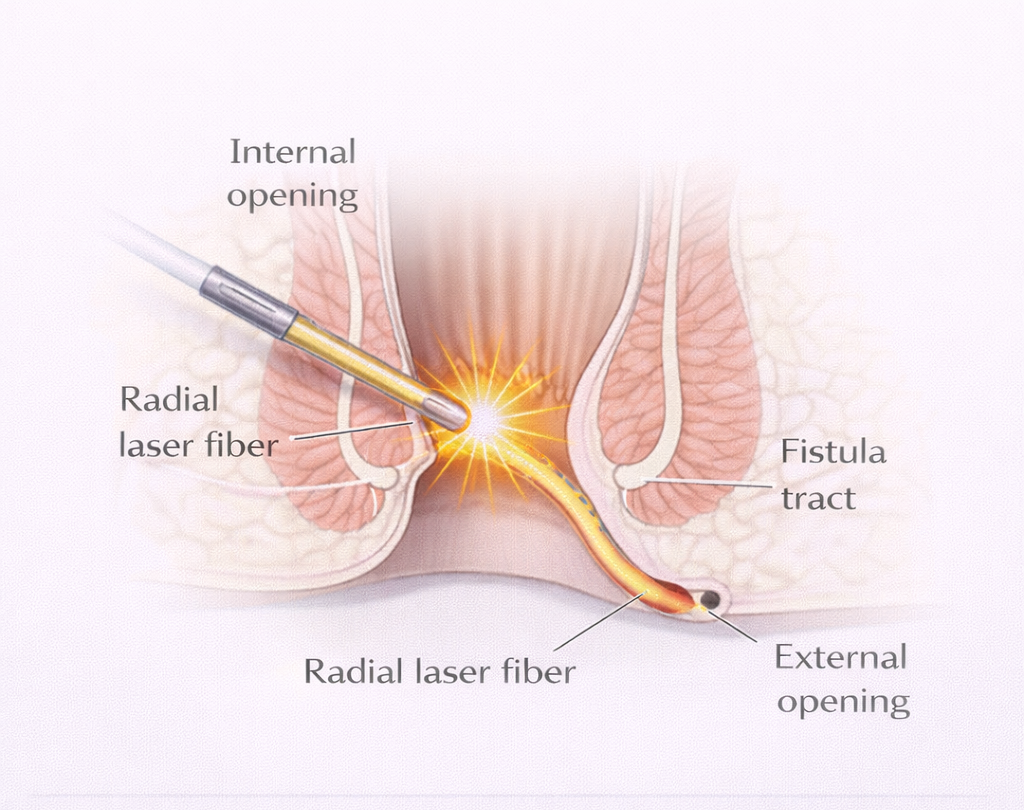
FiLaC uses a radially emitting laser fiber inserted into the fistula tract from the external opening. As the fiber is slowly withdrawn, it emits laser energy that destroys the epithelium lining the tract the idea being that without this lining, the tract will collapse and heal.
The Procedure
- Day-case or short-stay procedure
- Spinal or general anesthesia
- Duration: 30-45 minutes
- The internal opening is also closed (sutured or plugged)
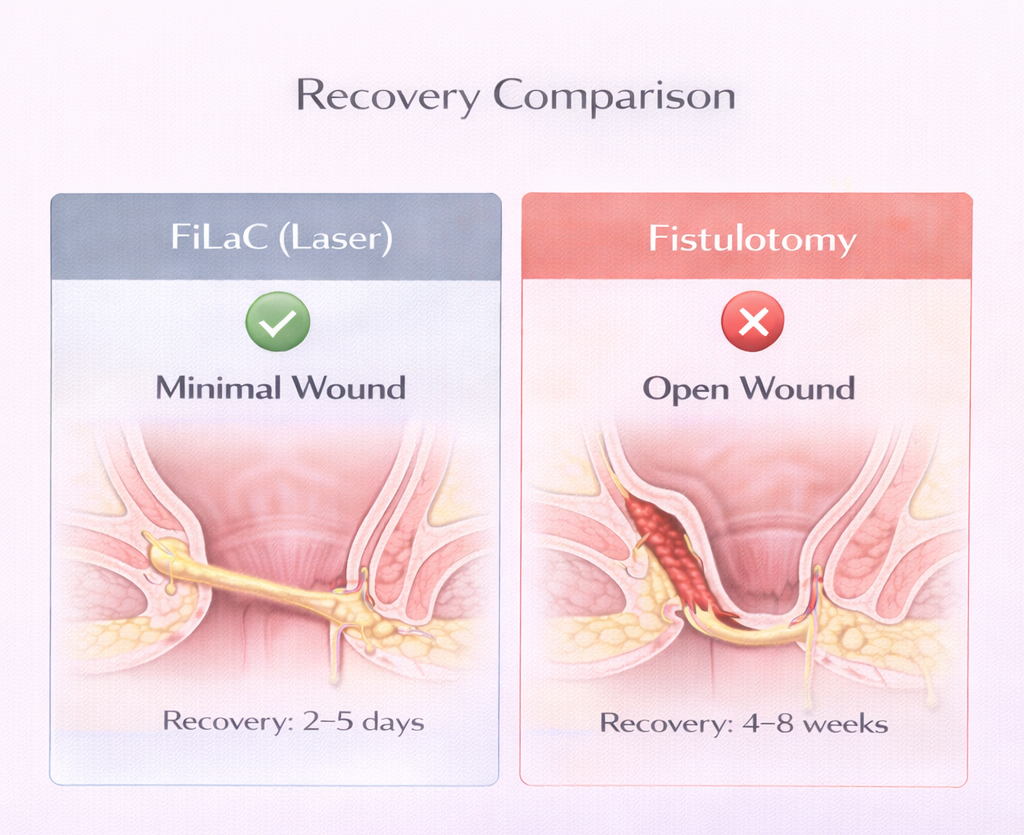
- Minimal wound – the tract is treated from within, no external cutting
Recovery
- Less painful than fistulotomy no open wound
- Return to work: 2-5 days for desk workers
- Full healing assessment: At 8-12 weeks
Who Is It Suitable For?
Good Candidates
- Simple or mildly complex fistulas intersphincteric or low transsphincteric
- Patients who want to avoid fistulotomy (concern about scarring or incontinence)
- First-time fistula treatment with clear anatomy
Poor Candidates
- Complex fistulas with multiple tracts – laser cannot address secondary tracts
- Long, tortuous tracts – the laser fiber may not pass fully
- Crohn’s fistulas – underlying inflammation means the tract will not close
- Fistulas with active sepsis or abscess – must be controlled first
Honest Assessment of Effectiveness
Published Results
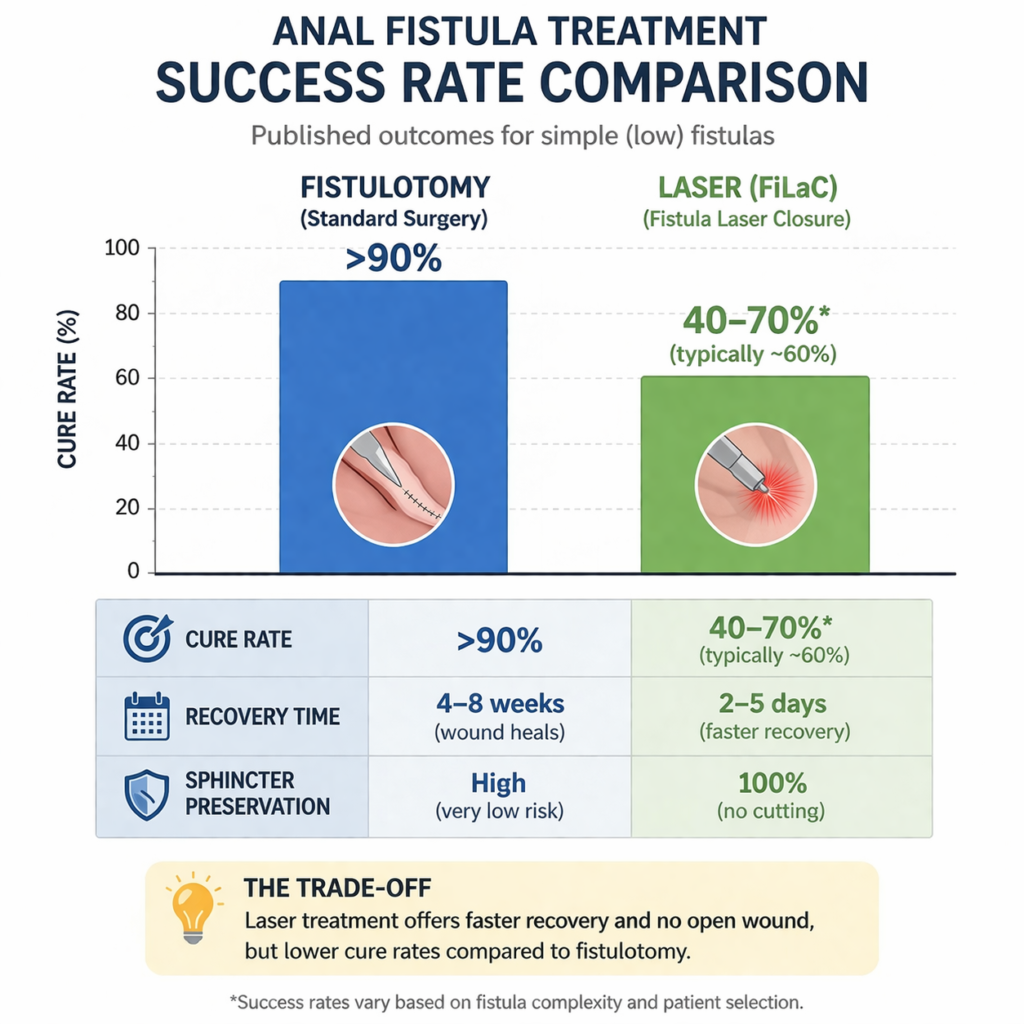
FiLaC success rates in published series range from 40-70% typically around 60% for simple fistulas. Fistulotomy achieves >90% for the same group.
Why the Lower Success Rate?
- The internal opening must be reliably closed this is technically demanding
- If any tract is missed, recurrence follows
- The laser destroys the lining but relies on the body to close the tract this does not always happen
Recurrence risk is higher in some cases. See fistula recurrence.
The Trade-Off
Laser: 60% cure rate, minimal wound, fast recovery, sphincter fully preserved.
Fistulotomy: >90% cure rate, open wound, 4-8 week healing, very low incontinence risk for simple fistulas.
Laser is often compared with standard surgery. See fistulotomy.
My Position
Laser is a reasonable option for carefully selected patients with simple fistulas who understand the lower success rate and accept that a second procedure (or conversion to fistulotomy) may be needed. I do not recommend laser as the default treatment for simple fistulas in patients who are otherwise fit for fistulotomy the cure rate difference is too significant.
Laser treatment is suitable only for selected cases and should be discussed with a specialist in Dubai.
Need expert treatment for hemorrhoids, anal fissure, or anal fistula? Book a consultation with Dr. Antonio Privitera in Dubai or Abu Dhabi.
📱 WhatsApp: +971 55 318 8469
📞 Phone: +971 55 318 8469
AUTHOR AUTHORITY BLOCK
Fellowship-trained at Mayo Clinic (USA) and the Royal College of Surgeons (UK). Member of the Royal College of Surgeons of Edinburgh. Certified in General Surgery by the Italian Medical Council.
About the Author