
Healing time for anal fissures depends on whether the fissure is acute or chronic and on the treatment used. For full management options, see anal fissure treatment in Dubai.
Some symptoms can overlap with hemorrhoids – see hemorrhoid treatment in Dubai for comparison.
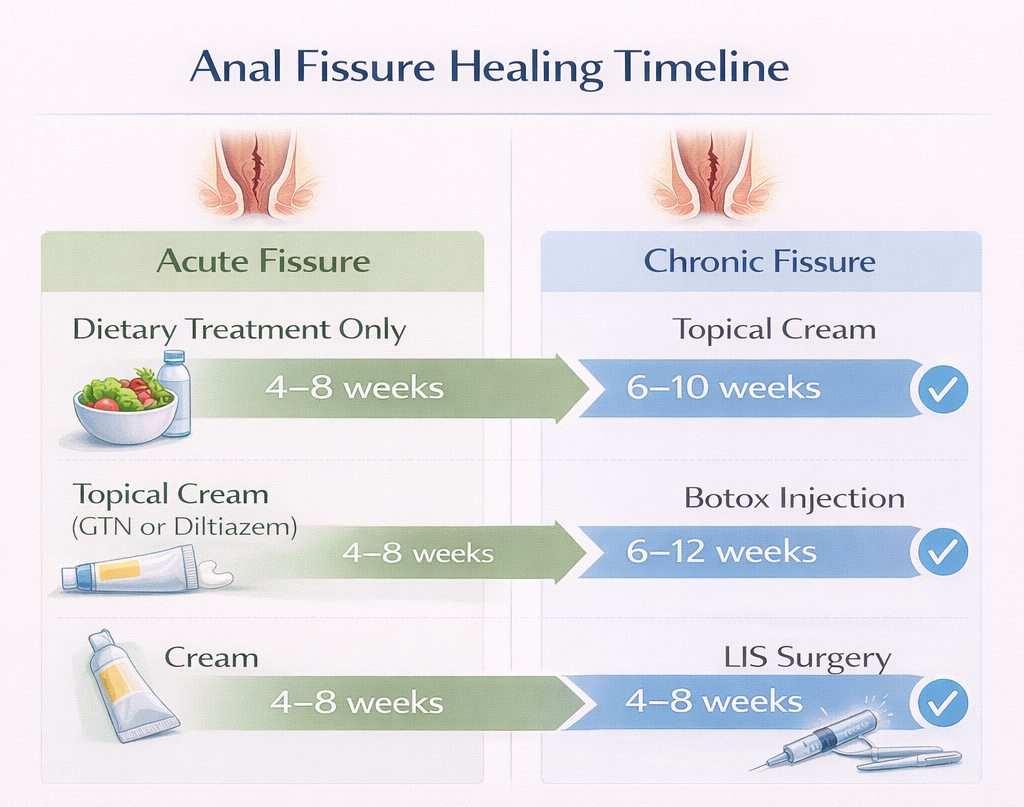
Here is a complete, realistic guide to healing timelines – and what it means if your fissure is not improving.
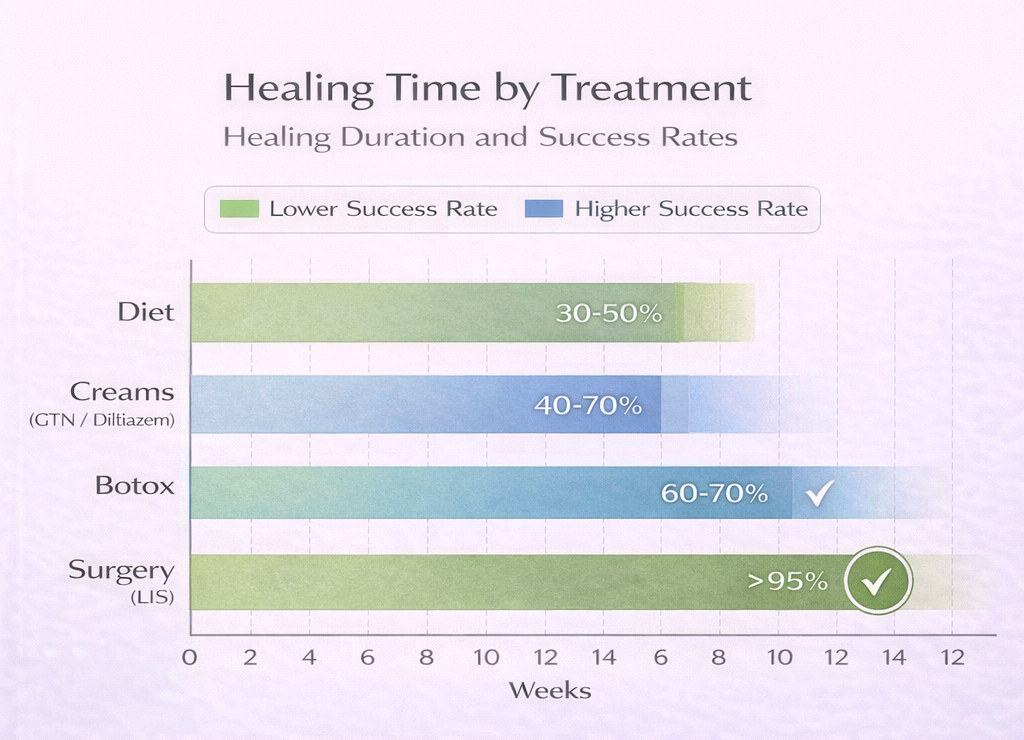
Acute Fissure with Dietary Changes Only
- Healing time: 4-8 weeks
- Condition: Must be a true acute fissure (less than 6 weeks old) with a soft stool trigger
- Success rate: 30-50% dietary changes alone heal roughly half of acute fissures
- What to watch: If no improvement by 4 weeks, add topical cream
Acute Fissure with Topical Cream (GTN or Diltiazem)
- Healing time: 4-8 weeks of treatment
- Success rate: 60-70% for acute fissures
- Important: Use the cream correctly twice daily, small amount,
inside the anal canal and for the full 6-8 weeks. Stopping too early is the most common reason for treatment failure.
Chronic Fissure with Topical Cream
- Healing time: 6-10 weeks if successful.
- Success rate: 40-50% lower than for acute fissures because the structural changes of chronicity reduce response.
- Next step if not healed: Botox injection.
Chronic Fissure with Botox Injection
- Pain improvement: Within 1-2 weeks
- Fissure healing: 6-12 weeks
- Success rate: 60-70%
- Assessment: At 3 months if not healed, second injection or surgery is discussed. Treatment timing matters. See Botox treatment.
Chronic Fissure with LIS Surgery
- Pain relief: Significant improvement within 1-2 weeks
- Wound healing: 4-8 weeks
- Success rate: >95%
- This is the most reliable option for chronic fissures that have failed other treatments
Signs That Your Fissure Is Healing
- Pain during and after bowel movements is becoming less severe and shorter-lasting
- Bleeding is reducing or has stopped
- You no longer fear going to the toilet
- On examination: the fissure looks smaller, pinker, and less deep
Signs That Your Fissure Is NOT Healing What to Do
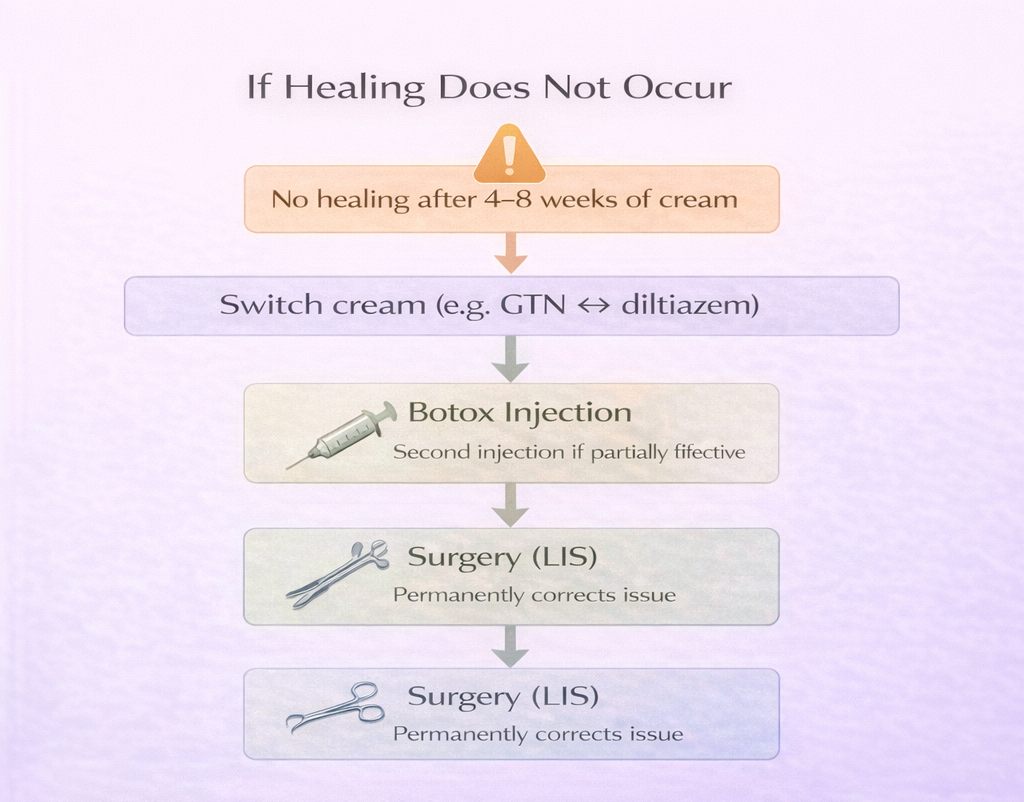
- No improvement in pain after 4 weeks of dietary changes + cream → Add or switch topical agent
- No improvement after 6-8 weeks of correct topical treatment → Specialist evaluation and Botox
- No improvement after Botox → Repeat injection or surgery
- Fissure in an unusual location (not posterior or anterior midline) → Biopsy to exclude malignancy, Crohn’s disease, STI
Why Fissures Relapse
Even after successful treatment, fissures can recur if the underlying cause is not addressed. The most common reasons:
- Constipation returns fiber and hydration must be maintained long-term, not just during treatment
- Diarrhea from IBS or food intolerance address the underlying bowel condition
- Return of high sphincter pressure more likely in patients who did not have surgery
Need expert treatment for hemorrhoids, anal fissure, or anal fistula? Book a consultation with Dr. Antonio Privitera in Dubai or Abu Dhabi.
📱 WhatsApp: +971 55 318 8469
📞 Phone: +971 55 318 8469
AUTHOR AUTHORITY BLOCK
Fellowship-trained at Mayo Clinic (USA) and the Royal College of Surgeons (UK). Member of the Royal College of Surgeons of Edinburgh. Certified in General Surgery by the Italian Medical Council.
About the Author