
Botox injection for anal fissure is one of the most effective non-surgical treatments for chronic fissures. For a complete overview of all treatment options, see anal fissure treatment in Dubai.
In Dubai and Abu Dhabi, Botox is my preferred second-line treatment before considering surgery. Most patients who have a Botox injection for a chronic fissure do not need surgery.
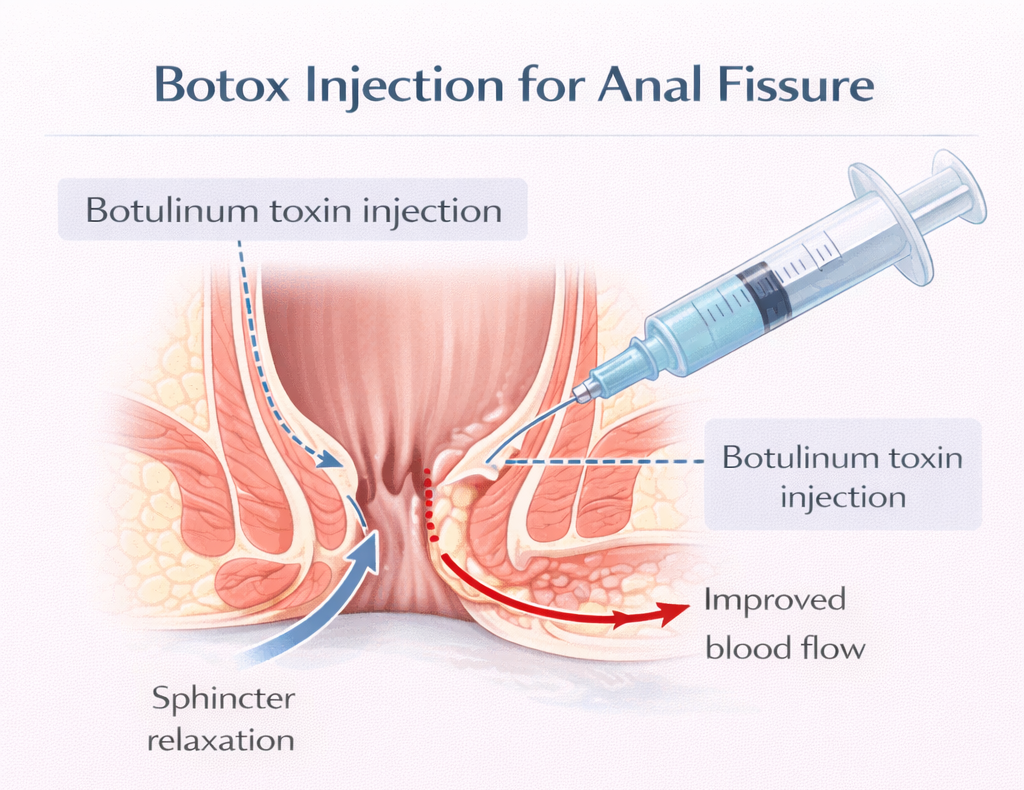
Why Botox Works for Anal Fissures
The internal anal sphincter spasm is the key problem in chronic anal fissures. Topical creams aim to relax it Botox directly paralyses the muscle fibres. With the spasm eliminated:
- Pressure in the anal canal drops
- Blood supply to the posterior midline is restored
- The fissure can heal over the 2-4 months that the Botox effect lasts
Healing rate: 60-70% of chronic fissures heal after a single Botox injection. The success rate is higher in patients with high resting anal pressure (the group most likely to develop chronic fissures in the first place). Chronic fissures need proper selection. See chronic fissure explanation.
The Procedure: What to Expect
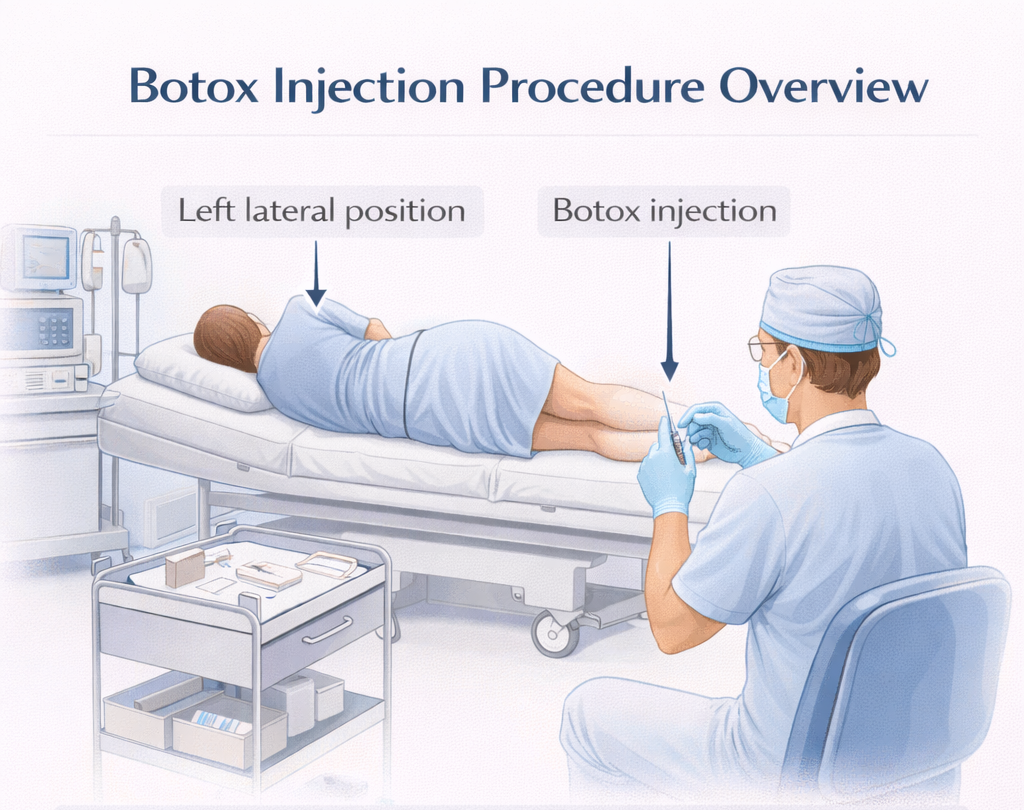
Before the Procedure
- No special bowel preparation required
- The procedure takes approximately 10-15 minutes
- It can be performed in clinic under local anesthesia, or under brief sedation if preferred
During the Procedure
- You are positioned on your side (left lateral position)
- Local anesthetic is applied to minimize discomfort
- Botulinum toxin (usually 20-50 units) is injected into one or both sides of the internal sphincter
- The injection is performed through the anal mucosa or via the skin of the anal margin
After the Procedure
- You can go home immediately this is a day-case or clinic procedure
- Mild discomfort for a few hours, easily managed with paracetamol
- No significant restrictions return to normal activities the same or next day
- No driving restriction unless sedation was used (no driving for 24 hours after sedation)
Results: When Will You See Improvement?
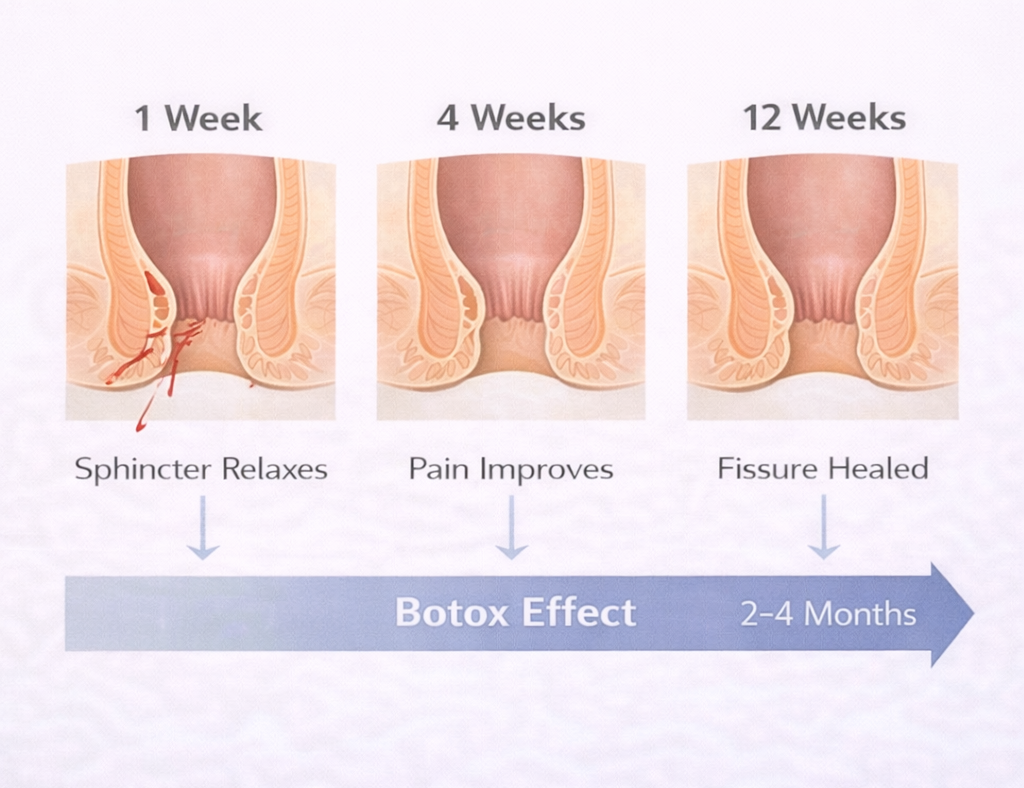
- Pain improvement: Often within 1-2 weeks as the sphincter relaxes
- Healing: The fissure typically heals over 6-12 weeks
- Full assessment: At 3 months if the fissure has not healed, a second injection or surgery is discussed
Risks and Side Effects
- Temporary incontinence: The most important potential side effect difficulty controlling gas or liquid stool. Occurs in approximately 5-10% of patients. Almost always temporary (resolves within weeks as the Botox effect wears off).
- Fissure recurrence: A fissure that heals after Botox can recur if the underlying cause (constipation, low fiber) is not addressed. Dietary changes must be continued long-term.
- No permanent sphincter damage: Unlike surgery, Botox does not permanently alter the sphincter.
If your fissure has not healed with creams, Botox injection in Dubai may be the next step before considering surgery.
Botox vs Surgery (LIS)
- Botox: Non-surgical, reversible, 60-70% healing rate, minor temporary incontinence risk, can be repeated.
- Surgery: Lateral internal sphincterotomy in Dubai is the definitive surgical option. It is permanent, offers a >95% healing rate, and carries a small but permanent incontinence risk.
For most chronic fissure patients in Dubai, Botox is tried first. Surgery is reserved for Botox failures or patients with very high sphincter pressure.
Need expert treatment for hemorrhoids, anal fissure, or anal fistula? Book a consultation with Dr. Antonio Privitera in Dubai or Abu Dhabi.
📱 WhatsApp: +971 55 318 8469
📞 Phone: +971 55 318 8469
AUTHOR AUTHORITY BLOCK
Fellowship-trained at Mayo Clinic (USA) and the Royal College of Surgeons (UK). Member of the Royal College of Surgeons of Edinburgh. Certified in General Surgery by the Italian Medical Council.
About the Author