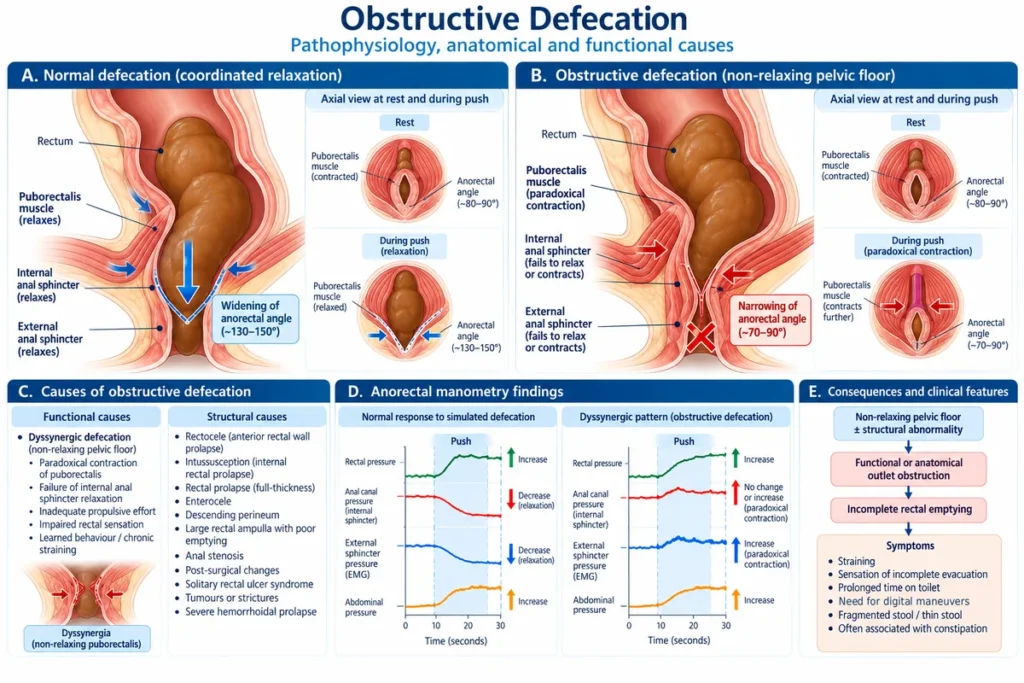
Obstructed defecation syndrome — ODS — is what patients are describing when they say “the stool is right there, but it will not come out.” It is not ordinary constipation. The bowel delivers stool to the rectum on schedule; the act of evacuation itself fails. Straining escalates, toilet visits stretch to twenty minutes, and the feeling of emptiness never arrives. Because the standard constipation advice — fiber, water, laxatives — targets the wrong step, ODS patients often spend years getting worse on correct-sounding treatment.
If this sounds like your problem, see how an obstructed defecation assessment works, including anorectal manometry and the balloon expulsion test.
The two families of causes
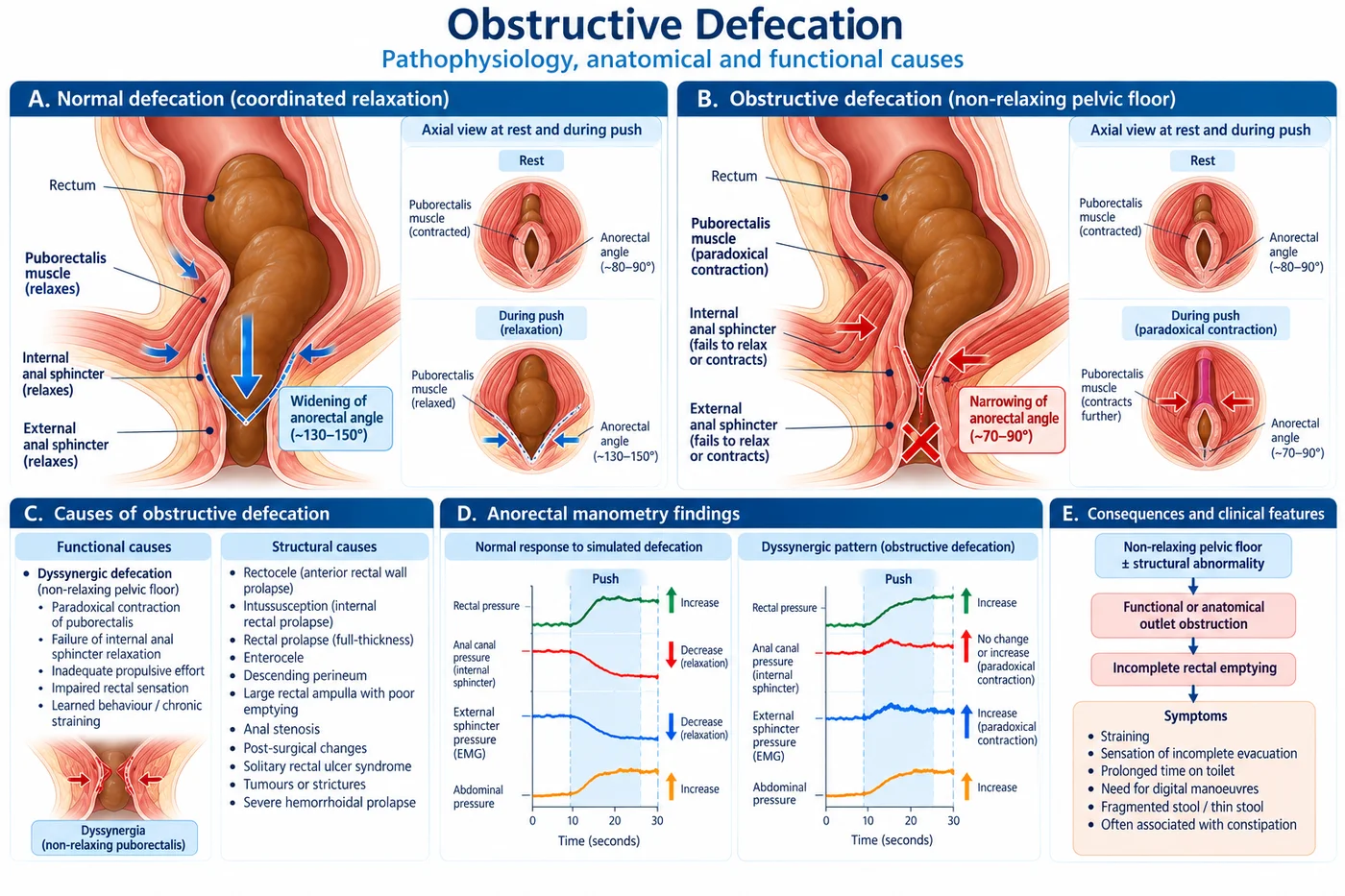
Functional: the pelvic floor muscles fail to relax, or contract paradoxically, during the push — pelvic floor dyssynergia. The outlet is anatomically normal but behaves as if locked.
Structural: the rectal wall itself gets in the way. A rectocele — a bulge of the front rectal wall into the vagina — traps stool in a pocket; an internal rectal prolapse (intussusception) telescopes the rectal wall into the canal during straining and plugs it; a descending perineum loses the geometry evacuation needs. These frequently coexist, and years of straining make each worse: the syndrome feeds itself.
Symptoms that distinguish ODS from slow-transit constipation
The pattern is recognizable once named: intense straining even at soft stool; fragmented evacuation — going several times in a morning, a little each time; a blocked, “trapdoor” sensation; pressing on the perineum or the back wall of the vagina to help stool out (a maneuver so characteristic of rectocele that I ask about it directly); and reliance on enemas or suppositories because oral laxatives merely make the trapped stool liquid. Slow-transit constipation, by contrast, is infrequency: days pass without any urge at all. The two can coexist, which is exactly why testing beats guessing.
How ODS is diagnosed
Examination comes first — inspection, digital assessment during a push, and proctoscopy — and often suggests the answer. Confirmation uses two functional tests: anorectal manometry, which measures whether the muscles relax when they should, and defecography (usually MRI-based), which films evacuation and shows rectoceles, intussusception and pelvic floor descent in motion. A colonoscopy may still be needed to exclude other disease, but it cannot diagnose ODS — the disorder exists only in the act the colonoscope never watches.
Treatment follows the mechanism
For functional ODS, biofeedback retraining is the primary treatment, with high response rates in properly selected patients. For structural ODS, treatment is graded to severity: many rectoceles behave once stool is soft, evacuation technique is corrected and the pelvic floor retrained; surgery is reserved for significant, symptomatic anatomy after functional treatment has been given its chance — repairing a rectocele in a patient whose real problem is dyssynergia fixes the X-ray and not the patient.
When surgery is indicated, the approach is chosen to the anatomy, from transanal and transvaginal repairs to ventral rectopexy for higher-grade prolapse. This staged logic — function first, structure second — is the core of how I manage ODS.
Frequently asked questions
Is ODS dangerous?
It is not malignant, but it is progressive when driven by continued straining, and its complications — prolapse, hemorrhoids, fissures, solitary rectal ulcer — are the reason to treat it rather than endure it.
I already had a normal colonoscopy. Was it wasted?
No — it excluded conditions that must never be missed. But a normal colonoscopy in a patient who cannot evacuate is the beginning of the functional work-up, not the end of the road.
Can ODS be treated without surgery?
Most cases, yes. Biofeedback, evacuation technique, stool optimization and treating the pelvic floor resolve or control the majority; surgery is for selected structural disease.
If evacuation — not frequency — is your problem, the condition has a name, tests and treatment. I assess ODS in Dubai and Abu Dhabi with manometry and defecography-based work-up; see also rectal prolapse or request a consultation.
About the Author