
Straining and Incomplete Emptying: How Obstructed Defecation Is Assessed
Fellowship-trained: Mayo Clinic (USA) · United Kingdom · South Korea — Associate Professor, UAE University
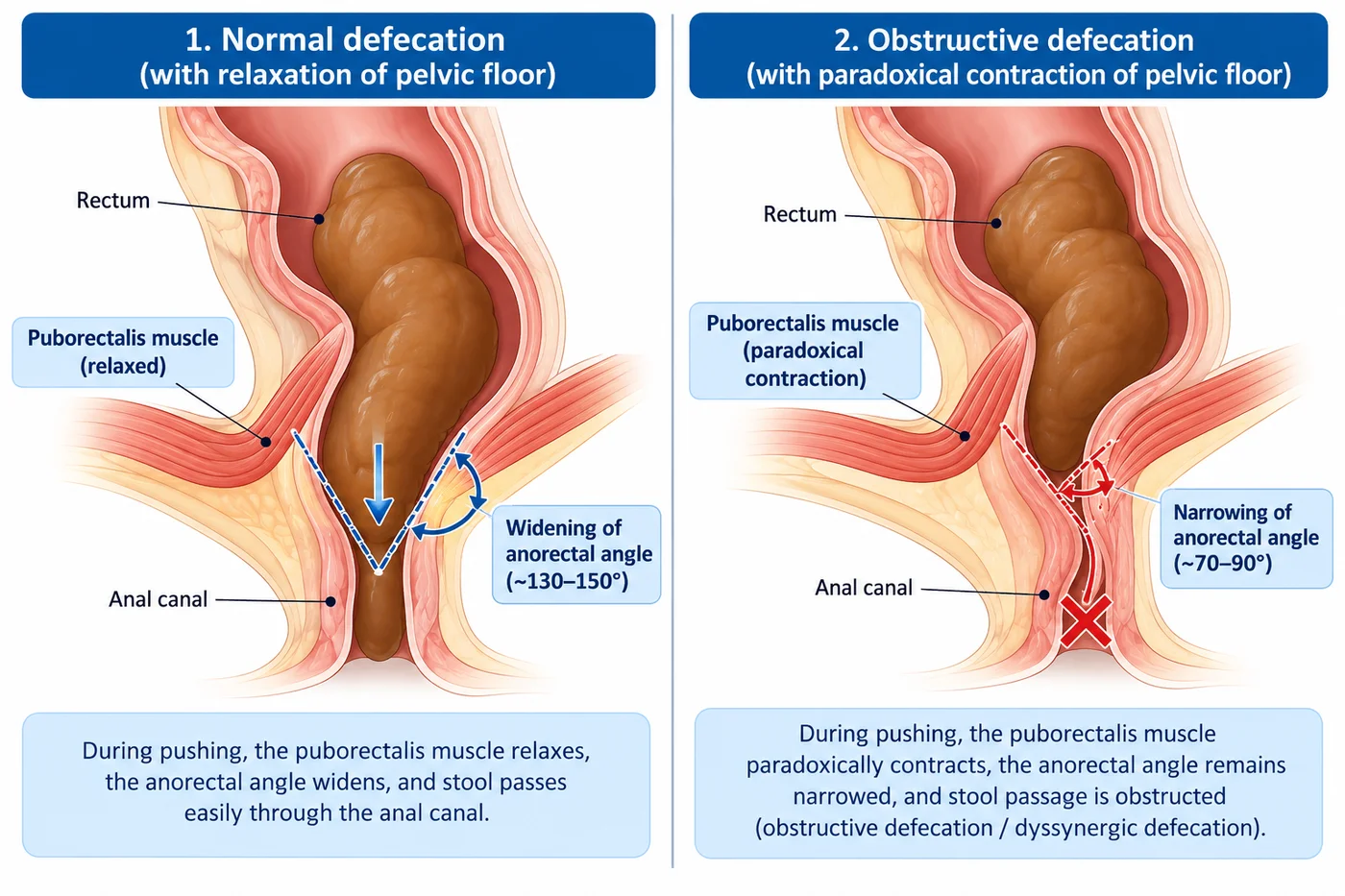
There is a group of patients whose main complaint is not pain and not bleeding, but that going to the toilet does not work. They strain. They feel the rectum has not emptied. They return to the toilet several times. Some press on the perineum or inside the vagina to get stool out, which is called splinting or digitation and is a specific and important symptom.
These patients are frequently treated for hemorrhoids, told they have irritable bowel syndrome, or given laxatives that do not help, because the problem is usually not the amount of stool or how fast it travels. It is the act of evacuation itself.
Slow transit and obstructed defecation are different problems
Constipation is used loosely to describe two mechanisms that behave differently. In slow transit constipation, stool moves through the colon slowly, and the patient goes infrequently. In obstructed defecation, stool reaches the rectum normally but cannot be evacuated efficiently. Those patients often have a daily urge and still cannot empty.
The distinction matters because laxatives address the first and do comparatively little for the second. A patient with an evacuation disorder who is given increasing doses of laxative typically ends up with urgency and loose stool that is still difficult to pass.
The mechanical causes
Several structural changes interfere with evacuation, and more than one is often present in the same patient. A rectocele is a bulge of the rectal wall forward into the vagina, which can trap stool; this is the finding behind most patients who describe needing to splint.
Internal rectal intussusception is a telescoping of the rectal wall into itself during straining, which obstructs the outlet. An enterocele brings small bowel down into the pelvis and presses on the rectum. Excessive perineal descent reflects a weakened pelvic floor. Full-thickness rectal prolapse is the visible end of the same spectrum.
These findings are common, including in people without symptoms. Their presence on a scan does not by itself establish that they are causing the problem, which is why they are interpreted alongside the history and examination rather than treated on sight.
The functional cause that is easy to miss
In dyssynergic defecation, the muscles that should relax during evacuation contract instead. The patient pushes, the outlet closes, and nothing passes. There is no structural abnormality to find on imaging, and patients are commonly told that everything looks normal.
This is worth identifying carefully, because it responds to retraining rather than to surgery. Operating on a coexisting rectocele in a patient whose underlying problem is dyssynergia is one of the more reliable ways to produce a disappointed patient.
Why hemorrhoid surgery often does not solve it
Patients with obstructed defecation frequently do have prolapsing anal tissue, because years of straining produce it. Treating that tissue addresses a consequence, not the mechanism, and the straining continues afterward.
This is the conversation I would rather have before an operation than after one. If the dominant complaint is difficulty emptying rather than bleeding or a lump, the evacuation mechanism should be assessed first, and hemorrhoid treatment considered separately on its own merits.
How the assessment is done
The history is specific: how long it takes, whether there is a sense of blockage or of incomplete emptying, how many attempts are made, whether splinting is used, whether there is a sensation of a bulge, and what has already been tried. Symptoms of urinary or sexual dysfunction and a full obstetric history are relevant, because the pelvic floor is one structure.
Examination includes assessment at rest and during straining, looking for a rectocele, prolapse, perineal descent and paradoxical contraction. Beyond that, defecography demonstrates what happens during evacuation rather than at rest, anorectal physiology testing and a balloon expulsion test help identify dyssynergia, and colonic transit studies are used where slow transit is suspected in addition. Endoscopic examination is performed where the history raises any question of a structural lesion, particularly with bleeding, weight loss or a change in caliber of the stool.
Before Your Assessment: What to Bring and How Booking Works
You do not need a referral to book. Message me on WhatsApp or use the appointment form, and mention that the problem is difficulty emptying — it helps me plan the right first visit.
- Bring: any previous colonoscopy report, imaging (defecography, MRI), prior test results such as manometry, and your current medication list including laxatives you have tried and their doses.
- The first visit: a detailed history of how you evacuate, an examination that assesses the pelvic floor as you bear down, and proctoscopy where relevant. Many patients leave with a working diagnosis the same day.
- If tests are needed: anorectal manometry and the balloon expulsion test are arranged as a separate short appointment; defecography is booked at an imaging facility. I explain at the first visit which of these your case actually needs — not every patient needs all of them.
- Insurance: consultations and these investigations are covered by most UAE policies with prior approval; the clinic handles the approval paperwork once a test is agreed.
The first steps are unglamorous and effective in a substantial proportion of patients: getting stool consistency right rather than simply softer, correcting toilet posture and habit, stopping prolonged straining, and addressing fluid and fiber realistically rather than as a slogan.
Where dyssynergia is identified, pelvic floor retraining with biofeedback is the appropriate treatment and has good evidence behind it. Where a rectocele is genuinely trapping stool and symptoms persist despite conservative measures, repair is considered. Procedures for internal intussusception, including ventral rectopexy, are reserved for carefully selected patients after physiological assessment, and the discussion should include what is known and not known about the durability of each approach, including the use of mesh.
The general principle is that an operation should be chosen to correct a mechanism that has been demonstrated, in a patient whose conservative treatment has been done properly first.
Where the tests are done
I arrange these tests for patients seen at any of the seven places where I work:
- Medcare Royal Speciality Hospital, Dubai
- Clemenceau Medical Center, Dubai
- Aster Hospital Al Qusais, Dubai
- Medcare Medical Centre Discovery Gardens, Dubai
- Medcare Medical Centre JVC, Dubai
- Burjeel Day Surgery Center Reem Island, Abu Dhabi
- Burjeel Day Surgery Center Al Shahama, Abu Dhabi
The place for your test is agreed with my secretary when the appointment is arranged.
FAQs About Obstructed Defecation
That sensation usually reflects an evacuation problem rather than a shortage of stool. Common causes include a rectocele trapping stool, internal rectal intussusception obstructing the outlet, or pelvic floor muscles contracting instead of relaxing during evacuation. Assessment distinguishes between them.
It is common, but it is a meaningful symptom rather than a harmless habit. Splinting, whether on the perineum or inside the vagina, usually indicates a rectocele or another structural cause of obstructed defecation, and it is one of the more useful symptoms in the history.
They help slow transit constipation more than they help evacuation disorders. Increasing laxative doses in an evacuation disorder often produces urgency and loose stool that is still difficult to pass. The underlying mechanism should be identified before treatment is escalated.
Not usually. Prolapsing anal tissue is often a consequence of years of straining rather than the cause of the difficulty, so treating it leaves the mechanism unchanged. Where emptying is the dominant complaint, the evacuation mechanism is assessed before surgery is planned.
It is a pattern in which the pelvic floor and anal sphincter contract during attempted evacuation instead of relaxing. Imaging is often normal. It is identified with anorectal physiology testing and a balloon expulsion test, and it is treated with pelvic floor retraining and biofeedback rather than surgery.
No. Rectoceles are found in many women without symptoms. Repair is considered when a rectocele is demonstrably trapping stool, when splinting is required, and when symptoms persist despite proper conservative management, rather than on the basis of an imaging finding alone.
Dr Antonio Privitera is a Consultant General and Colorectal Surgeon with a particular interest in pelvic floor and evacuation disorders, including anorectal physiology assessment.
Consultations are available in Dubai and Abu Dhabi.
To arrange an appointment, call +971 55 318 8469, message us on WhatsApp or request a consultation online.
Some patients come to us after hemorrhoid or prolapse surgery that has not relieved the difficulty emptying. In that situation the evacuation mechanism itself usually needs to be assessed before any further operation is discussed.
Assessment of Obstructed Defecation in Dubai and Abu Dhabi
Difficulty emptying the rectum is a mechanical and functional problem that benefits from proper assessment before any operation is considered. A colorectal service covering pelvic floor and evacuation disorders is currently consulting in Dubai and Abu Dhabi, and specialist consultation is available by appointment.
Related reading
Read more about the tests used in this assessment: anorectal manometry and the balloon expulsion test.
Book an Appointment