
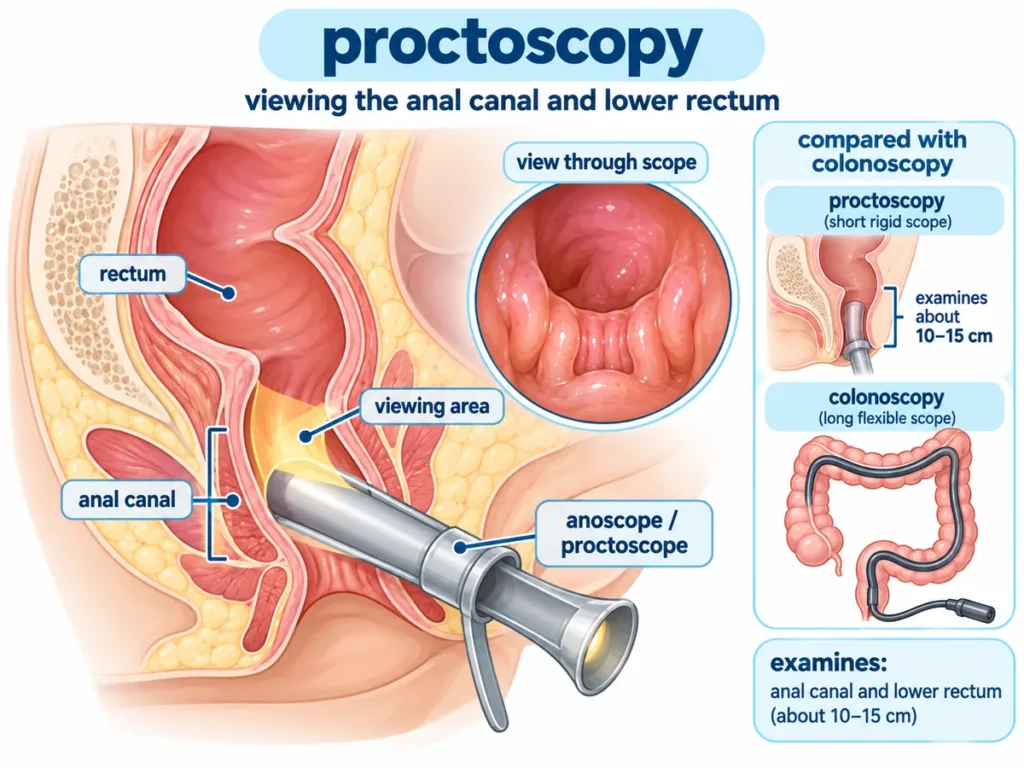
Proctoscopy is the examination most patients have never heard of until the moment it is proposed — and the one that answers more anorectal questions than any scan. It looks at the final few centimeters of the bowel: the anal canal and lower rectum, exactly where hemorrhoids, fissures and most causes of bright red bleeding live. This is what it involves, what it can find, and why a colonoscopy does not replace it.
What a proctoscopy is
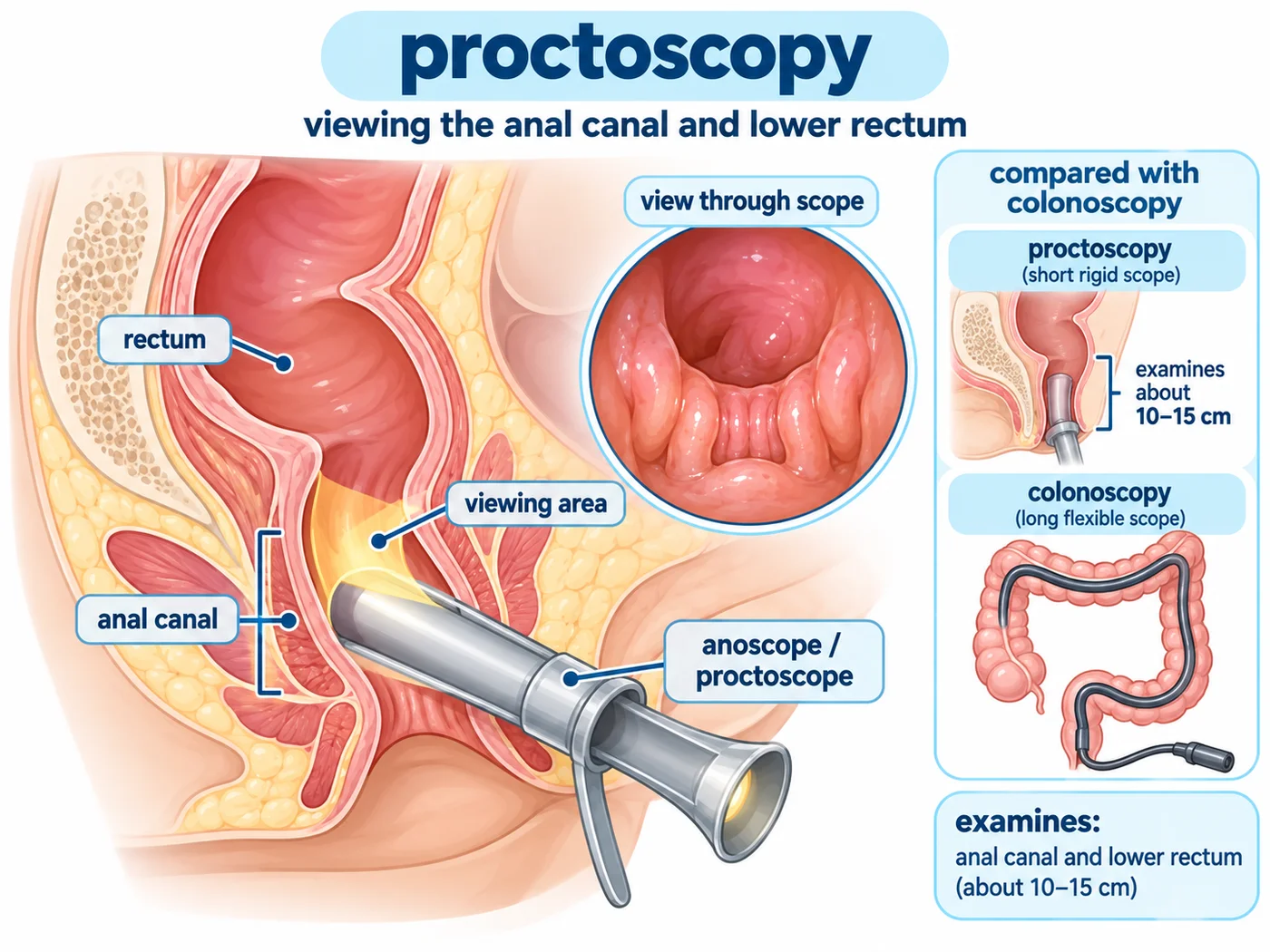
A proctoscope (or anoscope, for the shortest version) is a small, rigid, lubricated tube a few centimeters long, with a light. Inserted gently through the anus, it lets the surgeon inspect the anal canal and lower rectum directly. The examination takes one to two minutes, is performed in the clinic during a normal consultation, and needs no sedation and no bowel preparation — at most a small enema when the rectum is full.
What it can find
Proctoscopy is how internal hemorrhoids are actually graded — symptoms alone cannot distinguish a grade I from a grade III, and grade determines treatment. It also identifies anal fissures and confirms whether one is acute or chronic, shows the internal openings of fistulas, reveals proctitis, polyps of the lower rectum, skin tags, warts, and — importantly — localizes the source of bright red bleeding rather than leaving it assumed.
What it feels like
Patients expect the worst and are almost always surprised. There is a sensation of pressure, similar to the urge to pass stool, for the duration of the examination. The exception is a patient with an acutely painful condition — a fresh fissure or thrombosed hemorrhoid — where examination is adapted, deferred, or done with local anesthetic; forcing an instrument past an acutely painful anus is bad medicine.
Why a colonoscopy does not replace it
It seems logical that the bigger examination covers the smaller one, but the anal canal is precisely where a colonoscope’s view is weakest: the instrument passes through it in a second, angled away from the walls that matter. Hemorrhoids and fissures are routinely missed or misgraded on colonoscopy alone.
The two tests answer different questions — the colonoscopy examines the colon for polyps, inflammation and cancer; the proctoscopy examines the anal canal, where the symptom usually started. In a bleeding patient over 45, or with any alarm features, both may be needed: one to explain the symptom, the other to exclude what must never be assumed away.
How it fits into a consultation
In my clinics in Dubai and Abu Dhabi, assessment of anorectal symptoms follows a fixed sequence: history, inspection, digital rectal examination, then proctoscopy — four steps, a few minutes, and in most patients a working diagnosis at the first visit, often with treatment (such as banding of suitable hemorrhoids) at the same appointment. It is the reason I discourage patients from arriving with a self-diagnosis of “hemorrhoids” and asking for treatment unexamined: anal pain is frequently not hemorrhoids, and the proctoscope settles the question rather than the guess.
Frequently asked questions
Do I need to prepare for a proctoscopy?
No fasting, no laxative solution, no sedation. At most, a small enema beforehand when the rectum is loaded; usually nothing at all.
Is proctoscopy painful?
With normal anatomy it is uncomfortable rather than painful — pressure for a minute or two. Acutely painful conditions change the approach, and the examination is adjusted accordingly.
Can I drive and work afterwards?
Yes. There is no sedation, so the rest of your day continues normally.
If you have rectal bleeding, pain, a lump, or symptoms attributed to hemorrhoids without an examination, a proctoscopic assessment is the logical first step. Consultations are available in Dubai and Abu Dhabi through the proctology service page.
About the Author