
Enemas sit in an odd corner of medicine: freely sold, widely used, rarely explained. Patients use them too often for the wrong problem, or fear them entirely when one is genuinely needed — most commonly before endoscopy or anorectal surgery. This guide covers what each type does, how to use one safely, and where the limits are.
What an enema does — and does not do
An enema clears the rectum and the last portion of the colon. That makes it suited to two jobs: relieving stool that has reached the rectum but will not pass, and preparing the lower bowel for examination or surgery. It does not clean the whole colon — a full colonoscopy needs oral preparation — and it does not treat the cause of recurrent constipation.
The main types
Saline (sodium phosphate) enemas — the standard pharmacy option — draw water into the rectum and trigger evacuation within minutes. Effective for occasional use; not for routine repetition, and used cautiously in older patients and anyone with kidney or heart disease, where phosphate absorption matters.
Glycerin mini-enemas and suppositories act as a lubricant stimulus and are the gentler first choice when stool is sitting low and firm.
Tap-water enemas are mild and occasionally recommended in specific bowel-management programs — but as a prescribed routine, not improvisation.
Soap, herbal mixtures, coffee and other folk additives belong nowhere near the rectum. They irritate or injure the mucosa and have caused real harm; “detox” enemas in particular have no medical basis.
Using one safely
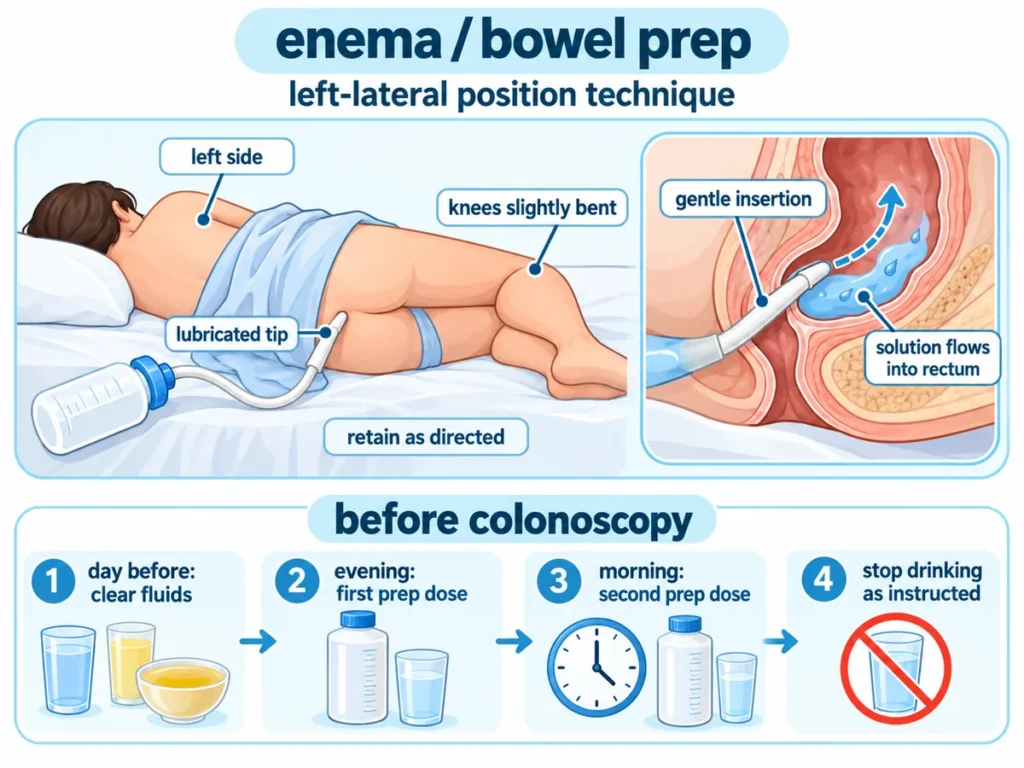
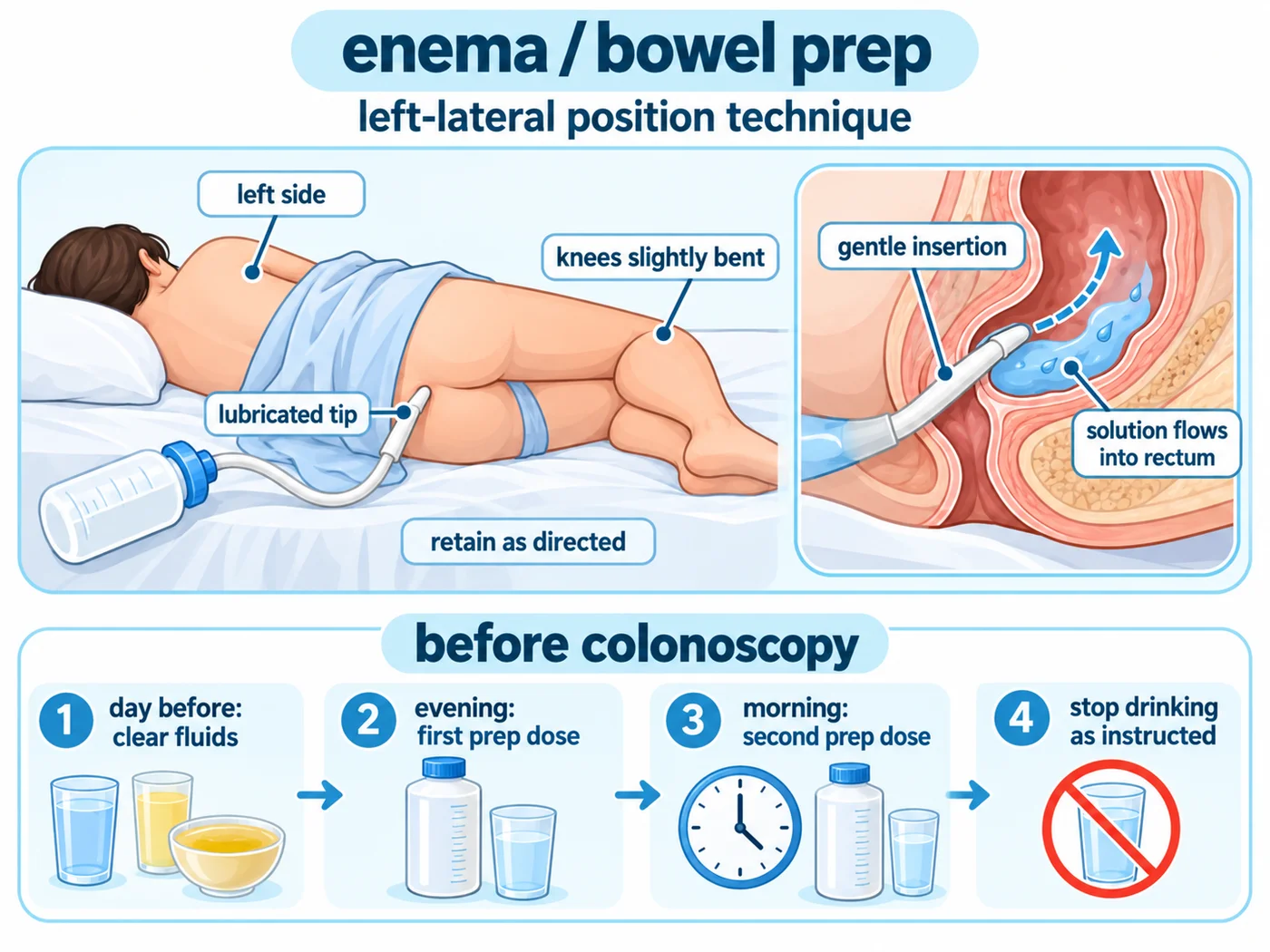
Lie on your left side with knees drawn up. Lubricate the nozzle, insert it gently a few centimeters toward the navel, and never force against resistance. Instill the contents slowly, hold for the time stated on the product, then evacuate. Stop and seek advice if you feel significant pain — an enema should be uncomfortable at most, never painful. Anyone with a known anal fissure, active hemorrhoid flare, or recent anorectal surgery should ask before self-administering: an ill-timed nozzle can undo healing.
Bowel preparation before colonoscopy
Preparation for colonoscopy is oral: a macrogol-based or similar solution taken the evening before and, for morning procedures, completed early on the day, alongside a low-residue then clear-fluid diet.
The single most common reason a colonoscopy has to be repeated is inadequate preparation, so the instructions are worth following exactly — including finishing the full volume, which patients understandably resent. Split dosing makes it more tolerable and gives a cleaner result.
Enemas enter this picture only in specific cases: limited examinations of the rectum and sigmoid, or as a rescue when oral preparation has worked incompletely — a decision for the endoscopy team, not the patient.
Before anorectal surgery
For most anorectal procedures — hemorrhoid surgery, fistula surgery, fissure surgery — full bowel preparation is unnecessary; a simple enema on the morning of surgery, or none at all, is typical. Your specific instruction comes with your admission plan, and it varies by procedure and anesthetic, which is why generic internet advice should not override it.
When repeated enemas are a warning sign
Needing enemas regularly to open your bowels is not a maintenance plan — it is a symptom. The usual culprits are an evacuation disorder such as obstructed defecation syndrome or pelvic floor dysfunction, conditions diagnosed with functional tests rather than colonoscopy, and treatable without laxative escalation.
Frequently asked questions
How often is it safe to use an enema?
Occasional use is safe for most adults. If you need one more than every week or two, the pattern needs assessment rather than repetition.
Do enemas damage the bowel long term?
Properly used saline or glycerin enemas do not. Harm comes from additives, force, and frequency substituting for diagnosis.
Can I rely on an enema instead of colonoscopy prep?
No. An enema clears only the last segment of bowel; the rest of the colon stays obscured, and polyps hide in residue.
If your bowels only work with mechanical help, that is a solvable problem. I assess and treat evacuation disorders and chronic constipation in Dubai and Abu Dhabi — start with a consultation.
Related reading
About the Author