
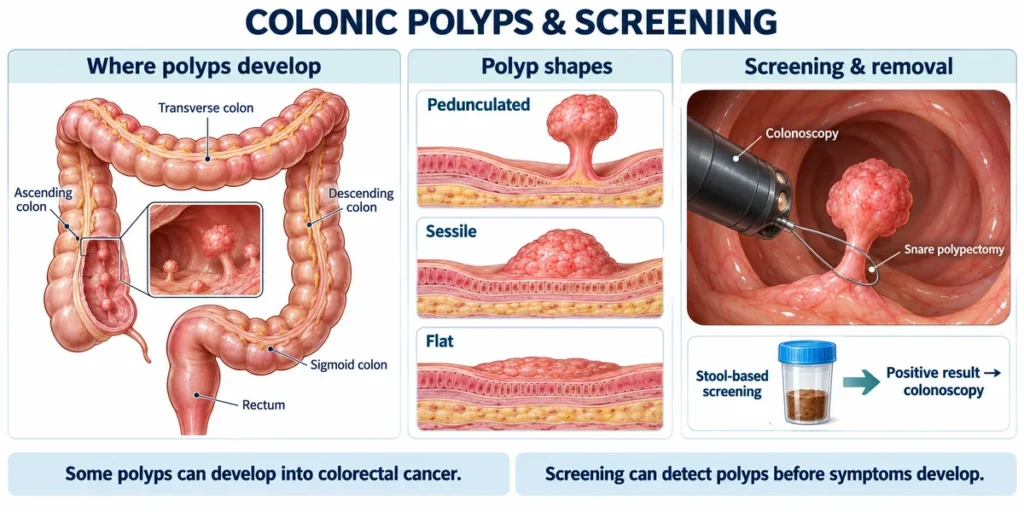
Nearly every colorectal cancer begins life as a polyp — a small growth of the colon’s lining that takes years to turn dangerous, if it ever does. That long, slow runway is the entire logic of screening: find and remove polyps before they become anything worse. In the UAE, where colorectal cancer ranks among the most common cancers and appears at younger ages than in Western data, this conversation is worth having earlier than most people expect.
What polyps are
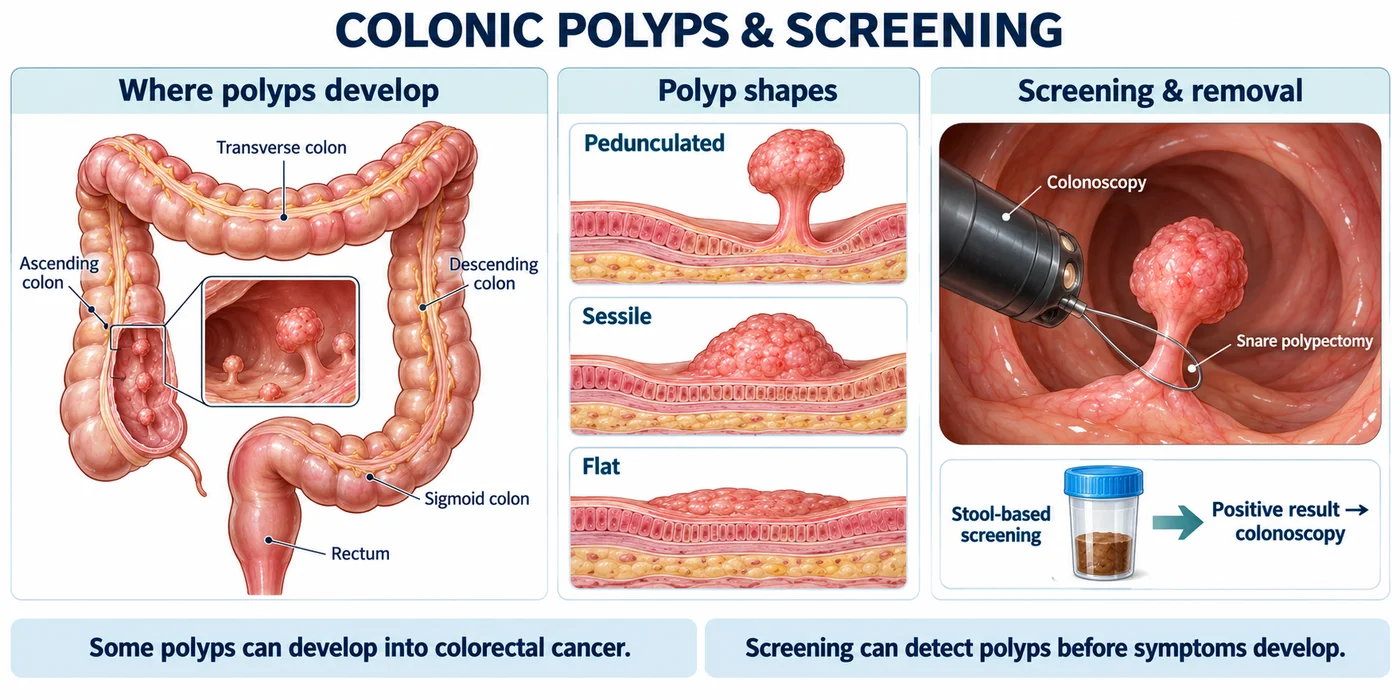
Most polyps are adenomas or serrated lesions — benign growths with malignant potential — while some (small hyperplastic polyps of the rectum) carry essentially none. Size, type and number determine risk: a single small adenoma is routine; large, multiple or dysplastic polyps mark a colon that needs closer surveillance. Crucially, polyps almost never cause symptoms. Waiting for symptoms means waiting too long — that is the whole case for screening.
Who should be screened, and when
For people at average risk, screening in the UAE is generally advised from age 40 — earlier than many international programs, reflecting the younger age pattern seen regionally. Screening starts earlier still with a family history of colorectal cancer or advanced polyps (typically ten years before the youngest affected relative’s age at diagnosis), and follows specialist plans for inflammatory bowel disease and hereditary syndromes. Symptoms are a different track altogether: bleeding, anemia, persistent change in bowel habit or unexplained weight loss at any age are investigated, not screened.
The screening options, honestly compared
Colonoscopy is the reference test: it examines the whole colon and removes polyps in the same sitting — detection and prevention in one procedure, repeated at intervals set by findings. Its price is the preparation and a small procedural risk.
Stool tests (FIT) detect hidden blood, are effortless and repeat annually or biennially — but a positive result still leads to colonoscopy, and they miss many polyps that do not bleed. Flexible sigmoidoscopy covers only the left colon (its proper roles are here). The best test remains the one that actually gets done — but when polyp prevention is the goal, colonoscopy does the most work per visit.
After a polyp is found
Removal (polypectomy) is usually done at the same colonoscopy, painlessly. The pathology report then sets the surveillance interval — commonly several years for low-risk findings, sooner for advanced ones. Two things patients often get wrong: a polyp on the report is not a cancer diagnosis, and a clear colonoscopy is not permission to ignore new symptoms in the years between examinations.
Frequently asked questions
I feel completely well. Why screen?
Because the polyp-to-cancer sequence is silent for years, and removing a polyp is prevention — not early detection but actual prevention.
Are polyps common?
Very. A substantial share of adults over 40 harbor at least one. Finding them is expected, not alarming.
Does a family history of polyps matter as much as cancer?
Advanced adenomas in a first-degree relative do shift your risk and your starting age. Bring the details — type and age — to the consultation.
Screening colonoscopy with polyp removal is available through my practice in Dubai and Abu Dhabi — consultant-performed, with the plan matched to your risk profile. More on the procedure itself is on the colonoscopy page, and on the disease it prevents at colorectal cancer. Request a consultation.
About the Author