
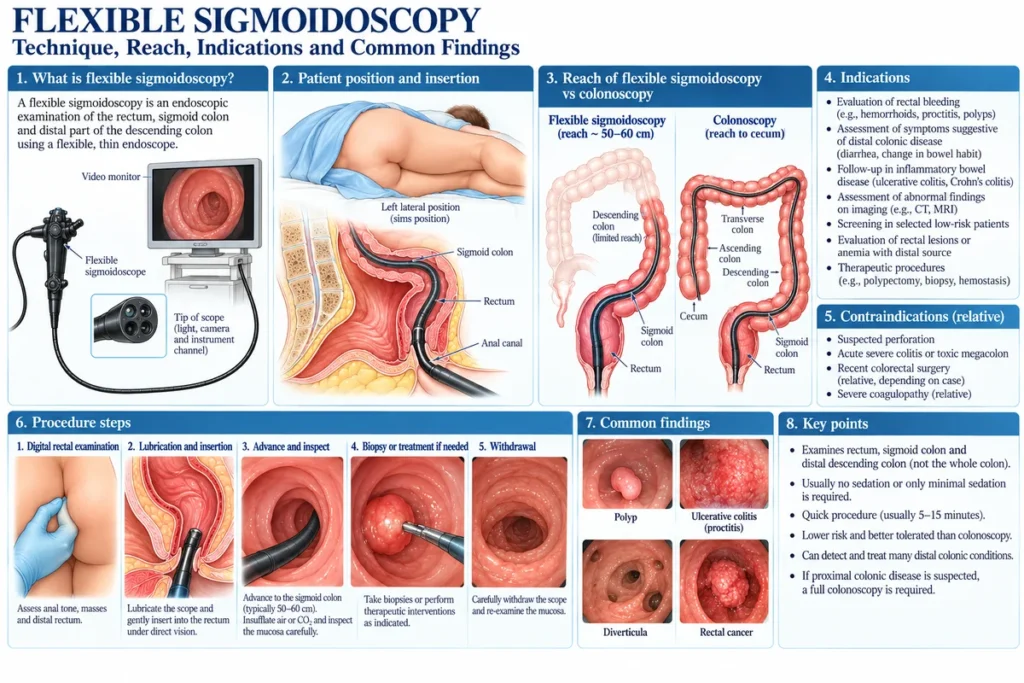
Flexible sigmoidoscopy is the examination between two better-known ones: more reach than a proctoscopy, less than a full colonoscopy. A thin flexible scope examines the rectum and the left side of the colon — the sigmoid and usually the descending colon — where a large share of significant pathology lives. Knowing when it is the right tool, and when only a full colonoscopy will do, saves patients both under- and over-investigation.
What it examines
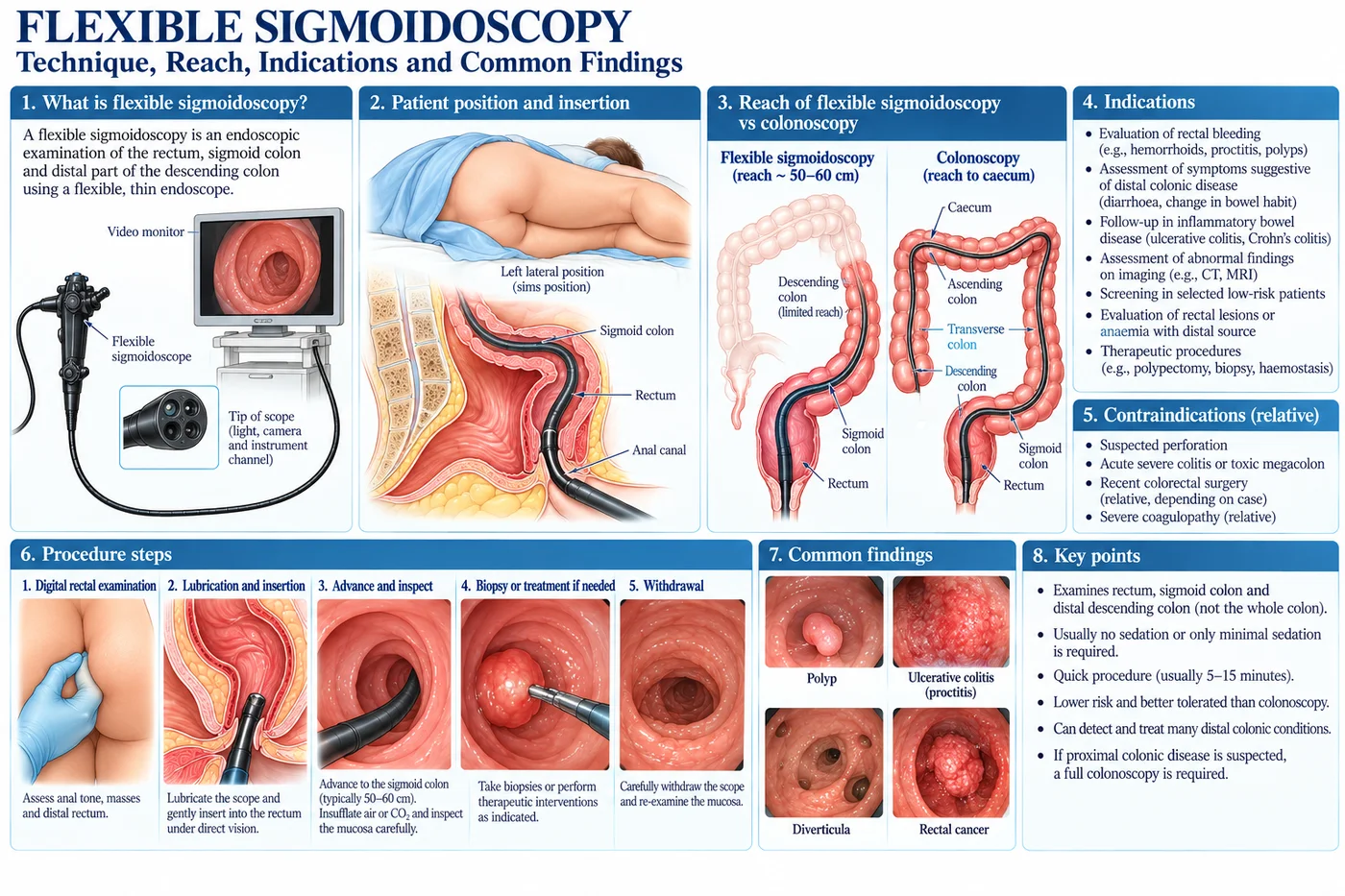
The final portion of the large bowel: anal canal margin, rectum, sigmoid and typically the descending colon. That segment is where most diverticular disease sits, where distal polyps and cancers arise, and where proctitis and other causes of visible rectal bleeding declare themselves.
When sigmoidoscopy is the right test
Its classic roles: investigating bright red rectal bleeding in younger, otherwise low-risk patients once anorectal causes are assessed; evaluating proctitis symptoms; surveillance of a known distal problem; and completing assessment when symptoms point clearly to the left colon. Its practical advantages are real — preparation is usually just one or two enemas rather than a full day of oral prep, sedation is often unnecessary, and the examination takes minutes.
When it is not enough
A sigmoidoscopy that finds a polyp answers one question and raises another: what does the rest of the colon hold? Anemia, a positive stool blood test, a family history of colorectal cancer, change in bowel habit in older patients, or any finding needing complete assessment — these call for full colonoscopy from the start. I would rather a patient have one complete examination than two partial ones.
What the procedure is like
You lie on your left side; the scope is introduced gently with air or CO2 to open the view. Pressure and bloating-type cramps are expected as the scope turns through the sigmoid; sharp persistent pain is not, and the examination adapts. Biopsies are painless. Without sedation you can drive and work immediately afterwards; with light sedation, the usual escort rules apply.
Frequently asked questions
Is flexible sigmoidoscopy painful?
Usually no more than crampy pressure for a few minutes. The sigmoid’s bends are the uncomfortable part, and technique matters more than anatomy.
Can polyps be removed during sigmoidoscopy?
Small polyps can be biopsied or removed, but a polyp found distally usually converts the plan to a full colonoscopy anyway, to check the rest of the colon.
Why did my doctor choose colonoscopy instead?
Because your age, symptoms or risk profile made a complete examination the safer answer. Sigmoidoscopy is a targeted tool, not a lighter substitute for screening.
If rectal bleeding or left-sided symptoms need looking at, the right examination — proctoscopy, sigmoidoscopy or colonoscopy — follows from an assessment, and all three are available through my clinics in Dubai and Abu Dhabi. Request a consultation.
About the Author