

Consultant Colorectal Surgeon · Dubai and Abu Dhabi · DHA and DoH licensed · Associate Professor, UAE University
About · Google Scholar · LinkedIn
- Incomplete evacuation means stool is reaching the rectum but not leaving it completely, which is an outlet problem rather than slow transit.
- Common causes are a rectocele, internal rectal prolapse, dyssynergic defecation and reduced rectal sensation.
- Returning to the toilet repeatedly and pushing harder worsens the problem and damages the anal cushions.
- Most cases improve with pelvic floor retraining; surgery is reserved for defined structural causes.
Patients describe it in almost identical words: “I go, and it feels like there is still something there.” Some return to the toilet three or four times in a morning. It is a precise symptom, and it narrows the diagnosis considerably — stool is arriving in the rectum, so the colon is doing its job. The problem is at the exit.
What causes it
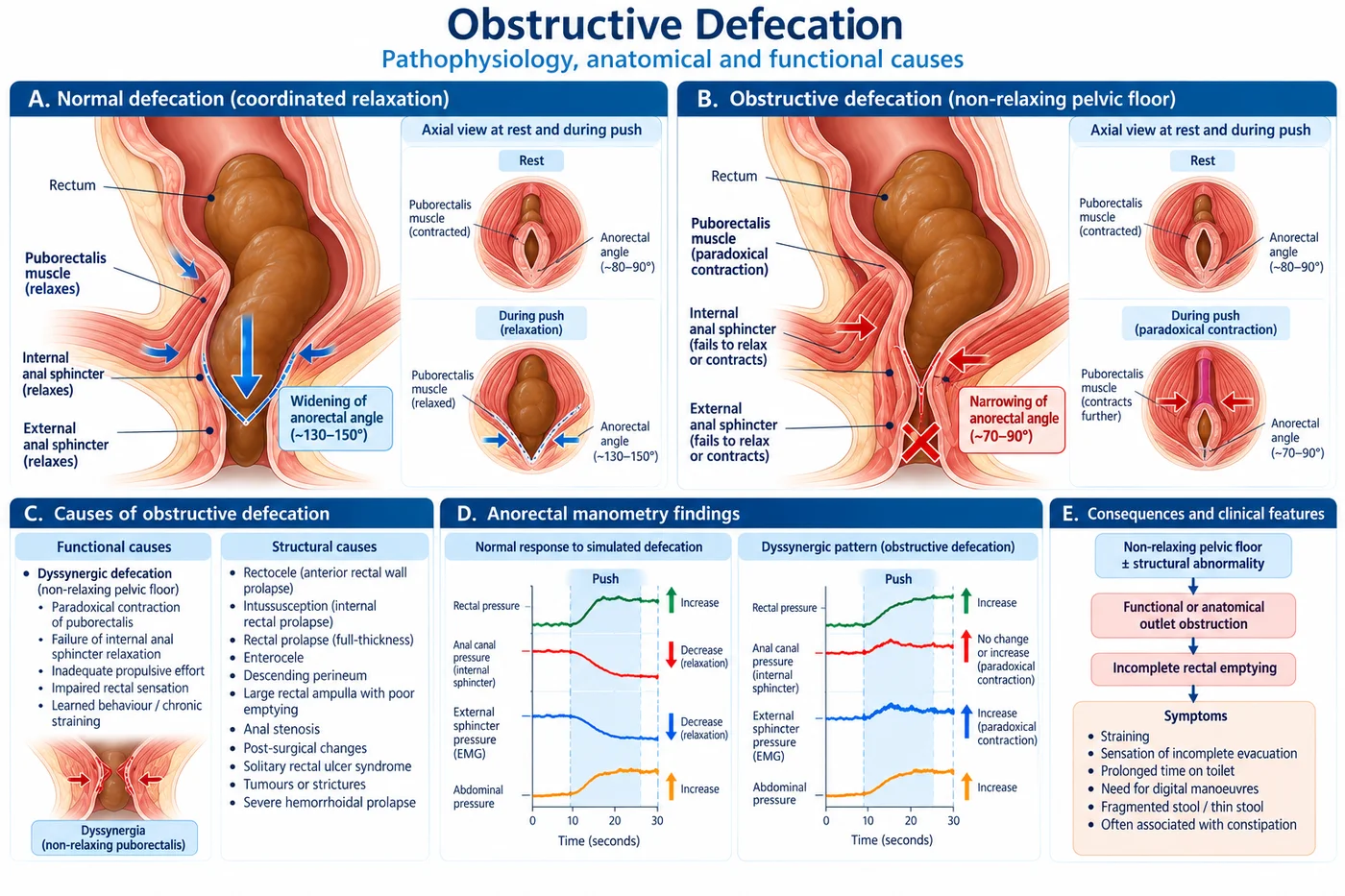
Rectocele. The wall between rectum and vagina weakens and bulges forward. Stool enters the pocket instead of passing through, and the sensation of fullness persists. Many women with a rectocele describe pressing on the perineum or inside the vagina to finish, which is a very specific clue.
Internal rectal prolapse. The upper rectum telescopes down into itself during straining and physically blocks the outlet. It also produces mucus discharge and a constant feeling of something in the rectum. More detail in internal rectal prolapse.
Dyssynergic defecation. The pelvic floor contracts instead of relaxing. Evacuation is partial, and the rectum is never fully emptied.
Reduced rectal sensation. Long-standing constipation, diabetes or neurological conditions can blunt the sensation that tells you the rectum is empty.
Large hemorrhoids or a prolapsing polyp. Tissue sitting in the anal canal mimics retained stool.
Proctitis. Inflammation of the rectum creates a persistent urge that empties nothing. That needs a different workup entirely.
Why repeated attempts make it worse
Each return trip means more straining against an outlet that is not opening. This enlarges the hemorrhoidal cushions, can tear the anal lining, and over time stretches the rectal supports, which is how a mild internal prolapse becomes a more significant one. The instinct to keep trying is understandable and counterproductive.
What helps immediately
- One attempt, ten minutes maximum, then leave regardless of the result.
- Feet on a low stool, lean forward, relax the abdomen outward, breathe out while pushing.
- Do not re-attempt within the hour.
- A glycerin suppository or small enema in the morning empties the rectum far more effectively than oral laxatives when the problem is at the outlet.
- Reduce fiber temporarily if bulk is making the fullness worse, which is the opposite of standard advice and often the right move here.
When to be examined
Incomplete evacuation deserves assessment if it has lasted more than a few weeks, if you are splinting to finish, if there is bleeding or mucus, or if it started after childbirth or pelvic surgery. Bleeding is never assumed to be hemorrhoids before examination, and colonoscopy screening starts at 40, earlier with a family history.
Assessment is straightforward: clinical examination and proctoscopy, then manometry, the balloon expulsion test, and defecography where a structural cause is suspected.
Treatment
For dyssynergia and most mixed pictures, biofeedback retraining is first line and effective. A significant rectocele that traps stool, or an internal prolapse causing genuine obstruction, can be repaired surgically — but only after pelvic floor function has been assessed, because operating on a rectocele in a patient whose real problem is dyssynergia produces a disappointed patient. The options are compared in treatment options for chronic constipation.
Frequently asked questions
Is this the same as constipation?
Not quite. You may open your bowels daily and still have this symptom, because the issue is completeness rather than frequency.
Can hemorrhoids cause it?
Large internal hemorrhoids prolapsing into the anal canal can give exactly this sensation, which is one reason examination matters before treatment.
Will surgery guarantee it resolves?
No, and that is why selection matters. Patients chosen on the basis of a structural problem plus a functioning pelvic floor do well; those operated on without that assessment often do not.
About the Author