

Consultant Colorectal Surgeon · Dubai and Abu Dhabi · DHA and DoH licensed · Associate Professor, UAE University
About · Google Scholar · LinkedIn
- Straining with soft stool points to a pelvic floor or structural problem rather than stool consistency.
- Repeated straining is a direct cause of hemorrhoids, anal fissures and, over years, rectal prolapse.
- Spending more than ten minutes on the toilet and pushing harder makes evacuation less effective, not more.
- Pelvic floor retraining resolves straining in a large proportion of patients without surgery.
Straining is so common that most people assume it is simply part of going to the toilet. It is not, and it is worth taking seriously for two reasons: it usually points to a specific and treatable problem, and the straining itself causes damage over time.
What straining does to the anus and rectum
Every strain raises pressure inside the abdomen and forces blood into the hemorrhoidal cushions, which gradually enlarge and prolapse. It stretches the anal lining, which is how many anal fissures start, and the pain of a fissure then produces more straining. Over years it stretches the supports of the rectum, contributing to internal prolapse and eventually full-thickness prolapse. It also contributes to pelvic organ prolapse in women.
The decisive question: how hard is the stool?
If the stool is hard, the problem is consistency, and fluid, fiber and an osmotic laxative at an adequate dose usually fix it.
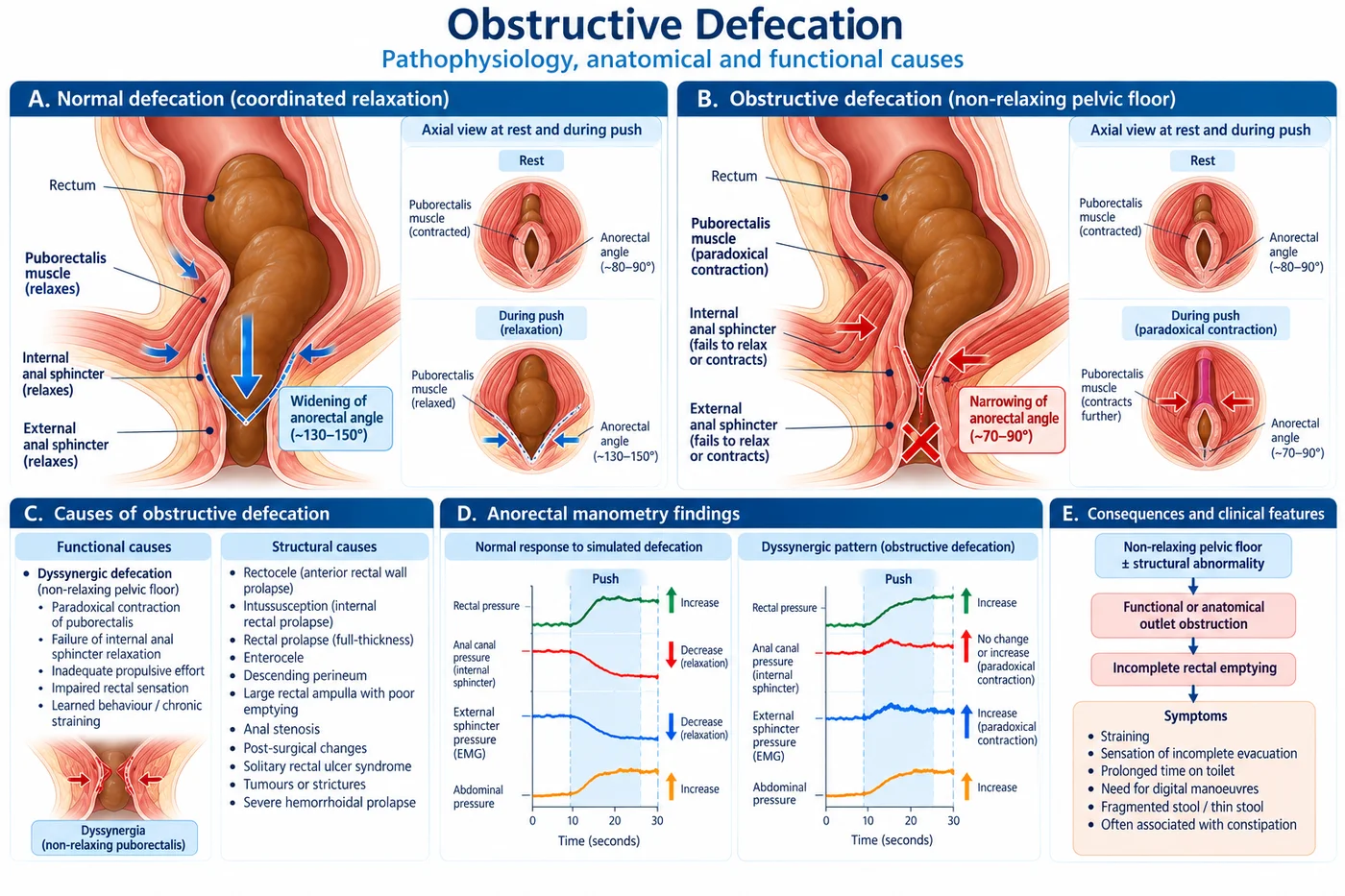
If the stool is soft and you are still straining, consistency is not the problem. Something is preventing evacuation. The usual causes are:
- Dyssynergic defecation — the pelvic floor and anal sphincter contract when they should relax. The patient pushes harder, the outlet closes tighter.
- Rectocele — a bulge of the rectal wall into the vagina that fills with stool instead of passing it.
- Internal rectal prolapse — the rectal wall folds inwards and blocks the way.
- Poor rectal sensation — the urge is weak, so the push arrives at the wrong time.
Technique: what actually helps
- Go when the urge arrives rather than postponing it.
- Feet raised on a low stool so the knees sit above the hips.
- Lean forward, elbows on knees, and let the abdomen relax outwards rather than bracing it.
- Breathe out through pursed lips while pushing; holding your breath and bearing down tightens the pelvic floor.
- Ten minutes maximum, no phone. If nothing happens, get up and come back later.
These instructions are not filler. Taught properly, with feedback, they are the core of pelvic floor retraining, which is the first-line treatment for dyssynergic defecation and works in most patients who complete it.
When straining needs assessment rather than advice
- Soft stool that still requires pushing.
- Pressing on the perineum or inside the vagina to evacuate.
- A sense of incomplete emptying.
- Bleeding, a lump, or pain with evacuation.
- Any bleeding at all, which needs examination rather than assumption.
What assessment involves
A clinical examination tells me whether the pelvic floor relaxes or contracts when you bear down. Manometry measures it objectively, the balloon expulsion test shows whether evacuation is possible, and defecography shows a rectocele or internal prolapse when surgery is on the table. Most patients never reach the surgical conversation.
Frequently asked questions
Is a squat position better?
Raising the feet straightens the angle between rectum and anal canal and helps many people. It does not overcome a pelvic floor that contracts on pushing, which is why technique and retraining matter.
Can straining cause a hernia?
Repeated straining raises intra-abdominal pressure and is a recognised contributing factor in inguinal hernia.
I only strain some days. Does that still matter?
Intermittent straining with otherwise normal evacuation is usually a consistency issue and responds to simple measures.
About the Author