
There is a specific kind of constipation that defeats every laxative, survives every diet change, and produces a normal colonoscopy. The patient strains even when stool is soft, feels blocked rather than sluggish, and never feels empty. In a large share of these cases the colon is innocent — the problem is the pelvic floor, the muscular platform that must relax at exactly the moment the bowel pushes. When it tightens instead, no fiber dose on earth fixes the result.
If this sounds like your problem, see how an obstructed defecation assessment works, including anorectal manometry and the balloon expulsion test.
What pelvic floor dysfunction means
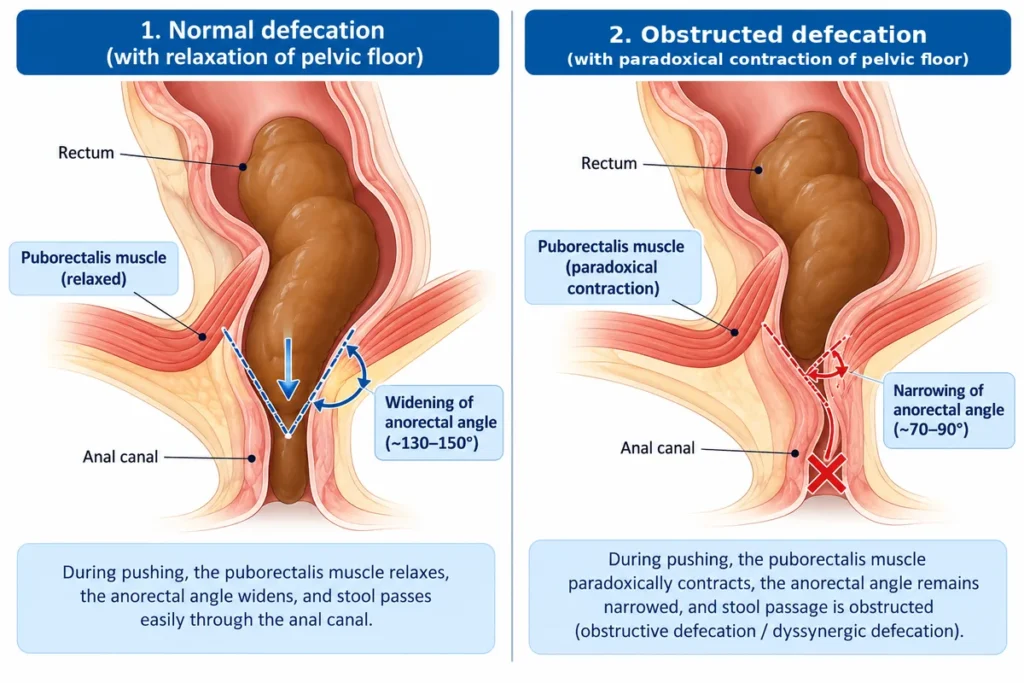
Normal defecation is coordination: the abdominal wall pushes, the pelvic floor descends, and the puborectalis muscle and anal sphincter relax to straighten and open the exit. In pelvic floor dyssynergia — also called dyssynergic defecation or anismus — that final relaxation fails. The muscles brace or even contract during the push, so the harder you strain, the more firmly the door is held shut. It is a learned, functional problem of muscle coordination, not damage — which is precisely why it is treatable.
The symptoms that point to it
Straining out of proportion to stool hardness is the flag I listen for — straining at soft stool makes no mechanical sense unless the outlet is the problem. The others: a sensation of blockage at the anus rather than a lazy bowel; incomplete emptying; needing to press on the perineum or use a finger to help stool out; long unproductive toilet sittings; and laxatives that produce liquid stool which is still difficult to pass — the near-diagnostic detail patients rarely volunteer.
Why colonoscopy cannot see it
A colonoscopy inspects the lining of the colon for polyps, inflammation and cancer. Pelvic floor dysfunction is a disorder of muscle function during defecation — a moment no endoscope observes. A normal colonoscopy in a chronically constipated patient rules out sinister causes; it does not end the diagnostic road. The next step is functional testing.
How it is actually diagnosed
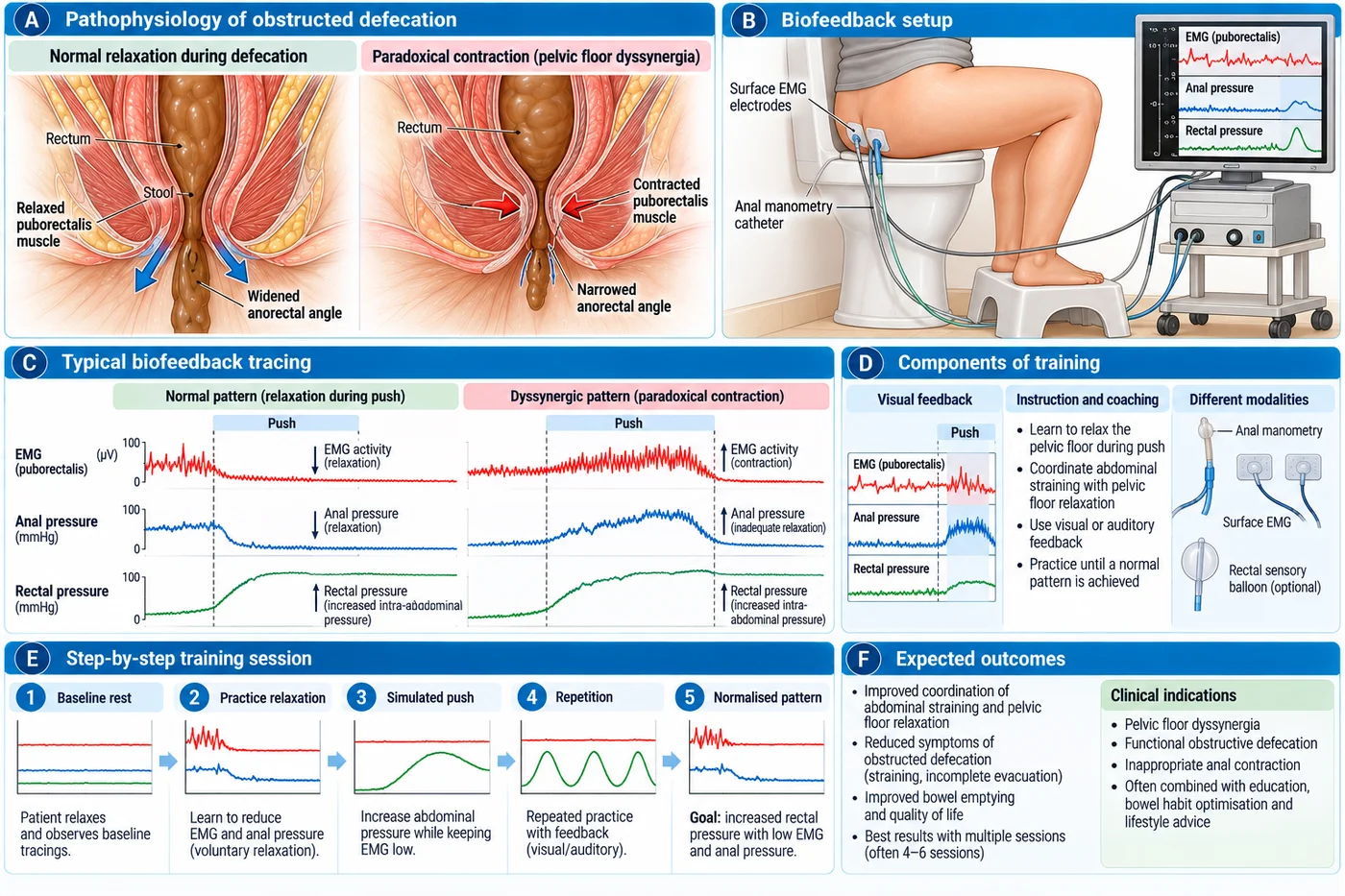
Two examinations carry the diagnosis. Anorectal manometry measures pressures in the anal canal while you squeeze, rest and push, and shows the paradoxical contraction directly, together with rectal sensation. Defecography — an imaging study of evacuation — demonstrates what happens dynamically and identifies associated structural problems such as rectocele or internal rectal prolapse that often coexist. A careful digital rectal examination by someone who assesses pelvic floors regularly predicts much of this in the clinic, and directs who needs the tests.
Treatment: retraining, not surgery
The core treatment is biofeedback — structured pelvic floor retraining in which sensors show you, in real time, what your muscles are doing while you practice the correct pattern. Published response rates in properly selected patients are high, and the improvement is durable because the faulty coordination itself is corrected.
Around it sit supporting measures: unhurried toilet routine, a footstool to unkink the anorectal angle, soluble fiber so stool arrives soft and formed, and weaning off the stimulant laxatives that this condition so often accumulates. Surgery has no role in dyssynergia itself; it is reserved for the structural companions when they are significant.
Why it matters beyond constipation
Years of straining against a closed pelvic floor is the engine behind much downstream anorectal disease — hemorrhoids, fissures, rectal prolapse. Treating the coordination problem is also prevention.
Frequently asked questions
How common is pelvic floor dysfunction in chronic constipation?
Studies suggest roughly one third to one half of patients referred with refractory chronic constipation have a defecatory disorder — it is common, and commonly missed.
Is biofeedback uncomfortable?
No. It uses a small sensor and guided exercises over several outpatient sessions. The main requirement is practice between sessions.
Can men have pelvic floor dysfunction?
Yes. It is often framed as a women’s condition, but dyssynergic defecation affects men regularly and is just as treatable.
If your constipation behaves like a blocked door rather than a slow bowel, functional assessment answers the question laxatives cannot. I evaluate and treat pelvic floor disorders of defecation in Dubai and Abu Dhabi, including manometry, defecography and biofeedback referral — see chronic constipation or request a consultation.
Pelvic floor problems are closely linked to rectal prolapse and how it is treated.
Read next: bowel endometriosis and colorectal surgery
About the Author