
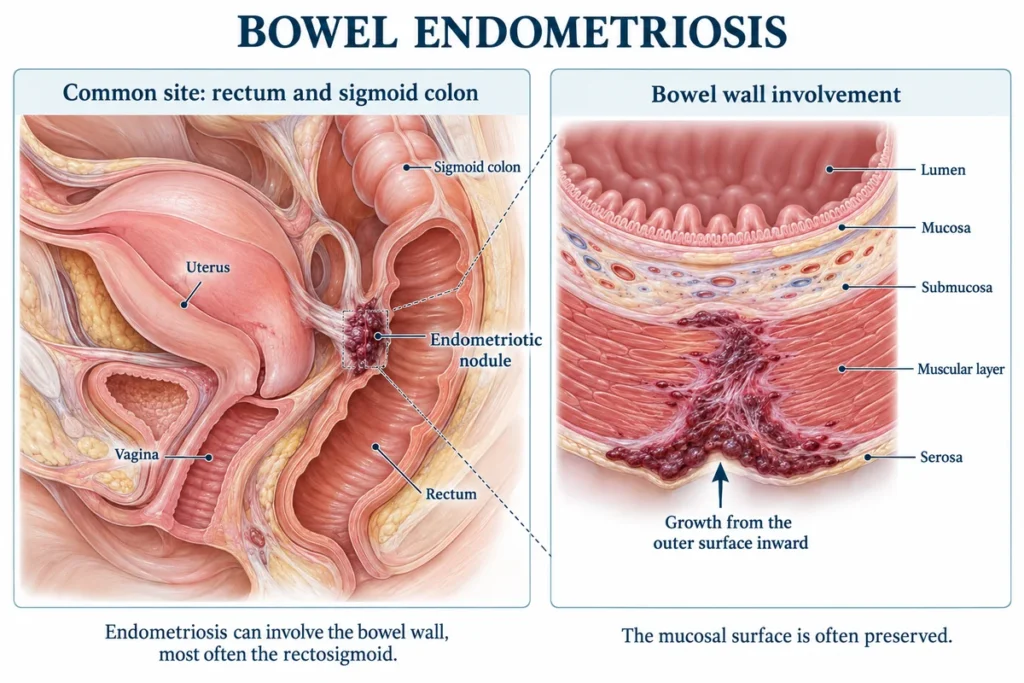
Endometriosis is usually thought of as a gynecological disease, but in its deep infiltrating form it frequently involves the bowel — most often the rectum and sigmoid colon. Bowel endometriosis is one of my subspecialty interests, and it sits exactly at the junction where gynecology and colorectal surgery must work together: the diagnosis is often missed for years, and when surgery is needed, the colorectal component determines how safe and how complete that surgery can be.
Prof. Dr Antonio Privitera is Lead for Colorectal Endometriosis at Medcare Group, and works with the gynaecology team when endometriosis involves the bowel.
What bowel endometriosis is
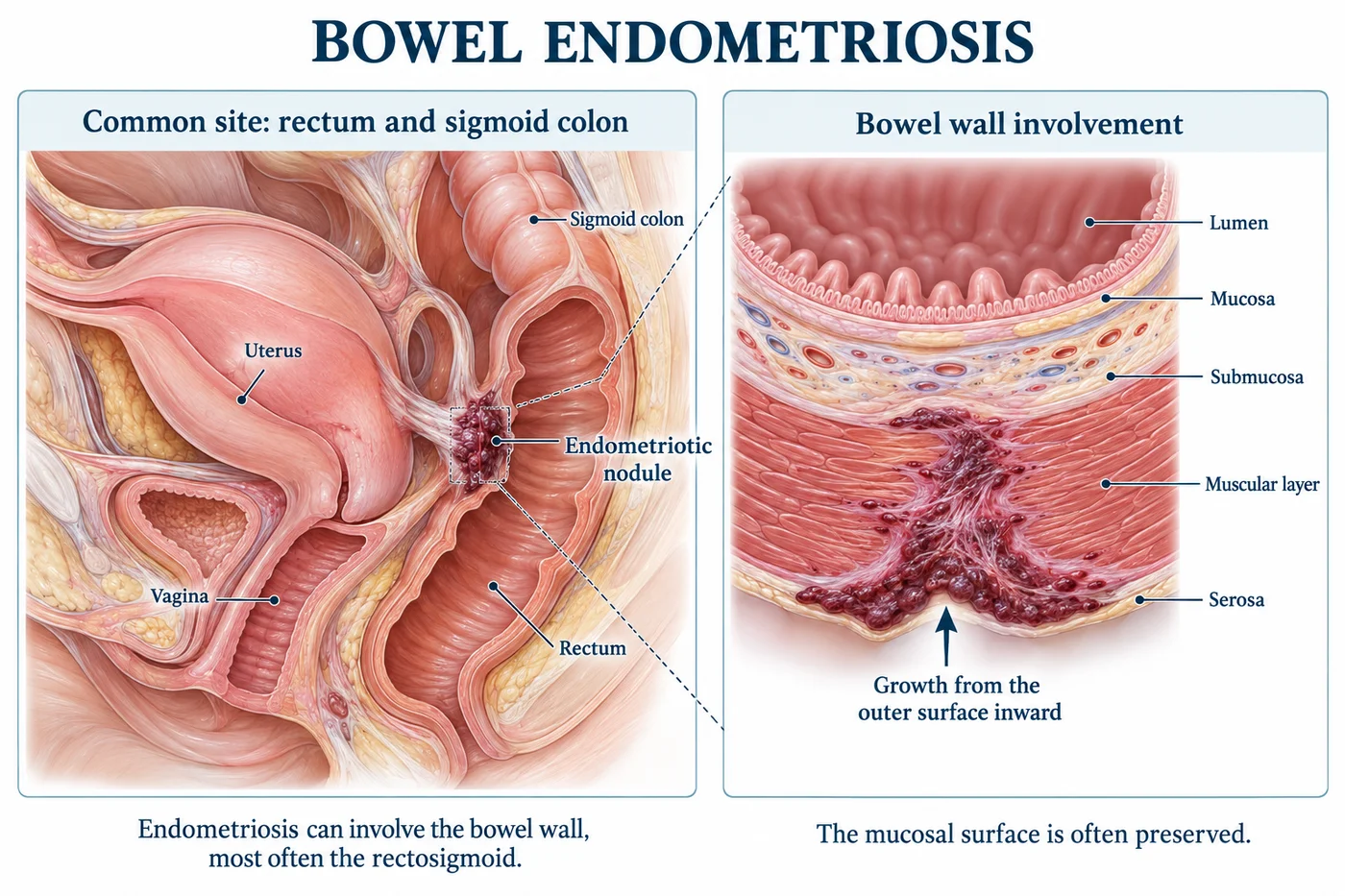
Endometrial-like tissue implants on or into the bowel wall, most commonly the front wall of the rectum behind the uterus. Unlike superficial pelvic disease, deep infiltrating endometriosis (DIE) penetrates beneath the surface — into the muscle layer of the rectum, the rectovaginal septum, or the sigmoid — forming firm nodules that scar and tether the organs together.
The symptoms that point to the bowel
The pattern is cyclical, tracking the menstrual period: painful defecation (dyschezia) during menstruation is the most telling symptom; others include cyclical rectal bleeding, deep pelvic pain during intercourse, bloating and altered bowel habit that worsen with the cycle, and sometimes constipation from a narrowed, tethered rectosigmoid. Because these overlap with irritable bowel syndrome, many women carry an IBS label for years. Cyclicity is the clue IBS does not explain.
How it is diagnosed
Expert transvaginal ultrasound and pelvic MRI map deep disease and its relationship to the rectal wall; colonoscopy is often normal because the disease grows from outside inward, and its main role is to exclude other causes of bleeding. Where significant rectal involvement is suspected, assessment of the bowel component by a colorectal surgeon before any operation — not during it — is what allows the right operation to be planned once.
Treatment: a genuinely joint decision
Not every bowel nodule needs surgery. Hormonal therapy controls symptoms in many women, and the decision to operate weighs symptoms, fertility plans and disease extent.
When surgery is indicated, the colorectal options are graded to the depth and size of the nodule: shaving the disease off the rectal wall, discoid excision of a full-thickness segment of the front wall, or segmental resection of the involved bowel with anastomosis — performed laparoscopically, jointly with the gynecological surgeon, in a single planned procedure.
Choosing the least radical operation that clears the disease is the entire art: overtreatment risks bowel function, undertreatment risks reoperation.
Why the colorectal surgeon matters
Complete excision of deep disease is what correlates with lasting symptom relief, and the rectal nodule is usually the reason excisions are left incomplete. A colorectal surgeon experienced in DIE brings the rectal dissection, the decision between shave, disc and segment, and the management of the bowel afterwards. This multidisciplinary model is the accepted standard for deep endometriosis with bowel involvement.
Frequently asked questions
Does bowel endometriosis mean I need part of my bowel removed?
Usually not. Most rectal nodules suitable for surgery can be shaved or excised as a disc; segmental resection is reserved for larger or obstructing disease.
Can bowel endometriosis turn into cancer?
Malignant change in bowel endometriosis is rare. The reasons to treat are pain, bowel function and fertility — not cancer prevention.
Who should I see first — gynecologist or colorectal surgeon?
Either, provided the two work together. If your endometriosis assessment mentions the rectum, rectovaginal septum or sigmoid, a colorectal opinion belongs in the planning, not in the operating room as a surprise.
I work with gynecological endometriosis teams across Dubai and Abu Dhabi on the colorectal component of deep infiltrating endometriosis. If your imaging shows bowel involvement, request a consultation to discuss the options before surgery is scheduled.
Bowel endometriosis is managed jointly, and the colorectal part of that decision needs a colorectal surgeon. Consultations are available with a colorectal surgeon in Dubai and with a colorectal surgeon in Abu Dhabi.
References
Papers by Prof. Dr Antonio Privitera on this subject:
- Privitera A, Nagy C, Al-Jefout M, Harikrishnan S, Jenitha CA, Guo SW. Near-Infrared Indocyanine Green (NIR-ICG) Fluorescence Imaging for Intraoperative Detection of Endometriosis: A Systematic Review and Meta-Analysis. J Endometr Uterine Disord. 2026;16:100173. doi:10.1016/j.jeud.2026.100173
More on the publications page.
About the Author