Recovery after anal fistula surgery depends on which operation was performed. Our anal fistula treatment in Dubai and Abu Dhabi explains what to expect from each type of surgery and what recovery involves. Fistulotomy leaves an open wound that heals over weeks. Seton insertion is a minor procedure with quick recovery. LIFT and other sphincter-sparing operations fall in between. Here is a complete, realistic recovery guide for each type of surgery.
Reading this from outside the UAE? I review cases remotely and see patients who travel to Dubai and Abu Dhabi. How it works →
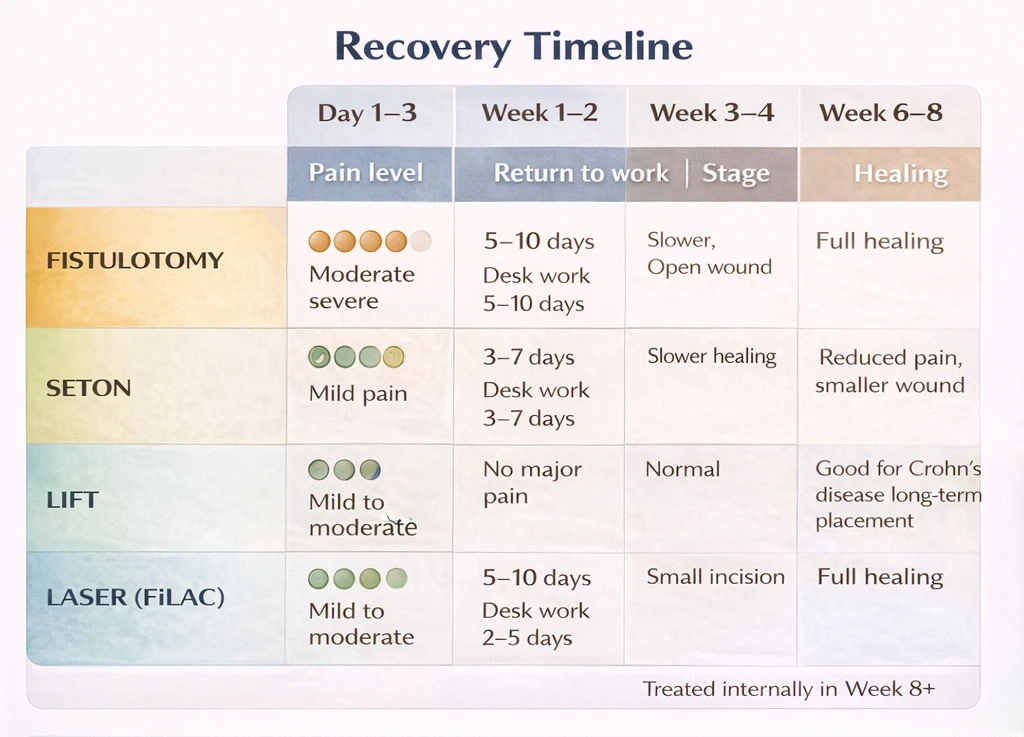
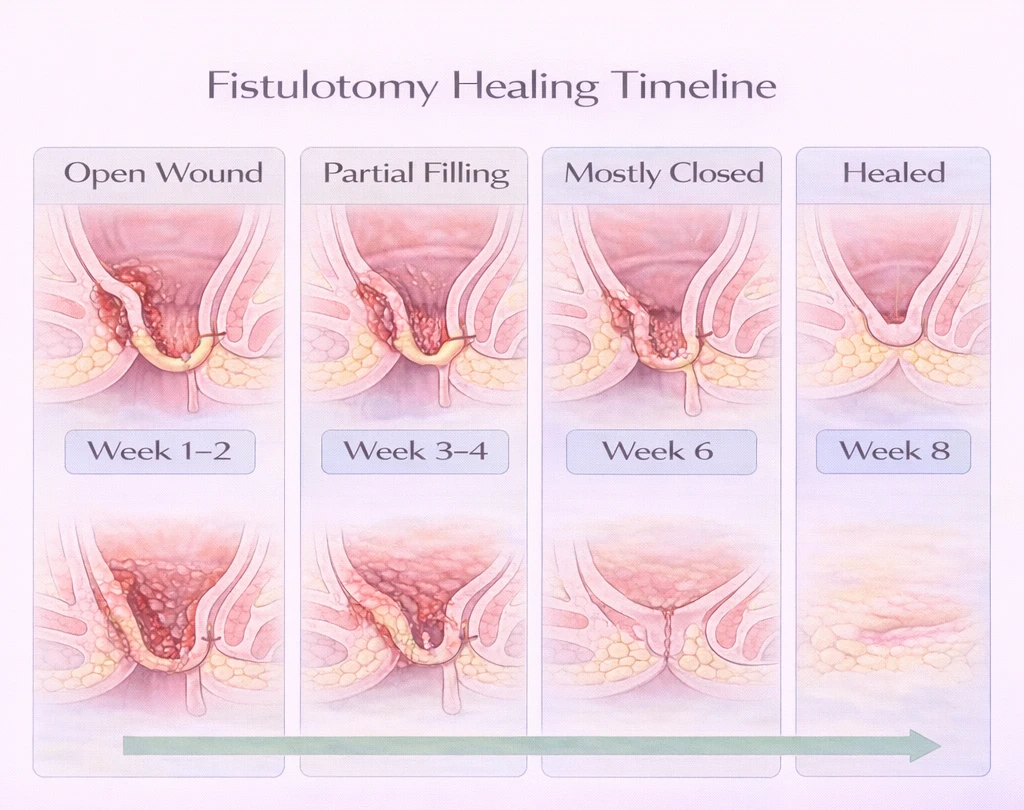
Recovery After Fistulotomy
The wound heals over time. See fistulotomy explained.
Wound Care
The wound is an open groove (not stitched) that heals from the base upward by secondary intention. Wound care:
- Keep the wound clean – shower and allow water to run over the area after bowel movements
- Pat dry gently – do not rub
- Avoid tight-fitting clothing that traps moisture
- Apply a light dressing if needed change after each bowel movement and at least once daily
- Sitz baths (warm water for 10-15 minutes) 2-3 times daily soothe the wound and keep it clean
Pain Management
- Moderate discomfort in the early part of recovery, most pronounced at the start
- Paracetamol + ibuprofen: Regular schedule (not just when severe)
- Oral analgesics prescribed by surgeon if needed
- The first bowel movement after surgery: uncomfortable but manageable with stool softeners
Return to normal activities and work
How soon you return to each activity depends on the procedure performed, the extent of treatment, your own recovery and the nature of your work. Desk-based work is generally resumed before physically demanding or manual work.
- Walking: light walking is encouraged from the outset
- Driving: once you are no longer taking narcotic pain medication and can move and brake comfortably
- Gym and heavy lifting: reintroduced progressively, later than everyday activity
- Sexual activity: when you are comfortable
Ongoing recovery
The wound is open at first and dressings are needed; this is the most uncomfortable part of recovery. Pain then reduces appreciably and the wound becomes visibly smaller as it fills in from the base. It closes fully in most patients, and larger wounds take longer. Recovery varies according to the procedure performed, the extent of disease and treatment, and the individual patient.
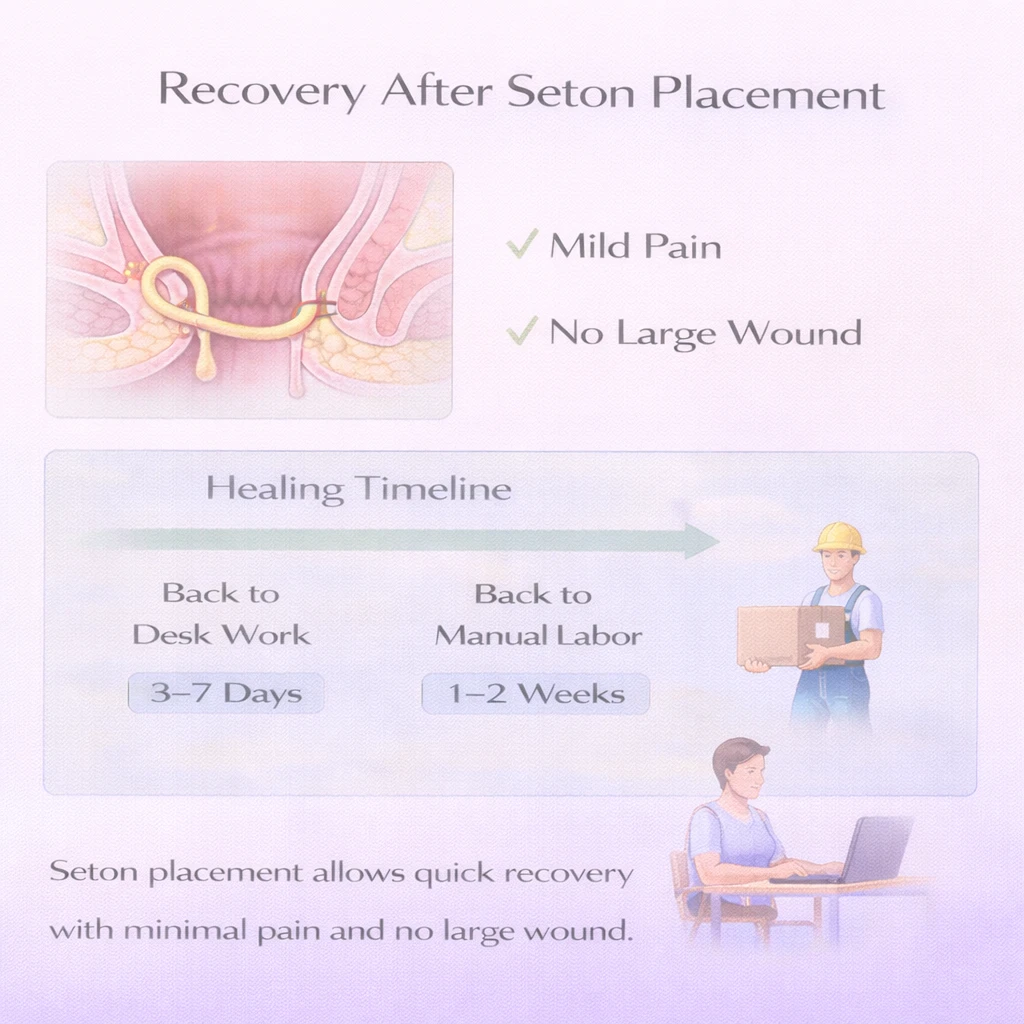
Recovery After Seton Placement
A seton placement is a common first step.
- Pain: Mild for a few days after insertion
- Return to work: usually sooner than after fistulotomy, guided by your comfort and the nature of your work
- The seton itself: A visible loop of thread. Some mucus discharge – this is normal and expected.
- Hygiene: Keep the area clean. Shower daily.
- Duration in place: 6-12 weeks before next stage of surgery, or long-term for Crohn’s fistulas
Recovery After LIFT Procedure
- Pain: moderate in the early part of recovery, and less than after fistulotomy because there is no large open wound
- Wound: a small intersphincteric incision, which heals more quickly than an open fistulotomy wound
- Return to desk work: generally before physically demanding work
- Full activity: resumed progressively as recovery and comfort allow
Recovery After Laser (FiLaC)
- Pain: mild to moderate in the early part of recovery, and less than after fistulotomy
- Return to work: desk-based work is generally resumed before physically demanding work
- No large wound the tract is treated internally
- Healing is assessed at the follow-up appointments arranged for you
Diet During Recovery
- High-fiber diet throughout recovery prevents constipation, which causes painful straining across the wound
- Stool softeners if needed macrogol, lactulose, or docusate
- Adequate hydration 2.5-3 liters daily
Follow-up and when to seek assessment
- Fever above 38°C
- Significant increase in pain, swelling, or redness after the first few days (signs of wound infection)
- Heavy bleeding from the wound
- Inability to pass urine after surgery (urinary retention)
Your recovery, and what is normal
Recovery after anal fistula surgery follows a rhythm worth knowing in advance, because the normal course includes things that alarm patients who were not warned. In the first days, expect soreness controlled with the medication you were prescribed, and expect discharge — a fistula wound is usually left open to heal from the inside out, so drainage on a dressing or pad is a sign of a wound doing its job, not failing at it.
Warm sitz baths, begun as instructed, ease the area and keep it clean; most patients sit, walk and manage stairs within days, and desk work is commonly possible before physically demanding work, depending on the procedure performed.
Through the following weeks the discharge lessens and the wound shallows. Full healing is measured in weeks to a few months by procedure and by the fistula’s complexity, and the follow-up visits exist precisely to watch that trajectory — keep them even when everything feels fine, because a fistula that heals over at the surface before the depth has closed is how recurrences are made.
If you have a seton, and the signs that need a call
Some fistulas are treated in stages, and stage one is a seton — a soft surgical thread left through the tract to drain it and protect the sphincter muscle while the definitive treatment is planned. A seton is meant to be there; it may be felt, it will cause some discharge, and it needs nothing from you beyond normal hygiene and the review appointments where the next stage is decided.
Whatever your procedure, call the clinic promptly — +971 55 318 8469 — for any of the following: fever; pain that increases after the first days instead of easing; bleeding beyond spotting; discharge that turns foul; inability to pass urine; or swelling that grows.
Each has a benign explanation more often than not, and each is exactly what the surgeon wants to hear about early rather than late.
Need expert treatment for hemorrhoids, anal fissure, or anal fistula? Book a consultation with Dr. Antonio Privitera in Dubai or Abu Dhabi.
📱 WhatsApp: +971 55 318 8469
📞 Phone: +971 55 318 8469
Dr Antonio Privitera completed colorectal surgery fellowships at the Mayo Clinic in Rochester, USA. He then trained on the combined colorectal surgery programme at Guy’s and St Thomas’ and University College London Hospitals (UCLH). He was the first fellow appointed to that programme. He also completed a fellowship in advanced laparoscopic and robotic surgery in Seoul, South Korea. Member of the Royal College of Surgeons of Edinburgh. Certified in General Surgery by the Italian Medical Council.
About the Author