
Anal fistula symptoms are often persistent and include discharge, irritation, and recurrent swelling. Recognizing these symptoms early is essential. For full management options, see anal fistula treatment in Dubai.
These symptoms differ from hemorrhoids – see hemorrhoid treatment in Dubai.
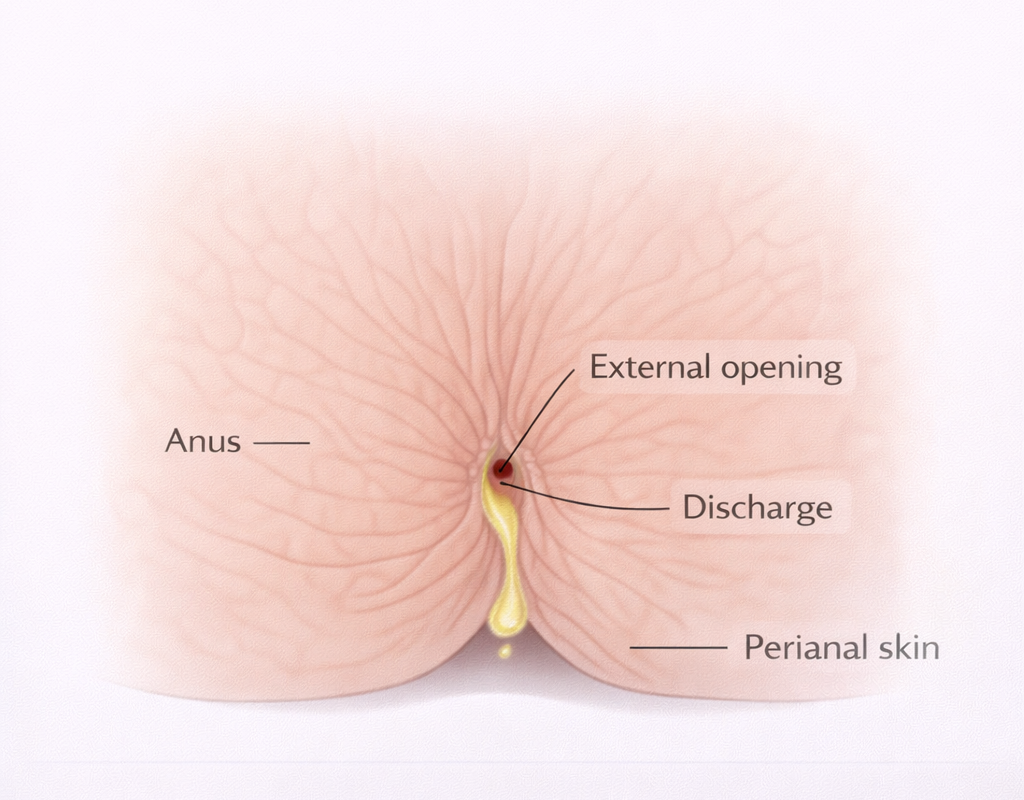
Here are the symptoms of anal fistula – and specifically, the signs that should prompt you to seek specialist evaluation without delay.
The Classic Symptom: Persistent Discharge Near the Anus
The hallmark of an anal fistula is persistent or intermittent discharge from a small opening on the skin near the anus. This discharge may be:
- Pus (yellow or green, sometimes foul-smelling)
- Blood – fresh, bright red
- Mucus – clear or whitish, slimy
- A mixture of pus and blood
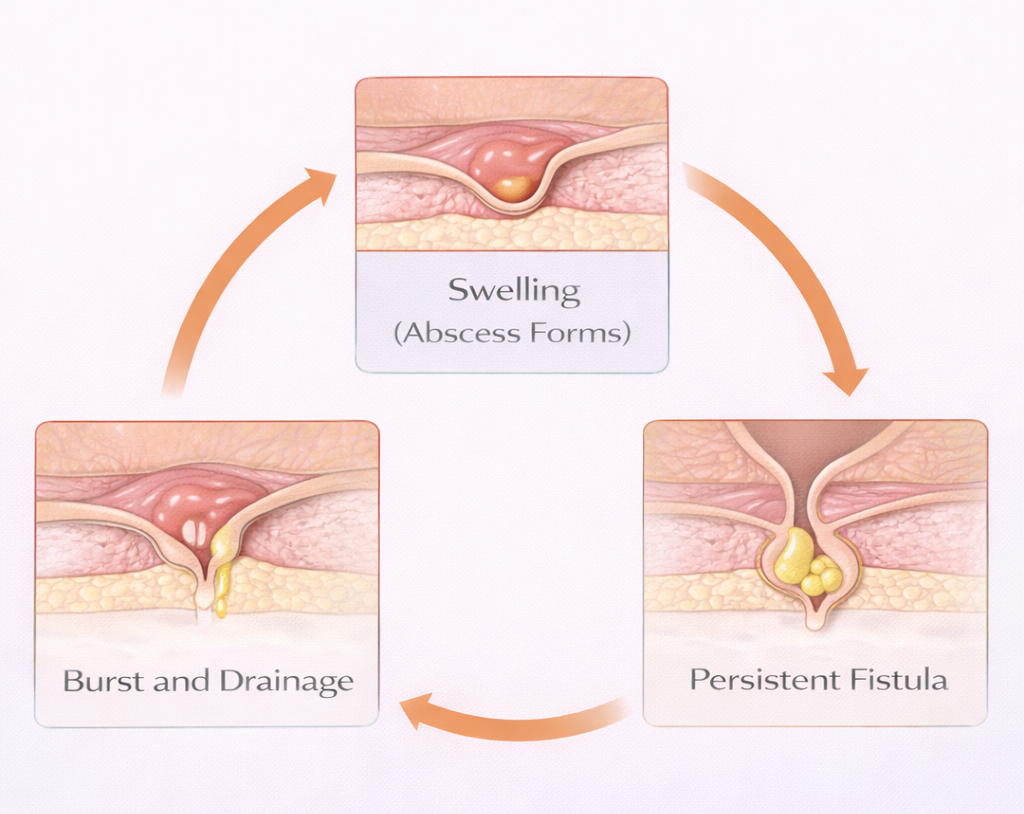
The discharge comes from the external opening of the fistula tract. It may be constant (if the tract is always open) or intermittent (if the external opening seals, the tract fills with pus, and then discharges again the ‘filling and draining’ cycle that many patients describe).
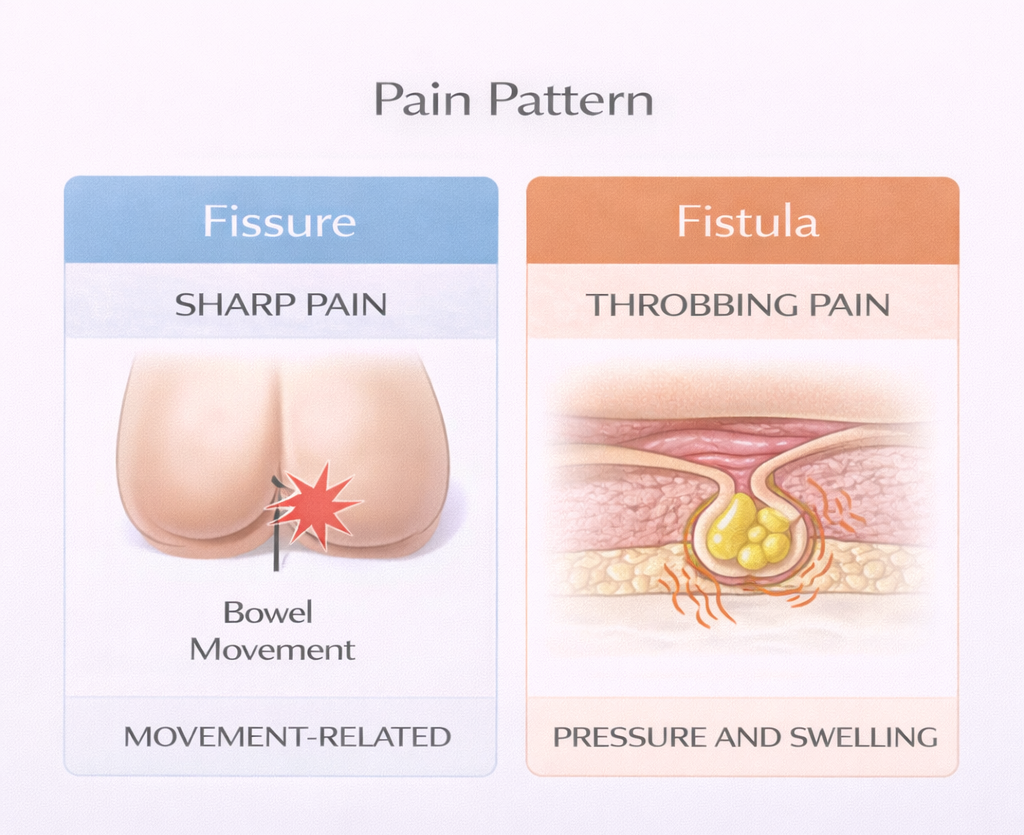
Pain – How It Differs from a Fissure
Fistula pain is different from fissure pain:
- Fissure: Sharp, tearing pain specifically during and after bowel movements (sphincter spasm)
- Fistula: Pain when the external opening seals and the tract fills – a throbbing, pressure-type pain. Relieved when discharge starts again. Often described as ‘a boil that keeps coming back.’
Some fistulas cause little pain between discharge episodes. Others particularly complex fistulas with multiple tracts cause persistent perianal discomfort.
Itching and Skin Irritation
Constant moisture from fistula discharge irritates the perianal skin, causing:
- Persistent itching (pruritus ani)
- Skin excoriation (soreness, rawness)
- Redness and inflammation around the external opening
This is often mistaken for fungal infection or hemorrhoidal irritation.
History of Perianal Abscess
The most important predisposing history is a previous perianal abscess – either:
- Surgically drained: By a surgeon in an emergency or elective setting
- Spontaneously drained: The abscess pointed through the skin and burst on its own
In approximately 50% of patients who have had a perianal abscess, a fistula develops. If you have had an abscess drained and continue to have discharge or intermittent pain at the same site, you have a fistula until proven otherwise.
Soiling and Underwear Staining
Fistula discharge may be enough to stain underwear continuously. Patients describe needing to wear a pad. This is socially distressing and, combined with the associated odor, significantly affects quality of life.
Intermittent Swelling That ‘Comes and Goes’
A classic fistula pattern: The external opening seals → the tract fills with pus → a lump or swelling appears near the anus → eventually it bursts, discharges, and temporarily subsides → the cycle repeats. Each cycle may be painful. Diagnosis often requires imaging. Read MRI for anal fistula.
What About Pain Only – No Discharge?
Perianal pain without discharge may indicate an abscess (not yet a fistula an abscess precedes a fistula) or other perianal pathology. If you have perianal swelling and pain with fever, seek urgent evaluation a perianal abscess is a surgical emergency.
Symptoms That Mean Something More Serious
- Fistula in the context of Crohn\’s disease: Multiple external openings, complex tracts, induration requires specialist colorectal IBD input
- Fistula with blood loss: Heavy bleeding from a fistula tract is unusual and requires investigation
- Fistula that does not respond to treatment: May indicate malignancy, tuberculosis, radiation injury, or actinomycosis biopsy required
When to See a Specialist
If you have any discharge from near the anus that has been present for more than 2 weeks, you need specialist evaluation. A fistula will not heal on its own and will not resolve with topical cream. The longer it is left, the more complex the tract can become.
Need expert treatment for hemorrhoids, anal fissure, or anal fistula? Book a consultation with Dr. Antonio Privitera in Dubai or Abu Dhabi.
📱 WhatsApp: +971 55 318 8469
📞 Phone: +971 55 318 8469
AUTHOR AUTHORITY BLOCK
Fellowship-trained at Mayo Clinic (USA) and the Royal College of Surgeons (UK). Member of the Royal College of Surgeons of Edinburgh. Certified in General Surgery by the Italian Medical Council.
About the Author