
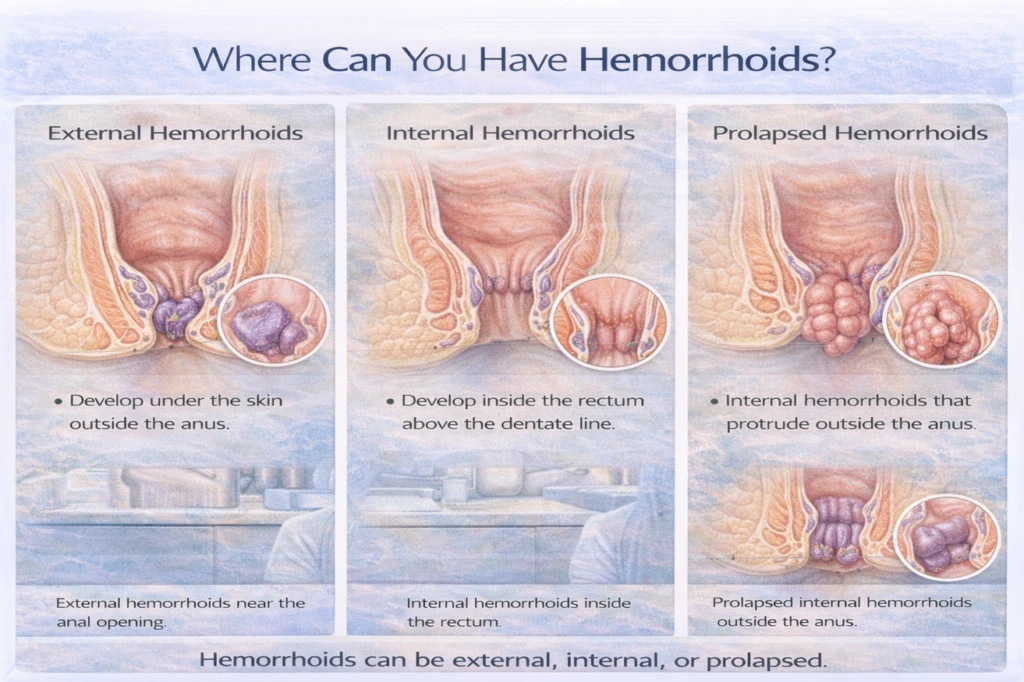
Hemorrhoids (piles) look different depending on where they are. Internal hemorrhoids are inside the anal canal and cannot be seen unless they slip out, when they appear as soft, moist, pink or red swellings. External hemorrhoids sit under the skin at the edge of the anus and look like soft, skin-coloured or bluish lumps. A thrombosed external hemorrhoid is a sudden, tense, dark purple lump that hurts. The illustrations below show each type.
First, what hemorrhoids are
Everyone has hemorrhoidal cushions. They are normal pads of blood vessels in the anal canal that help with continence. They become “hemorrhoids” in the everyday sense when they enlarge, slip down or bleed. Piles and hemorrhoids are the same thing.
Internal hemorrhoids
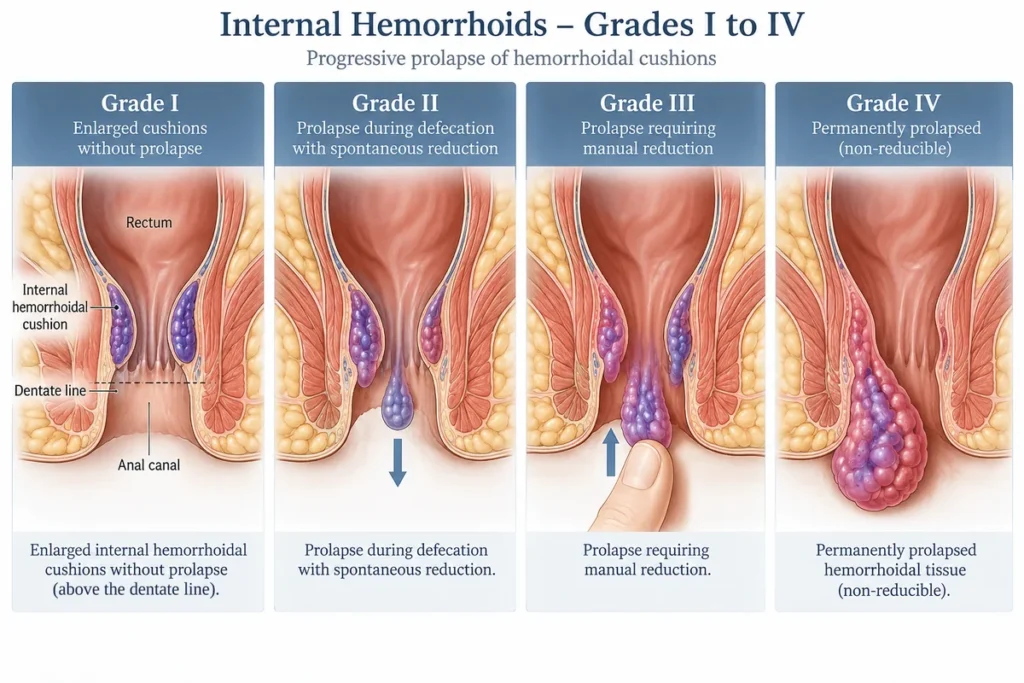
Internal hemorrhoids start above the dentate line, the point inside the anal canal where the lining changes and where pain nerves begin. That is why they usually bleed without hurting. You cannot see them in a mirror unless they prolapse. They are graded by how far they come down:
| Grade | What you notice | What it looks like |
|---|---|---|
| I | Bright red bleeding, nothing comes out | Nothing visible from outside |
| II | A swelling comes out with a bowel movement and goes back by itself | A soft pink lump seen only briefly |
| III | The swelling comes out and has to be pushed back | Moist, pink to dark red folds at the opening |
| IV | The swelling stays out | Permanent, often purplish tissue outside the anus |
More on the grades in grade 2 hemorrhoids, grade 3 hemorrhoids and grade 4 hemorrhoids, and on pushing them back in prolapsed hemorrhoids.
External hemorrhoids
External hemorrhoids form under the skin around the opening, below the dentate line, so they can be felt and seen. They look like soft, skin-coloured or slightly bluish swellings that get bigger when you strain and settle afterwards. They often itch and can make cleaning difficult. See external hemorrhoids and internal vs external hemorrhoids.
Thrombosed external hemorrhoid
When a clot forms inside an external hemorrhoid, the lump appears suddenly, becomes tense, round and dark blue or purple, and is painful, especially when sitting. It can look alarming. It is not dangerous, but it is worth being seen early because the treatment depends on how long the clot has been there. See thrombosed hemorrhoid.
Mixed hemorrhoids
Many people have internal and external hemorrhoids at the same time. Where both are large, the internal part comes down and the external part stays swollen around it. This matters for treatment: some techniques act only on the internal part.
Lumps that are not hemorrhoids
Several conditions look like piles at first glance:
- Skin tags: soft, painless flaps of skin that do not change size. See anal skin tag or hemorrhoid?
- Sentinel pile: a tag at the end of a chronic fissure, with sharp pain during bowel movements. See anal fissure vs hemorrhoids.
- Perianal abscess: red, hot, increasingly painful swelling. See perianal abscess.
- Anal warts: rough, cauliflower-like growths. See anal warts.
- Rectal prolapse: a ring of rectal lining that comes out with bowel movements. See rectal prolapse.
- Polyps and, rarely, cancer: a lump that grows, bleeds or does not settle needs to be examined.
Why pictures are not enough
Comparing yourself with photos is understandable, but it is unreliable. The same condition looks different from person to person, and two problems are often present together, for example hemorrhoids with a fissure. Bleeding in particular should never be assumed to be from piles without an examination. An examination takes a few minutes, a female nurse is present in the room for every examination, and a proctoscopy in the clinic usually gives the answer the same day.
When to be seen
- bleeding from the back passage, at any age
- a lump that is new, growing, hard or not settling
- sudden severe pain, or a painful swelling with fever
- a change in bowel habit, weight loss or anemia
- you are 40 or older and have never had bowel screening
Heavy bleeding or severe pain with fever should be seen urgently at an emergency department.
Treatment in brief
Treatment depends on symptoms and type, not on appearance alone. Fiber, fluids and avoiding straining help all types. Bleeding internal hemorrhoids often respond to office treatment such as rubber band ligation. Larger or mixed hemorrhoids may need laser, THD or excision. The options are compared in banding vs laser vs THD, and creams are covered in hemorrhoid cream and piles medicine.
Frequently asked questions
What color are hemorrhoids?
Internal hemorrhoids that come out are pink to dark red and moist. External hemorrhoids are skin-coloured or bluish. A clotted external hemorrhoid is dark blue or purple.
Can you see internal hemorrhoids?
Not unless they prolapse. Grade I hemorrhoids are only seen during an examination with a proctoscope.
Do hemorrhoids feel hard?
Usually they are soft. A hard, tender lump that appeared suddenly is typically a thrombosed external hemorrhoid. A hard lump that grows slowly or bleeds should be examined.
Can hemorrhoids go away on their own?
Small ones often settle with stool regulation. See can hemorrhoids go away on their own?
Seeing Dr Antonio
Prof. Dr Antonio Privitera is a consultant colorectal surgeon seeing patients in Dubai and Abu Dhabi. All UAE insurance policies are accepted across his locations, and no referral is needed. To book, call or message on WhatsApp. More about hemorrhoid treatment in Dubai and in Abu Dhabi.
About the Author