
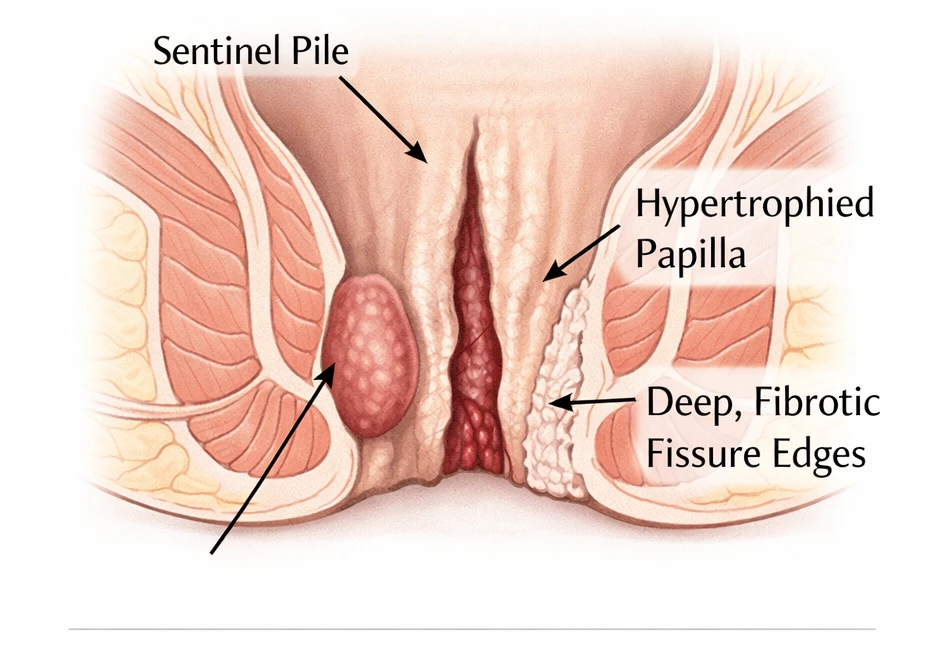
An anal skin tag is a soft, painless flap of skin at the edge of the anus that stays the same size. A hemorrhoid is a swollen blood-vessel cushion that can bleed, swell, shrink back or become suddenly painful. Tags are harmless and need treatment only if they bother you. Because several other conditions can look similar, a short examination is the reliable way to tell them apart.
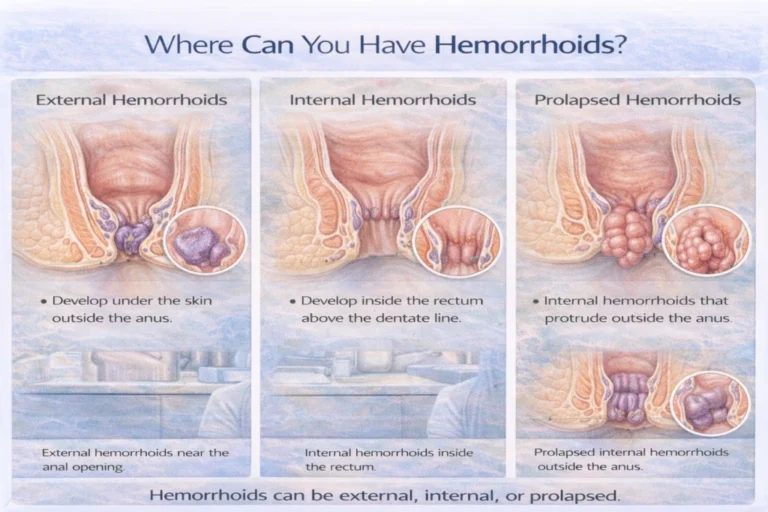
Quick comparison
| Feature | Anal skin tag | External hemorrhoid | Prolapsed internal hemorrhoid |
|---|---|---|---|
| Feel | Soft, skin-coloured flap | Soft swelling under the skin, may feel bluish | Moist, pink or red, comes from inside |
| Pain | None | Usually none; sudden severe pain if a clot forms | Discomfort, aching |
| Bleeding | Rarely | Occasionally | Common, bright red |
| Size | Stays the same | Swells with straining, settles afterwards | Comes down with bowel movements, may go back in |
| Main problem | Cleaning, itching, appearance | Swelling, itching, clots | Bleeding, mucus, prolapse |
Where skin tags come from
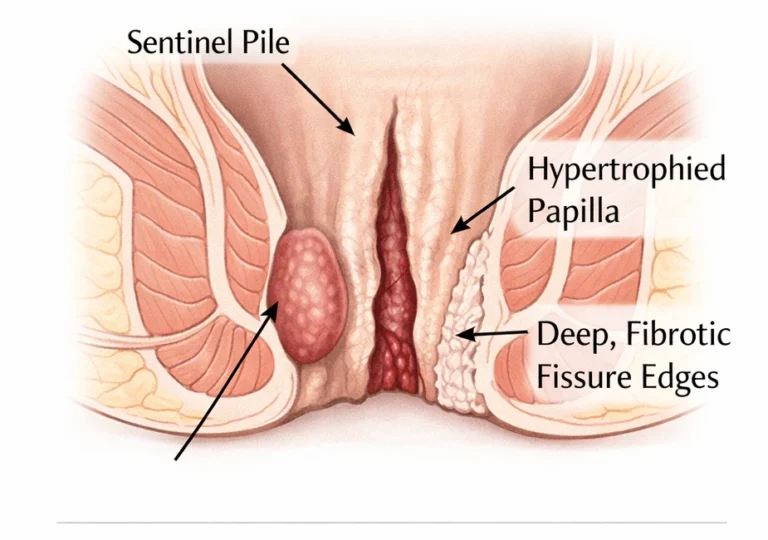
Most skin tags are what remains after an external hemorrhoid has swollen and settled, particularly after a clot (a thrombosed hemorrhoid). The stretched skin does not shrink back completely. Others form at the lower end of a chronic anal fissure: this is called a sentinel tag, or sentinel pile, and it signals that the fissure has been present for some time. Less often, tags are part of Crohn’s disease, where they tend to be larger, firmer or more than one.
Other lumps that can look similar
- Sentinel pile with a fissure: a tag together with sharp pain during and after bowel movements. The fissure, not the tag, needs treatment. See acute vs chronic anal fissure.
- Thrombosed external hemorrhoid: a sudden, tense, painful purple lump. See thrombosed hemorrhoid.
- Perianal abscess: a hot, red, increasingly painful swelling, sometimes with fever. It needs prompt drainage. See perianal abscess.
- Anal warts: small, rough, often multiple growths that can spread. See anal warts.
- Rectal prolapse: a larger ring of tissue that comes out with bowel movements. See rectal prolapse.
- Rarely, anal cancer: a firm lump that grows, ulcerates or bleeds and does not settle. See anal cancer.
Do skin tags need treatment?
No, not for medical reasons. A skin tag is not dangerous and does not turn into cancer. People ask for removal when the tag makes cleaning difficult, traps moisture and causes itching, or simply bothers them. Removal is a short procedure; the type of anesthesia is agreed with you beforehand according to your preferences. Two points matter:
- If the tag sits at the end of a fissure, the fissure has to be treated as well, or the problem returns.
- Tags linked to Crohn’s disease are generally left alone unless they cause real problems, because healing can be slower.
Most people have a quick return to normal activities after removal.
Do hemorrhoids need treatment?
That depends on the symptoms rather than on how they look. Many hemorrhoids settle with fiber, fluids and not straining. Persistent bleeding or prolapse may need office treatment such as rubber band ligation, and larger or mixed hemorrhoids may need surgery. The options are compared in banding vs laser vs THD.
Why an examination is worth it
Photos online are a poor guide: lumps around the anus look very different from person to person, and two conditions can be present at once. An examination takes a few minutes, a female nurse is present in the room for every examination, and in most cases the answer is clear the same day. See what hemorrhoids look like for the different types.
Frequently asked questions
Can a skin tag turn into a hemorrhoid?
No. A tag is skin. But a tag is often what an external hemorrhoid leaves behind, so the two are frequently found together.
Will a skin tag go away on its own?
Usually not. Swelling around a recent tag can settle, but the skin itself remains unless it is removed.
Can I remove a skin tag at home?
Please don’t. The area bleeds easily and becomes infected easily, and a lump you think is a tag may be something else.
Is a skin tag removal covered by insurance?
Coverage depends on your policy and on whether removal is medically needed. Dr Antonio’s secretary checks this with your insurer before any procedure.
Seeing Dr Antonio
Prof. Dr Antonio Privitera is a consultant colorectal surgeon seeing patients in Dubai and Abu Dhabi. All UAE insurance policies are accepted across his locations, and no referral is needed. To book, call or message on WhatsApp. More about hemorrhoid treatment in Dubai and in Abu Dhabi.
About the Author