
Choosing the Right Anal Fistula Operation: How the Decision Is Made
Fellowship-trained: Mayo Clinic (USA) · United Kingdom · South Korea — Associate Professor, UAE University
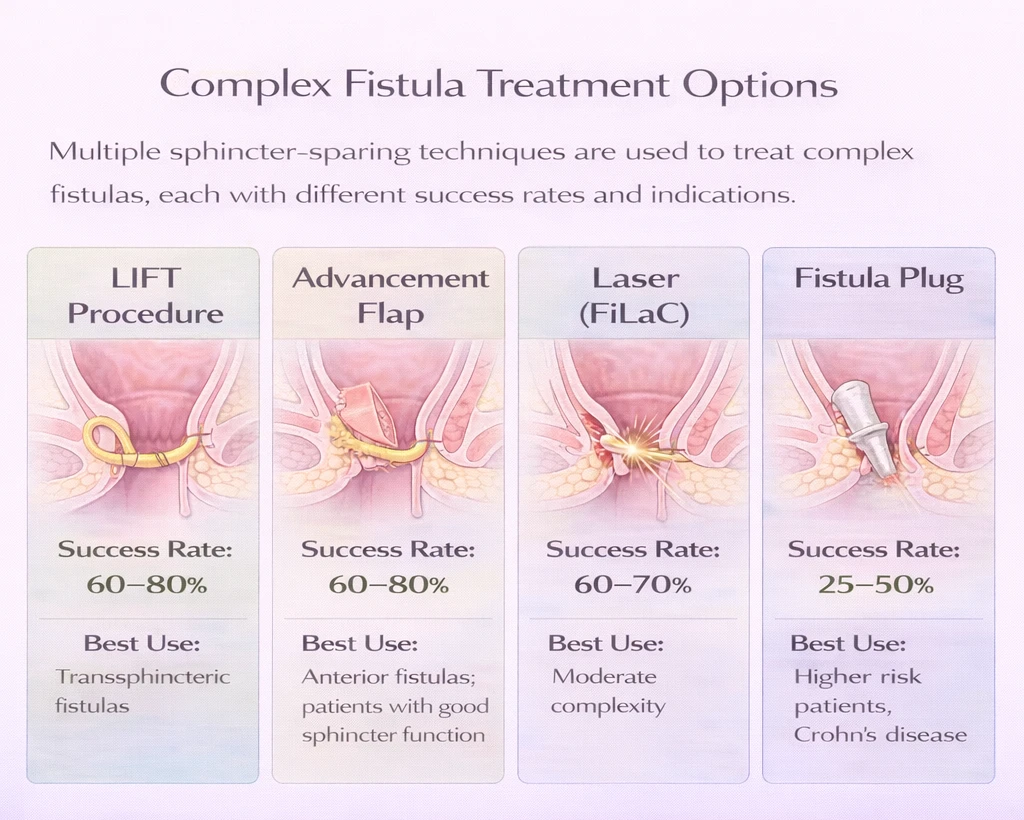
Most patients researching anal fistula surgery are comparing technologies: laser, LIFT, plug, flap, fistulotomy. That is the wrong starting point. The technology does not determine the result. The anatomy of your fistula determines which operation is reasonable, and using an operation outside the anatomy it was designed for is one of the more common reasons a fistula fails to close or recurs.
This page explains how the choice is actually made in clinic, what I look for on examination, where imaging can mislead, and which questions are worth asking any surgeon before you agree to an operation. It is written to be read alongside the anal fistula treatment page, which describes each procedure in detail.
The question that decides everything: where does the tract run?
An anal fistula is a tunnel between the anal canal and the skin. What matters surgically is the relationship between that tunnel and the two rings of muscle that control continence: the internal sphincter, a thin involuntary muscle, and the external sphincter, the voluntary muscle around it.
A tract running only in the narrow plane between those two muscles is called intersphincteric. A tract crossing the external sphincter is transsphincteric, and whether it crosses low down or high up changes the options considerably. Tracts running above or outside the sphincter complex are less common and are managed differently again. Two patients with identical symptoms, identical discharge and identical discomfort can need entirely different operations because of where their tract sits.
Why one technology cannot be right for every fistula
Laser closure of a fistula tract, often marketed as FiLaC, works by delivering energy circumferentially inside the tract so that the tissue contracts and seals. That concept was developed for tracts with a reasonable length of tissue around them, typically mid and high transsphincteric fistulas, where there is muscle bulk surrounding the tunnel to absorb the energy.
My concern, based on operating on these fistulas and on re-operating on patients who have had laser elsewhere, is that intersphincteric tracts are a different substrate. The tract often sits in a narrow plane against an internal sphincter only a few millimeters thick, and the tissue lining it is frequently immature granulation tissue rather than an established fibrous wall. In that setting I have seen laser energy produce tissue necrosis and spreading infection rather than closure.
I would put this honestly: this is my clinical position, drawn from operative observation, and it is not settled evidence. Published studies of laser closure report mixed results and rarely separate intersphincteric tracts out as their own group, which is precisely the analysis that would answer the question. What I would say to a patient is narrower and safer: a laser is an instrument, not a treatment plan, and it should be chosen for a tract whose anatomy suits it.
Where imaging can mislead
MRI is valuable and I use it, particularly in recurrent fistulas, suspected complex anatomy and Crohn’s disease. But it has a specific blind spot worth understanding. A low transsphincteric tract that passes through the subcutaneous part of the external sphincter can be reported as intersphincteric, because at that level the two muscles sit very close together and the plane between them is hard to resolve.
That distinction changes the operation. On examination, this low tract can often be felt as an indurated cord running just under the skin toward the intersphincteric space — a finding that guides me more reliably than the report alone. A scan is one input. It does not replace examination, and in my practice it does not make the decision on its own.
How a fistula is assessed before any operation is chosen
Assessment starts with the history: how the problem began, whether there was an abscess, how often it discharges, whether there has been previous surgery and what was done. Previous operations matter a great deal, because each one changes the anatomy and the amount of sphincter available.
Examination follows, looking for the external opening, the direction and feel of the tract, and any induration. Where the anatomy is unclear or the fistula is recurrent, an examination under anesthesia gives information no scan provides. Imaging is added where it changes the plan. Continence is assessed directly, because it determines how much risk any operation is allowed to carry — and that conversation belongs before surgery, not after it.
Matching the operation to the fistula
For a simple low tract involving little sphincter muscle, laying the tract open — fistulotomy — remains the operation with the most reliable closure, and the muscle divided is small enough that continence is usually not compromised.
For the low subcutaneous tracts described above, my preference is a fistulectomy of the subcutaneous component with closure of the skin. The reasoning is practical: simply laying these open leaves a keyhole-shaped groove at the anal verge, and patients with that groove commonly describe seepage and difficulty keeping the area clean long afterward. Closing the skin component avoids that.
Where a tract crosses a significant amount of external sphincter, dividing the muscle is not acceptable and the sphincter-preserving options come into consideration: a seton to drain and settle infection, often as a first stage; LIFT, which addresses the tract in the intersphincteric plane; an advancement flap to close the internal opening; and, in selected tracts whose length and anatomy suit it, laser or video-assisted treatment.
Plugs and glues have a limited role in my practice. Stem-cell therapy has a defined place in Crohn’s-related perianal fistulas rather than in routine cryptoglandular disease.
None of these is a default. Each is a reasonable answer to a particular anatomy, and the honest version of the conversation includes what happens if the first operation does not close the tract, because sphincter-preserving procedures have real recurrence rates and a plan for that should exist from the start.
When continence is the deciding factor
Some patients have less margin than others. Women with an anterior fistula have less muscle in front to work with, and any previous obstetric injury reduces it further. Patients who have already had fistula surgery, patients with Crohn’s disease, and older patients with weaker baseline control all fall into the same category: the operation with the highest closure rate may not be the operation that is right for them.
In these situations I would rather accept a staged approach, or a procedure with a lower single-operation closure rate, than take a continence risk that cannot be undone. That trade-off should be explained clearly enough for you to weigh it yourself.
Questions worth asking before you agree to surgery
These are reasonable questions to ask any colorectal surgeon, and a clear answer to each is a fair test of whether the plan has been thought through:
- What type of fistula do I have, and how much sphincter muscle does the tract cross?
- Why is this operation the right one for that anatomy, rather than another?
- What is the realistic chance this closes the fistula, and what is the plan if it does not?
- What effect could this have on my continence, both immediately and in the longer term?
- Will you examine me under anesthesia before deciding, or is the plan fixed in advance?
If the answer to the second question is a description of the technology rather than a description of your anatomy, it is worth asking again.
If you are ready to have the tract assessed rather than the technology chosen for you, the consultation routes are anal fistula treatment in Dubai and anal fistula treatment in Abu Dhabi.
FAQs About Choosing Fistula Surgery
No. Laser closure was developed for tracts with surrounding tissue bulk, typically mid and high transsphincteric fistulas. In my clinical view it is poorly suited to intersphincteric tracts, where the tissue plane is narrow and the internal sphincter is thin. The anatomy of the tract should determine the choice.
It is a fistula whose tract runs in the plane between the internal and external anal sphincter muscles, without crossing the external sphincter. Because that plane is narrow and the internal sphincter is only a few millimeters thick, the operations suited to it differ from those used for tracts crossing muscle.
No. MRI is useful, particularly for recurrent or complex fistulas, but low tracts passing through the subcutaneous external sphincter can be reported as intersphincteric. Examination findings, and where needed an examination under anesthesia, are combined with imaging before the operation is chosen.
It can, which is why the amount of sphincter involved is assessed before surgery. Where a tract crosses significant muscle, sphincter-preserving procedures are used instead of laying it open. Anterior fistulas in women, previous fistula surgery and previous obstetric injury all reduce the margin available.
Recurrence is a recognized outcome, particularly with sphincter-preserving procedures. The tract is reassessed, often with examination under anesthesia and imaging, and a further plan is made. A staged approach using a seton is sometimes the appropriate next step rather than repeating the same operation.
Not always. It is most useful where the anatomy is unclear, where the fistula is recurrent, where previous surgery has altered the tissue, or where the internal opening cannot be identified in clinic. It allows the tract to be assessed directly before a decision is made.
Dr Antonio Privitera is a Consultant General and Colorectal Surgeon with a particular interest in complex and recurrent anal fistula and sphincter-preserving treatment.
Consultations are available in Dubai and Abu Dhabi.
To arrange an appointment, call +971 55 318 8469, message us on WhatsApp or request a consultation online.
Some patients come to us after surgery elsewhere has not closed the fistula. Our page on a second opinion after failed fistula surgery explains what that assessment involves.
Discussing Your Fistula with a Colorectal Surgeon in Dubai and Abu Dhabi
A proctology service covering anal fistula and a range of other colorectal conditions is currently consulting in Dubai and Abu Dhabi. If you have been offered an operation and want the anatomy of your own fistula explained before you decide, specialist consultation is available by appointment.
Book an Appointment