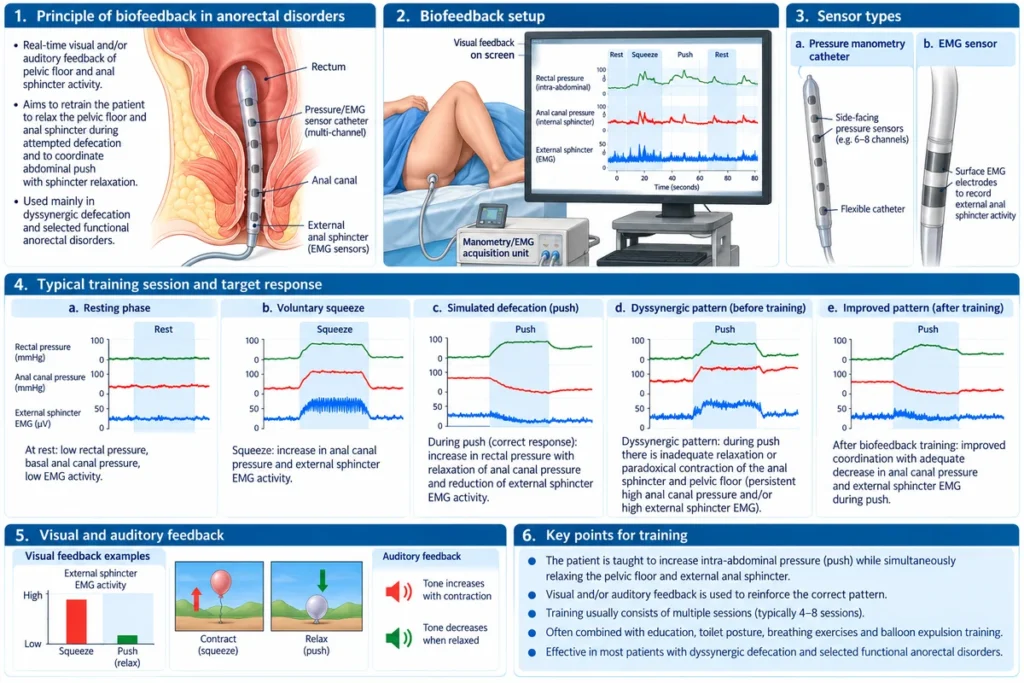
Biofeedback is the treatment I recommend most often after functional testing of the pelvic floor, and the one patients know least about. It is not a machine that fixes you — it is structured retraining that teaches muscles to do, on command, what they have been doing wrong for years. For dyssynergic defecation it is the primary evidence-based treatment; for fecal incontinence it is a core component. This is how it works and what makes it succeed.
If this sounds like your problem, see how an obstructed defecation assessment works, including anorectal manometry and the balloon expulsion test.
The problem biofeedback solves
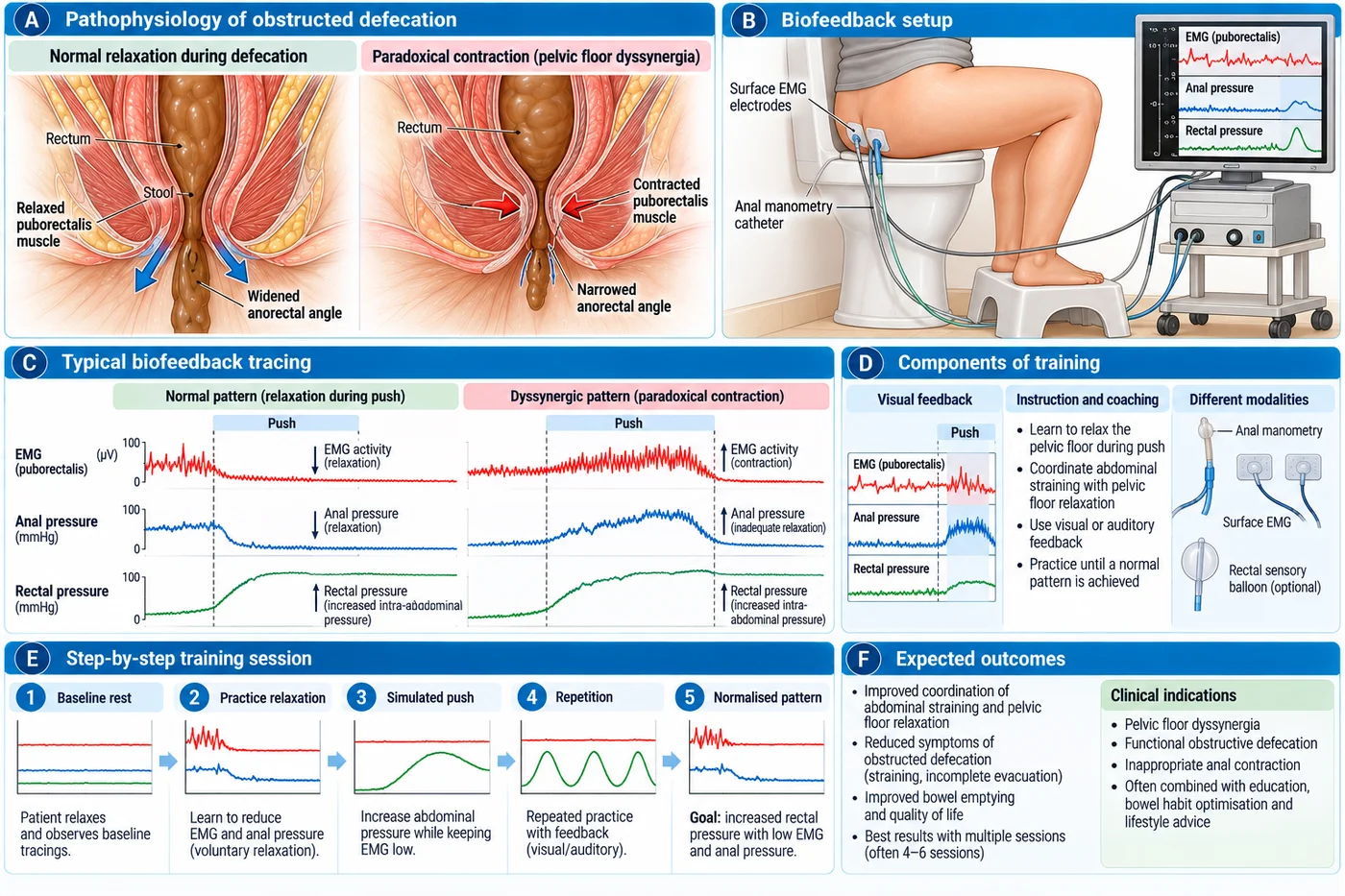
The pelvic floor is unusual among muscle groups: you cannot see it, most people cannot feel it accurately, and half of patients asked to squeeze it push instead. That blindness is why pelvic floor dyssynergia persists — the muscle contracts when it should relax, and no amount of willpower fixes a movement you cannot perceive. Biofeedback removes the blindness: a small sensor shows you, on a screen in real time, exactly what your muscles are doing while you practice.
What a program involves
Treatment starts from measurement — anorectal manometry defines the faulty pattern and gives the baseline. Sessions then follow, typically a handful spread over weeks with a trained therapist: for evacuation disorders, you learn to brace the abdomen while relaxing the anal sphincter and pelvic floor, often practicing expulsion with a small balloon; for incontinence, the training strengthens the squeeze, lengthens how long it holds, and sharpens the reflex response to rectal filling. Between sessions, short daily home practice does most of the real work.
Kegels: useful, and widely done wrong
Kegel exercises — repeated lifts of the pelvic floor as if stopping urine midstream — strengthen a weak floor and support continence. Two corrections from clinical practice: first, a large share of people perform them incorrectly (pushing down, clenching buttocks, or holding breath), which is why one supervised session teaching the correct contraction outperforms months of guessing; second, Kegels are for weakness — in dyssynergic constipation, where the muscle already over-contracts, unsupervised strengthening can make symptoms worse. Which exercise you need follows from testing, not from a leaflet.
What results to expect
In properly selected patients with dyssynergia, controlled trials show biofeedback outperforms laxatives, with most completers gaining lasting improvement — durable because the corrected pattern persists. For incontinence, it improves control in the majority when combined with stool optimization. The honest predictors of success are selection by testing and willingness to practice; the honest limitation is that it treats coordination and strength, not structural disease — a significant prolapse or obstructing rectocele needs its own plan.
Where the tests are done
I arrange these tests for patients seen at any of the seven places where I work:
- Medcare Royal Speciality Hospital, Dubai
- Clemenceau Medical Center, Dubai
- Aster Hospital Al Qusais, Dubai
- Medcare Medical Centre Discovery Gardens, Dubai
- Medcare Medical Centre JVC, Dubai
- Burjeel Day Surgery Center Reem Island, Abu Dhabi
- Burjeel Day Surgery Center Al Shahama, Abu Dhabi
The place for your test is agreed with my secretary when the appointment is arranged.
Frequently asked questions
Is biofeedback uncomfortable or embarrassing?
It uses a slim sensor, in a private clinical setting, with a therapist who does this daily. Most patients find it far easier than expected — and considerably easier than living with the symptoms.
How soon will I notice change?
Typically within the first few sessions, with consolidation over the following weeks of home practice. It varies with the pattern being corrected.
Is it available in the UAE?
Yes — pelvic floor physiotherapy and biofeedback are available in Dubai and Abu Dhabi, and I refer directly after functional assessment.
If chronic constipation or imperfect bowel control has resisted everything else, retraining the pelvic floor may be the step that was missing — but testing comes first. Request a consultation in Dubai or Abu Dhabi.
About the Author