
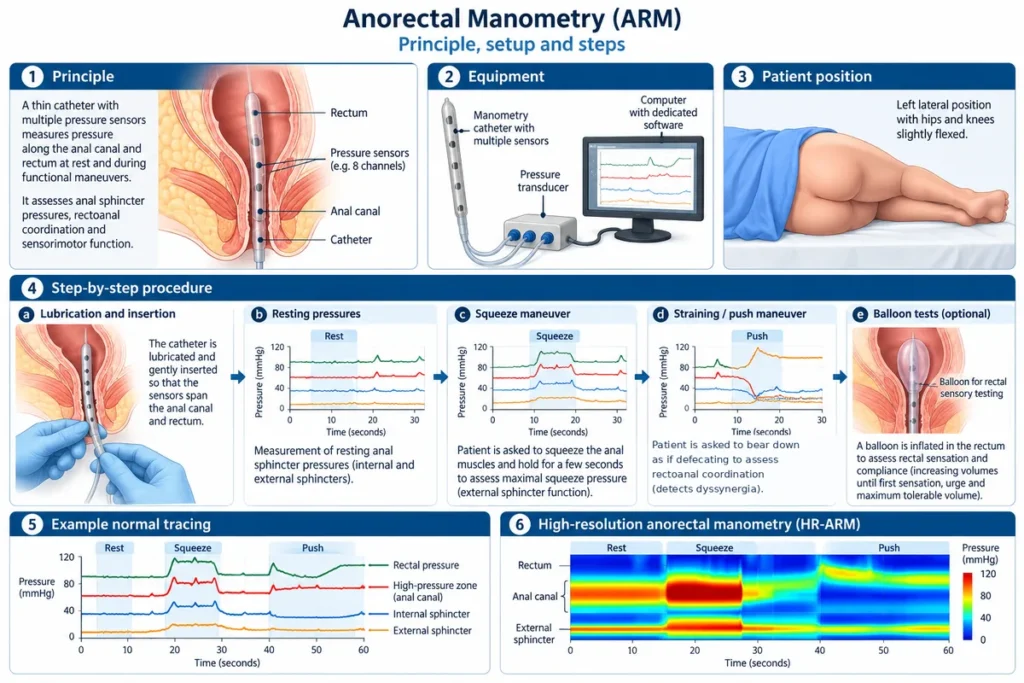
Anorectal manometry is the test I order when the question is no longer “is something growing in the colon?” but “why does the machinery not work?” It measures what no scope can see: the pressures, reflexes and sensations of the anal canal and rectum during rest, squeeze and push. For chronic constipation that has defeated treatment — and for incontinence, and before certain operations — it converts guesswork into a mechanism.
What the test measures
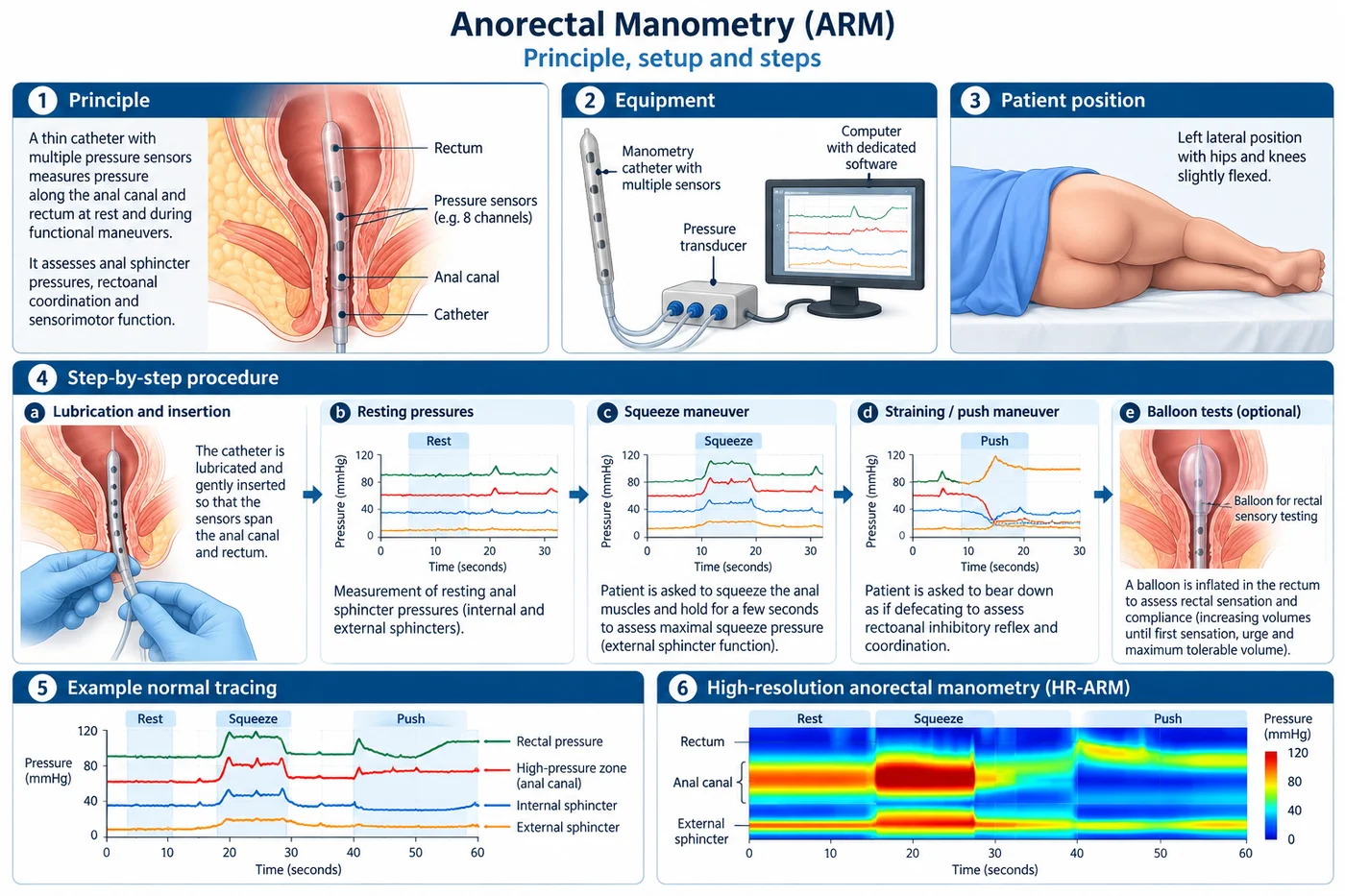
A thin, flexible catheter carrying pressure sensors is placed a few centimeters into the rectum, with a small balloon at its tip. Over about twenty to thirty minutes it records four things: resting pressure (the internal sphincter’s baseline tone), squeeze pressure (the external sphincter’s voluntary strength), the push maneuver (whether the pelvic floor relaxes or paradoxically contracts when you bear down — the signature of dyssynergic defecation), and rectal sensation, tested by gently inflating the balloon to map when you first feel it, when you feel urge, and what is tolerable.
A balloon expulsion test — passing a small water-filled balloon in privacy — often completes the picture as a simple, real-world check of evacuation.
What it feels like
The catheter is narrow — a few millimeters — and insertion is momentary pressure, not pain. There is no sedation, because your cooperation is the test: you squeeze, relax and push on instruction. Preparation is minimal; at most a small enema beforehand. You drive yourself home and return to work the same day.
Who actually needs it
Refractory chronic constipation. When fiber, fluids and sensible laxative use have failed and colonoscopy is normal, manometry separates the two mechanisms that look identical from the outside — a bowel that moves too slowly versus an outlet that will not open, as in obstructed defecation syndrome. The treatments are entirely different, which is why treating without the test so often fails.
Fecal incontinence. Manometry grades sphincter weakness and sensory loss, and separates a muscle problem from a sensation problem — different problems, different treatments.
Before biofeedback. The manometric pattern defines what the retraining must correct, and provides the baseline that progress is measured against.
Before selected surgery. Knowing sphincter function before operations that stress continence — complex fistula surgery, redo anorectal procedures, prolapse repair — is basic surgical prudence.
What the results change
Each pattern leads somewhere concrete. Paradoxical contraction on push → biofeedback retraining, with high response rates. Blunted rectal sensation → sensory retraining protocols. A weak sphincter → targeted strengthening, and caution before any operation that could weaken it further. Normal manometry with delayed markers on a transit study → treatment aimed at the colon itself. The test does not treat anything — it decides what deserves treating, which in chronic constipation is precisely the step that is usually skipped.
Where the tests are done
I arrange these tests for patients seen at any of the seven places where I work:
- Medcare Royal Speciality Hospital, Dubai
- Clemenceau Medical Center, Dubai
- Aster Hospital Al Qusais, Dubai
- Medcare Medical Centre Discovery Gardens, Dubai
- Medcare Medical Centre JVC, Dubai
- Burjeel Day Surgery Center Reem Island, Abu Dhabi
- Burjeel Day Surgery Center Al Shahama, Abu Dhabi
The place for your test is agreed with my secretary when the appointment is arranged.
Frequently asked questions
Is anorectal manometry embarrassing or painful?
It is a private, clinical, twenty-minute outpatient test with a millimeters-thin catheter. Most patients report it as far easier than they feared — and considerably easier than the years of symptoms that led to it.
Do I need it if my colonoscopy was normal?
A normal colonoscopy excludes structural disease; it says nothing about function. If evacuation remains abnormal, manometry is the logical next test, not a repeat scope.
Is it available in the UAE?
Yes — anorectal physiology testing is available in Dubai and Abu Dhabi, and I incorporate it routinely into the work-up of chronic constipation and incontinence.
If your constipation has outlasted every remedy, the missing step is usually measurement, not another laxative. Request a consultation in Dubai or Abu Dhabi and we will decide whether manometry is the right next test.
About the Author