
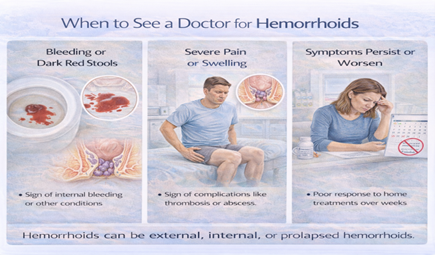
Knowing when to see a doctor for hemorrhoid treatment in Dubai is important to avoid complications and delays in treatment. Early specialist assessment often leads to simpler and more effective management. something I can manage at home? Or do I need to see a doctor? What if it’s not just hemorrhoids? How do I know when it’s serious?
I’m Professor Dr. Antonio Privitera, Fellow of the American Society of Colon and Rectal Surgery and Fellow of the Royal College of Surgeons. I’m the only surgeon in the world with both a Mayo Clinic and Dubai.
The short answer: Any rectal bleeding or persistent anal symptoms warrant at least one medical evaluation to establish proper diagnosis.
But urgency varies based on symptoms.
This guide helps you decide:
- When you can try home treatment first
- When you should schedule a consultation
- When you need same-day evaluation
- What happens during a hemorrhoid consultation
- Why self-diagnosis can be dangerous
To schedule evaluation:
The Golden Rule: Don’t Self-Diagnose Serious Symptoms
Why This Matters:
Many conditions cause similar symptoms:
- Hemorrhoids
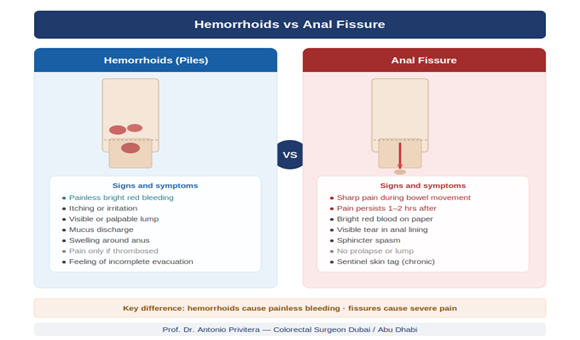
- Anal fissure
- Anal fistula or abscess
- Inflammatory bowel disease
- Polyps
- Colorectal cancer
You cannot reliably distinguish these based on symptoms alone.
Assuming “it’s just hemorrhoids” without examination:
- Delays diagnosis of potentially serious conditions
- Allows treatable conditions to worsen
- Can be life-threatening if cancer is missed
The rule: Any rectal bleeding requires at least one medical evaluation for proper diagnosis.
When Home Treatment Is Reasonable First Step
Situations Where You Can Start at Home:
Scenario 1: Very Mild Symptoms, First Occurrence
- Symptoms:
- Tiny amount of bright red blood (few drops on tissue)
- Minimal or no pain
- Small soft lump you can feel
- Just started (past day or two)
- Action:
- High-fiber diet
- Adequate hydration
- Sitz baths
- OTC hemorrhoid cream
- Timeline: Try 3-7 days
- Reassess: If not improving or worsening → see doctor
Scenario 2: Known Hemorrhoids, Mild Flare-Up
- Symptoms:
- You’ve been previously diagnosed by doctor
- Symptoms similar to past episodes
- Mild discomfort only
- Action:
- Resume treatments that worked before
- Conservative management
- Caveat: If symptoms different from usual, see doctor
Even in These Cases:
See a doctor eventually to confirm diagnosis and get proper treatment plan. Home treatment is temporary management, not definitive care.
When to Schedule a Consultation (Non-Urgent)
Book Appointment Within Days to 1-2 Weeks:
1. Any Rectal Bleeding – First Time
- Even if minor
- Need proper examination to rule out other causes
- Especially important if age 40+ (colon cancer screening age)
2. Bleeding Persists Beyond 1-2 Weeks
- You tried home treatment
- Symptoms continue
- Need diagnosis and proper treatment
3. Visible Prolapse (Tissue Coming Out)
- Internal hemorrhoid protruding through anus
- Need examination to determine grade
- Need treatment recommendation
4. Chronic Symptoms Affecting Quality of Life
- Ongoing discomfort for weeks/months
- Interfering with work, activities, sitting
- You’ve been putting it off—time to address it
5. Recurrent Episodes
- Hemorrhoids that keep coming back
- Pattern of flare-ups every few months
- Need definitive treatment, not just symptom management
6. Pain That’s Manageable But Persistent
- Not severe emergency
- But ongoing discomfort for more than a few days
- Interfering with daily activities
7. Concerns About Diagnosis
- Symptoms don’t quite fit what you’ve read about hemorrhoids
- You’re worried it might be something else
- Peace of mind requires examination
When to Seek Same-Day or Urgent Evaluation
Contact Surgeon Immediately / Same Day:
1. Severe Uncontrolled Pain
- Symptoms:
- Pain 8-10 out of 10
- Not relieved by over-the-counter medication
- Can’t sit, can’t walk comfortably
- Sudden onset
- Possible cause: Thrombosed hemorrhoid, strangulated hemorrhoid
- Why urgent: Treatment within 48-72 hours provides relief; after that window, must wait weeks for natural resolution
2. Heavy or Persistent Bleeding
- Symptoms:
- Soaking through multiple pads
- Blood dripping continuously
- Large amount of blood in toilet bowl repeatedly
- Feeling weak, dizzy, lightheaded
- Possible cause: Severe hemorrhoid bleeding
- Why urgent: Risk of anemia, need to identify and stop bleeding source
3. Fever with Anal Pain
- Symptoms:
- Temperature >38°C (100.4°F)
- Anal or rectal pain
- Possible swelling, redness
- Possible cause: Perianal abscess, infection
- Why urgent: Abscess needs drainage, infection needs antibiotics
4. Sudden Hard, Purple Lump (Thrombosed Hemorrhoid)
- Symptoms:
- Sudden severe pain
- Hard, tender lump near anus
- Purple or blue color
- Appeared within past 24-48 hours
- Why urgent: Excision within 48-72 hours provides immediate relief
5. Inability to Urinate
- Symptoms:
- Can’t pass urine
- Associated with severe hemorrhoid pain/swelling
- Possible cause: Urinary retention from pain/swelling
- Why urgent: May need catheter
6. Prolapsed Hemorrhoid That Won’t Reduce
- Symptoms:
- Tissue stuck outside anus
- Can’t push it back in
- Swollen, painful, possibly purple
- Possible cause: Strangulated hemorrhoid (blood supply cut off)
- Why urgent: Risk of tissue damage, needs evaluation
Age-Specific Considerations
Age 40 and Above:
ANY rectal bleeding requires evaluation.
Why this matters:
- Colorectal cancer risk increases significantly after 40
- Early-stage colon cancer causes same symptom as hemorrhoids: bleeding
- You cannot distinguish cancer from hemorrhoids without examination
- Colon cancer is highly treatable when caught early
The approach:
- Assume hemorrhoids AFTER proper examination rules out cancer
- Not the other way around
What you’ll need:
- Examination (visual, digital rectal exam, anoscopy)
- Often colonoscopy if you haven’t had one or it’s been 5+ years
Under Age 40:
Still need evaluation but slightly less urgent if:
- No family history of colon cancer
- No concerning symptoms (weight loss, change in bowel habits, blood mixed with stool)
But don’t delay indefinitely – hemorrhoids deserve treatmen regardless of age.
Family History of Colorectal Cancer:
If first-degree relative had colon cancer:
- You need colonoscopy 10 years earlier than their diagnosis age
- Example: Father diagnosed at 50 → You need colonoscopy at 40
- Any rectal bleeding should prompt colonoscopy if not done
If symptoms persist or are not improving, a specialist assessment in Dubai can help determine the most appropriate treatment.
What Happens During a Hemorrhoid Consultation
Understanding the Process Reduces Anxiety:
Step 1: History (Medical Discussion)
- Symptoms (bleeding, pain, prolapse, duration)
- Bowel habits (constipation, diarrhea, straining)
- Previous treatments tried
- Medical history, medications
- Family history
Step 2: Examination
Visual Inspection:
- Look at anal area
- Identify external hemorrhoids, skin tags, fissures
- Check for prolapse
Digital Rectal Exam:
- Gloved, lubricated finger inserted into rectum
- Feels for masses, hemorrhoids, sphincter tone
- Brief (30 seconds), uncomfortable but not painful
Anoscopy (Essential):
- Small, lighted tube inserted into anus
- Directly visualizes internal hemorrhoids
- Determines hemorrhoid grade
- Only way to see internal hemorrhoids
- Takes 1-2 minutes, pressure but not pain
Step 3: Diagnosis and Discussion
- Explain findings (grade, type)
- Discuss treatment options
- Explain pros/cons of each
- Answer questions
- Make treatment plan
Step 4: Treatment or Follow-Up Plan
- Some treatments can be done same visit (banding)
- Others require scheduling (laser, THD, surgery)
- Conservative management recommendations
Total visit time: 20-30 minutes typically
Why People Delay Seeing a Doctor
Common Reasons (and Why They’re Problematic):
1. “I’m embarrassed”
- Reality: Hemorrhoids are extremely common (50% of adults)
- Colorectal surgeons see this every day, all day
- We’re not judging—we’re here to help
- Your comfort and health matter more than momentary embarrassment
2. “I’m too busy”
- Reality: Delaying often makes problem worse
- Worse hemorrhoids = more invasive treatment needed
- Early treatment is simpler and quicker
- Delaying “to save time” often costs more time later
3. “I’m afraid it will hurt”
- Reality: Examination is uncomfortable but brief
- Much less painful than you imagine
- We use lubrication, go gently
- Temporary discomfort vs ongoing suffering—worth it
4. “I’m worried about the cost”
- Reality: Consultation is usually covered by insurance
- Early treatment is less expensive than advanced treatment
- Don’t let cost fears prevent diagnosis—ask about costs upfront
5. “Maybe it will go away on its own”
- Reality: Some hemorrhoids improve, many don’t
- You won’t know which without evaluation
- Bleeding might not be hemorrhoids at all
- “Wait and see” can be dangerous if it’s not hemorrhoids
6. “I tried cream and it didn’t help, so nothing will help”
- Reality: Over-the-counter cream only treats symptoms
- Doesn’t address underlying problem
- Many effective treatments exist (banding, laser, THD, surgery)
- Don’t give up after one failed attempt at home treatment
Red Flags: Never Ignore These Symptoms
Seek Medical Attention for:
Associated Symptoms:
- Unintended weight loss
- Change in bowel habits (new constipation or diarrhea)
- Abdominal pain
- Blood mixed WITH stool (not just on surface)
- Dark or black stools (melena—sign of upper GI bleeding)
- Narrow “pencil” stools
These suggest something beyond hemorrhoids.
Concerning Bleeding Patterns:
- Bleeding without bowel movement (spontaneous)
- Large clots
- Blood that’s dark red or maroon (not bright red)
These warrant urgent evaluation.
The Danger of Self-Diagnosis: Real Examples
Case Study 1: “Just Hemorrhoids”
Patient: 55-year-old male, rectal bleeding 6 months
Self-diagnosis: Hemorrhoids (bought cream, didn’t help)
Delayed: 6 months before seeing doctor Actual diagnosis: Stage
II colon cancer Outcome: Treatable, but 6 months of growth before diagnosis
Lesson: Any persistent bleeding at age 40+ needs colonoscopy.
Case Study 2: “I’ll Wait Until It’s Serious”
Patient: 38-year-old female, Grade II hemorrhoids Approach:
Lived with symptoms for 2 years Progression: Became Grade IV
(permanently prolapsed) Treatment needed: Hemorrhoidectomy (surgery, 4-week recovery) What could have been: Early banding (office procedure, 2-day recovery)
Lesson: Early treatment is simpler. Waiting makes it worse.
Case Study 3: “It’s Just a Painful Lump”
Patient: 42-year-old male, sudden severe anal pain and lump
Self-management: Ice, painkillers for 5 days Delayed: Came in day 6 Diagnosis: Thrombosed hemorrhoid (past excision window)
Treatment: Had to wait 3 weeks for pain to resolve naturally What could have been: Excision on day 1-2 would have provided immediate relief
Lesson: Thrombosed hemorrhoids need urgent care (48-72 hour window).
How to Prepare for Your Consultation
Before Your Appointment:
1. Track Symptoms:
- Duration (how long has this been happening?)
- Frequency (constant, or comes and goes?)
- Triggers (during bowel movements, after sitting, etc.?)
- What makes it better or worse?
2. List Treatments Tried:
- Over-the-counter creams
- Diet changes
- Anything else
3. Prepare Questions:
- Write them down so you don’t forget
- No question is too basic or embarrassing
4. Bring:
- Insurance card
- List of medications
- Medical records if you have them (previous colonoscopy reports, etc.)
Day of Appointment:
Bowel Preparation:
- NOT required for hemorrhoid consultation
- Unlike colonoscopy, no special prep needed
- Just come as you are
What to Wear:
- Comfortable clothing
- You’ll be in exam gown for examination
Expect:
- Some waiting room time
- 20-30 minute consultation
- Examination will happen (this is essential)
- Clear diagnosis and plan
This article is written and reviewed by Prof. Dr Antonio Privitera, consultant colorectal surgeon with fellowship training at Mayo Clinic (USA) and the Royal College of Surgeons (UK), specializing in hemorrhoid diagnosis and minimally invasive treatment.
Frequently Asked Questions
1. Can I just show my GP instead of a specialist?
GPs can diagnose obvious external hemorrhoids but cannot perform anoscopy to see internal hemorrhoids. For proper diagnosis and treatment, colorectal surgeon is better.
2. Do I need a referral?
Depends on your insurance. Many UAE plans require GP referral to see specialist. Check your policy.
3. Will examination be painful?
Uncomfortable but not painful. Brief pressure sensation. Anoscopy takes 1-2 minutes.
4. Can I drive myself home after consultation?
Yes. Consultation involves no sedation or procedures requiring someone to drive you.
5. Will I need colonoscopy?
Depends on your age, symptoms, and when you last had one. Age 40+ with bleeding should have colonoscopy.
6. How long until I can get treatment?
Some treatments (banding) can be done same visit. Others (laser, THD, surgery) require scheduling.
7. What if I faint during examination?
Very rare. We position you carefully and go slowly. Tell us if you feel lightheaded.
8. Can I bring someone with me?
Yes, support person can wait in waiting room or be present for discussion (but not examination).
9. How do I explain to work why I need time off for appointment?
“Medical consultation” is sufficient. You’re not required to specify hemorrhoids if you prefer privacy.
10. What if I’m menstruating?
Not a problem. Examination is of anal area, not vaginal area. Proceed with appointment.
The Bottom Line: When in Doubt, Get Checked
Better to see a doctor and be told “it’s minor” than to delay and:
- Miss cancer diagnosis
- Turn Grade II into Grade IV
- Miss the 48-72 hour treatment window for thrombosed hemorrhoid
- Suffer unnecessarily for months/years
Your health is worth one hour and a brief moment of discomfort for examination.
References and Medical Sources
1. Colorectal Cancer Screening Guidelines – Age-based recommendations. US Preventive Services Task Force. Screening for Colorectal Cancer: US Preventive Services Task Force Recommendation Statement. JAMA. 2021;325(19):1965-1977. PubMed
2. Hemorrhoid Evaluation Standards – Clinical practice guidelines. Davis BR, Lee-Kong SA, Migaly J, Feingold DL, Steele SR. The American Society of Colon and Rectal Surgeons Clinical Practice Guidelines for the Management of Hemorrhoids. Dis Colon Rectum. 2018;61(3):284-292. PubMed
Medical Review: This content was written and reviewed by Professor Dr. Antonio Privitera, Fellow of the American Society of Colon and Rectal Surgery and Fellow of the Royal College of Surgeons, the only Colorectal Surgery Fellowship.
Need expert treatment for hemorrhoids, anal fissure, or anal fistula? Book a consultation with Dr. Antonio Privitera in Abu Dhabi.
Book Your Appointment
WhatsApp / Phone: +971 55 318 8469
About the Author