
Understanding how hemorrhoids develop and how they are treated is covered fully in our hemorrhoid treatment in Abu Dhabi.
You probably never thought your bathroom habits could cause a medical problem. But the way you use the toilet — how you sit, how long you stay, how you wipe — has a direct impact on whether you develop hemorrhoids.
I’m Professor Dr. Antonio Privitera, a consultant colorectal surgeon with fellowship training at the Mayo Clinic and Royal College of Surgeons (UK), practicing across Abu Dhabi. In my consultations, I regularly ask patients about their bathroom habits, and I’m often met with surprise: “Does that really matter?”
Yes. It matters enormously.
Some of the most common causes of hemorrhoids are entirely preventable by changing bathroom habits:
- Sitting on the toilet too long (especially while scrolling your phone)
- Straining during bowel movements
- Delaying when you feel the urge to go
- Poor wiping technique
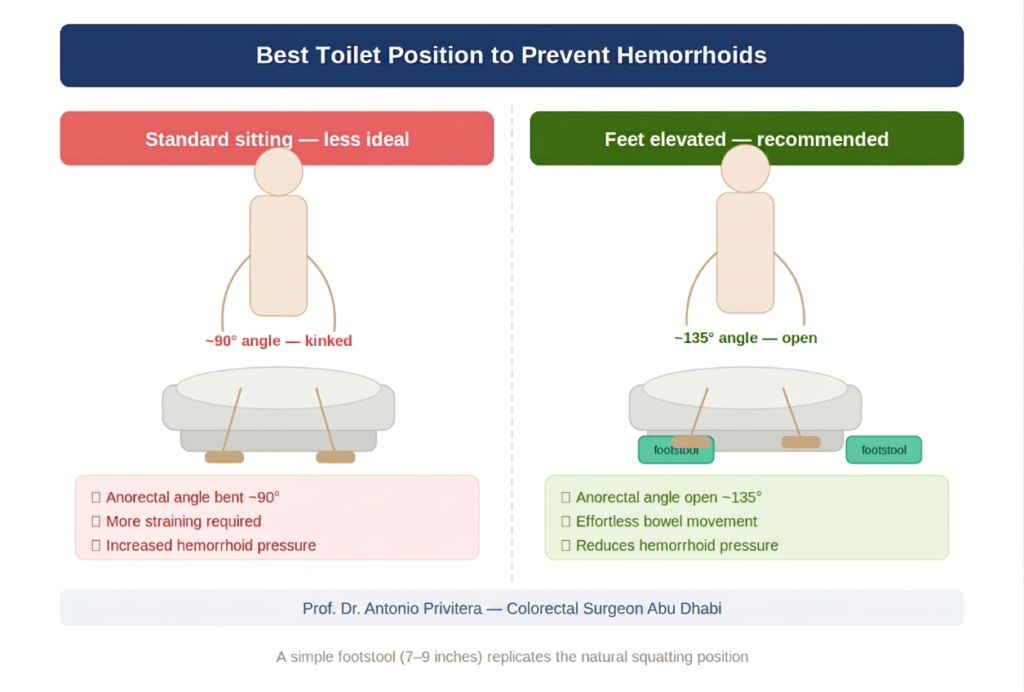
- Wrong sitting position
This article covers everything you need to know about proper bathroom habits to prevent hemorrhoids, or manage them if you already have symptoms.
For assessment of existing hemorrhoid symptoms:
Frequently Asked Questions
1. Is squatting better than sitting on a Western toilet?
Squatting opens the anorectal angle more effectively, making bowel movements easier with less straining. If you have access to squat toilet, it’s beneficial. On Western toilet, use footstool to mimic squatting position.
2. How long is too long to sit on the toilet?
More than 5 minutes is too long. If you haven’t had a bowel movement in 5 minutes, get up and try again later.
3. Is it okay to read on the toilet?
If it means you sit for 10-15 minutes, no. Reading (or phone use) encourages prolonged sitting, which is harmful for hemorrhoidal veins.
4. Should I wipe standing up or sitting down?
Either is fine. What matters is gentle technique, not position. Some people find one position more comfortable or thorough.
5. Are wet wipes better than toilet paper?
Generally yes — more gentle and get cleaner with less wiping. Choose unscented, alcohol-free varieties. Don’t flush them even if labeled “flushable.”
6. What if I can’t have a bowel movement without straining?
This indicates constipation that needs to be addressed. Increase fiber, increase water, consider fiber supplement. If chronic, see doctor — may need stool softener or investigation of underlying cause.
7. Is it normal to have a bowel movement multiple times per day?
Can be normal depending on diet and individual variation. As long as stools are formed (not diarrhea), no straining, and no symptoms, this can be normal. If concerned, discuss with doctor.
8. Should I go at the same time every day?
Ideally, yes. Routine helps regulate bowel function. But don’t force it — if you don’t feel the urge at your “usual” time, don’t strain to produce a bowel movement.
9. Is it bad to hold in a bowel movement occasionally?
Occasionally (once in a while) won’t cause long-term harm. Habitual delaying causes problems. Go as soon as reasonably possible.
10. What’s the best position to sleep for hemorrhoids?
Side-lying with pillow between knees reduces pressure on hemorrhoidal veins. If hemorrhoids are prolapsed/painful, experiment with positions — many find side-lying or stomach-lying more comfortable than back-lying.
References and Medical Sources
Bathroom habit recommendations based on evidence:
1. Anorectal Angle and Defecation Posture – Biomechanics of bowel movements. Sikirov D. Comparison of straining during defecation in three positions: results and implications for human health. Dig Dis Sci. 2003;48(7):1201-5. PubMed
2. Toilet Posture and Hemorrhoid Development – Clinical observations. Sakakibara R, Tsunoyama K, Hosoi H, et al. Influence of body position on defecation in humans. Low Urin Tract Symptoms. 2010;2(1):16-21. PubMed
3. American Society of Colon and Rectal Surgeons Guidelines – Prevention recommendations. Davis BR, Lee-Kong SA, Migaly J, Feingold DL, Steele SR. The American Society of Colon and Rectal Surgeons Clinical Practice Guidelines for the Management of Hemorrhoids. Dis Colon Rectum. 2018;61(3):284-292. PubMed
Medical Review: Written and reviewed by Prof. Dr. Antonio Privitera, consultant colorectal surgeon, fellowship training at the Mayo Clinic and Royal College of Surgeons (UK), and European Board Certification in Colorectal Surgery.
Need expert treatment for hemorrhoids, anal fissure, or anal fistula? Book a consultation with Dr. Antonio Privitera in Abu Dhabi.
Book Your Appointment
WhatsApp / Phone: +971 55 318 8469
About the Author