
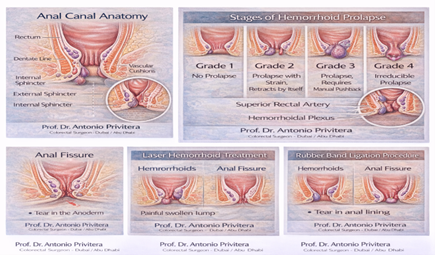
I offer laser hemorrhoid treatment in Dubai and Abu Dhabi. It is mainly suited to Grade II–III internal hemorrhoids; when prolapse also needs correcting, a mucopexy can be added. The procedure is carried out in hospital after an examination at one of my clinics.
Booking: call +971 55 318 8469 or message on WhatsApp. The secretary will book you into the clinic that suits your insurance and how soon you need to be seen.
I have performed laser proctology in the UAE since 2021 and chaired the first Gulf meeting on laser in proctology.
Laser is one of several options I offer. For some grades, banding or THD is the better choice, and I will tell you which applies after examining you.
I see patients in Dubai at Medcare Royal Speciality Hospital, Clemenceau Medical Center, Aster Hospital Al Qusais, Medcare Discovery Gardens and Medcare JVC, and in Abu Dhabi at Burjeel Day Surgery Center Reem Island and Burjeel Day Surgery Center Al Shahama.
Common Marketing Claims vs Clinical Reality
Laser hemorrhoid treatment in Dubai and Abu Dhabi is a minimally invasive option for selected patients and can offer less pain and faster recovery than traditional surgery. The key is choosing the right procedure for the right hemorrhoid grade.
These are the claims most often made in hemorrhoid advertising, and what they mean in practice:
Claim #1: “100% Painless Treatment“
Reality: Laser is LESS painful than traditional hemorrhoidectomy (surgical excision), but it’s not painless. You will experience:
- Discomfort in the days after the procedure
- Pain with bowel movements (especially first few days)
- Need for oral pain medication
- Requirement for stool softeners
The term “painless” is technically referring to the procedure itself (you’re under sedation or spinal anesthesia, so you feel nothing during it). But that’s true for ANY surgery—you don’t feel pain during operation. The question is recovery pain, and there IS recovery pain with laser.
Claim #2: “No Downtime—Back to Work Same Day”
Reality: Time away from work is not the same for every patient. It depends on:
- Physical nature of your job (desk work vs manual labor)
- Your pain tolerance
- Number of hemorrhoids treated
Yes, you walk out the same day (it’s day-surgery), but “walking out” doesn’t mean “back to normal activities.” You’ll be on pain medication, using stool softeners, and taking sitz baths multiple times daily. What “no downtime” actually means: No hospital stay. But that’s also true for banding, which genuinely involves less downtime.
When is laser hemorrhoidoplasty appropriate?
Laser hemorrhoidoplasty can be considered across different grades of hemorrhoidal disease when the hemorrhoidal tissue itself requires procedural treatment.
The important limitation is not simply the grade number. It is whether additional components of the disease also need treatment.
In particular, from Grade II onward, prolapse may become clinically important. Laser treats the hemorrhoidal tissue; it does not mean that an associated prolapse should be ignored. When prolapse requires correction, mucopexy can be added.
Where there is advanced prolapse, a substantial external component or combined internal and external disease, the treatment plan may require additional or alternative surgical techniques.
This is why treatment should follow examination rather than being selected solely from a website description of the hemorrhoid grade.
Claim #4: “Latest European/American Technology”
Reality: Laser for hemorrhoids has been used since the 1990s. It’s not cutting-edge—it’s an established option among several. What’s “latest” is the marketing strategy, not the technology itself.
Moreover, “European technology” is a marketing phrase. Germany, France, Italy, and UK all have different approaches to hemorrhoid treatment, and laser isn’t universally preferred in any of them. Traditional methods (banding for Grade I-II, hemorrhoidectomy for Grade IV) remain standard in most European colorectal surgery units.
Claim #5: “No Anesthesia Required”
Laser hemorrhoidoplasty is generally performed in an appropriate procedural or day-surgery setting. The anesthetic approach is selected according to the technique, extent of treatment and individual patient.
Laser hemorrhoidoplasty and THD/HAL are procedural treatments generally performed in an appropriate procedural or day-surgery setting, with the anesthetic approach selected according to the procedure and individual case.
Claim #6: “Permanent Cure—Hemorrhoids Never Come Back”
Reality: No hemorrhoid treatment (including surgery) is 100% guaranteed permanent. Recurrence depends on:
- Hemorrhoid grade treated
- Whether underlying causes are addressed (constipation, straining, diet)
- Technique quality
- Individual anatomy
Reported recurrence varies between studies and is not directly comparable between them, because the groups treated differ in grade, prolapse and external component. What the published results mean for you is discussed at assessment. See also hemorrhoidectomy. Claiming “permanent cure” is dishonest regardless of the procedure.
Experiencing symptoms like these? A discreet same-day specialist assessment is available in Dubai and Abu Dhabi.
WhatsApp: +971 55 318 8469 | Phone: +971 55 318 8469
Medcare Medical Centre Discovery Gardens (Dubai)
How Laser Hemorrhoid Treatment Actually Works (piles)
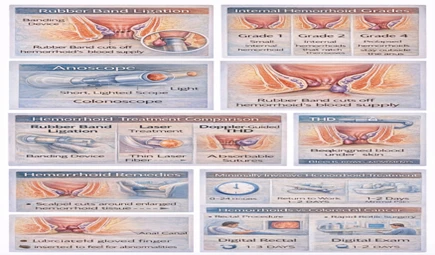
Let me explain what actually happens during laser hemorrhoid treatment (beyond marketing buzzwords):
The Procedure: Step by Step
Pre-procedure:
- You arrive at the surgical facility/hospital
- Change into a gown
- IV line is placed
- Anesthesiologist administers sedation or spinal anesthesia
During procedure (20-30 minutes):
1. You’re positioned (usually on your back or left side)
2. A specialized proctoscope (lighted viewing tube) is inserted into the rectum
3. I identify each internal hemorrhoid
4. A thin laser fiber (connected to a diode laser machine) is inserted directly into the hemorrhoid tissue through a small puncture
5. Laser energy is delivered for several seconds per hemorrhoid (this shrinks the hemorrhoid by:
- Coagulating blood vessels (cutting off blood supply)
- Causing controlled thermal damage that leads to fibrosis/scarring
- Reducing hemorrhoid volume over following weeks)
6. The laser fiber is withdrawn
7. Process is repeated for each hemorrhoid (usually 2-4 hemorrhoids treated)
No tissue is cut away. The laser shrinks the hemorrhoid from inside. Over the next 4-6 weeks, the treated hemorrhoid tissue scarifies and reduces in size.
Different Laser Techniques:
Several brand names exist:
- FiLaC (Fistula Laser Closure—adapted for hemorrhoids)
- HeLP (Hemorrhoidal Laser Procedure)
- LHP (Laser Hemorrhoidoplasty)
They’re all variations of the same concept: delivering laser energy into hemorrhoid tissue to shrink it. The specific brand is less important than the surgeon’s skill and patient selection. What Makes It “Minimally Invasive”:
Compared to traditional hemorrhoidectomy (where hemorrhoid tissue is surgically cut away and the wound heals over weeks), laser leaves no open wounds. The small punctures where the laser fiber entered heal within days. This is why recovery is faster than hemorrhoidectomy.
However, “minimally invasive” doesn’t mean “no recovery”—it means LESS invasive than surgery.
Who Actually Benefits from Laser Treatment?
Laser hemorrhoid treatment is a legitimate option for the right patient.
Here’s who genuinely benefits:
✅ IDEAL CANDIDATES:
1. Grade II-III Internal Hemorrhoids
- You’ve tried conservative treatment (fiber, hydration) without lasting success
- You’ve tried banding but symptoms returned or you want single-session treatment
- You have primarily internal hemorrhoids without large external component
2. Patients Who Prefer OR-Based Treatment Over Banding
- You want to avoid multiple banding sessions (banding often requires 2-3 sessions spaced weeks apart)
- You prefer one definitive procedure under anesthesia
3. Patients Who Understand Realistic Expectations
- You understand that recovery is discussed for the procedure you are actually having, rather than taken from a general timetable
- You’re not expecting “zero pain, zero downtime”
- You understand recurrence is possible
4. Patients Who Have Confirmed How Their Insurance Treats the Procedure
- You have asked your insurer how your policy treats the procedure being proposed
- You are comfortable proceeding on the answer you were given
Which treatment is considered for each hemorrhoid grade?
Grade I hemorrhoids
Grade I hemorrhoids remain inside the anal canal and do not prolapse.
Treatment usually begins with measures to improve bowel habits, including adequate fiber and fluid intake, avoidance of excessive straining and treatment of constipation where present.
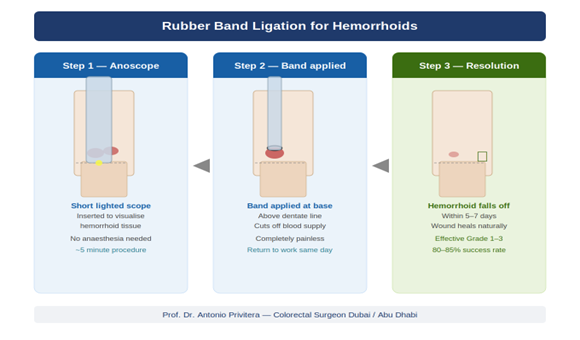
When symptoms persist and an intervention is appropriate, office-based treatment such as rubber-band ligation or sclerotherapy can be considered.
Laser hemorrhoidoplasty can also treat hemorrhoidal tissue, but the decision to use a procedural treatment for Grade I disease should be based on the patient’s symptoms, anatomy, previous treatment and preferences rather than on the grade alone.
Grade II hemorrhoids
Grade II hemorrhoids prolapse during defecation or straining and then reduce spontaneously.
This is important because treatment now has to consider two components: the hemorrhoidal tissue itself and the associated prolapse.
Office-based treatments such as rubber-band ligation or sclerotherapy can treat the internal hemorrhoidal component and may be appropriate in selected patients. More than one treatment session may sometimes be required.
Laser hemorrhoidoplasty can be used to treat the hemorrhoidal tissue. Where the prolapse is clinically significant, mucopexy may be added to address the prolapse rather than treating the hemorrhoidal tissue alone.
THD/HAL is another minimally invasive procedural approach and may also be combined with mucopexy where prolapse needs to be corrected.
The treatment therefore depends on both the hemorrhoids and the degree of prolapse, rather than simply the label “Grade II.”
Grade III hemorrhoids
Grade III hemorrhoids prolapse and require manual reduction.
At this stage, prolapse is an important part of the disease and treatment should address it.
Repeated banding can sometimes reduce hemorrhoidal symptoms, but where the objective is a more definitive procedural treatment rather than multiple office sessions, laser hemorrhoidoplasty with appropriate treatment of the prolapse or THD/HAL with mucopexy are important minimally invasive options.
Laser hemorrhoidoplasty acts directly within the hemorrhoidal tissue to produce shrinkage. When prolapse is present, mucopexy is added to correct that component.
THD/HAL approaches the disease differently by targeting hemorrhoidal arterial inflow and, when combined with mucopexy, treating the prolapse.
Excisional surgery may be appropriate when there is a substantial external component, combined internal and external disease, advanced prolapse or anatomy that is not adequately addressed by a less invasive procedure.
Treatment is selected according to the individual anatomy rather than by declaring one technique universally superior.
Grade IV hemorrhoids
Grade IV hemorrhoids remain prolapsed and cannot be reduced.
These patients require careful assessment of the prolapse, hemorrhoidal tissue and external component.
Laser can treat the hemorrhoidal tissue, but treatment of Grade IV disease cannot ignore the prolapse. When a laser-based approach is selected, the prolapse component must also be appropriately addressed, for example with mucopexy.
Excisional hemorrhoidectomy remains an important option for advanced prolapse, a substantial external component or combined internal and external disease.
The operation is selected after examination rather than from the grade number alone.
How does recovery differ between treatments?
Recovery varies with the procedure performed and the individual patient.
Office-based treatments such as rubber-band ligation and sclerotherapy generally involve less procedural intervention than day-surgery operations.
After an office-based treatment, many patients return to ordinary activity within a relatively short time.
Recovery after laser hemorrhoidoplasty, THD/HAL, mucopexy or excisional hemorrhoid surgery depends on the extent of treatment, the individual anatomy and whether procedures are combined.
Excisional hemorrhoidectomy creates surgical wounds and generally has a different recovery pattern from non-excisional procedures.
For all treatments, maintaining soft stools, avoiding constipation and excessive straining and following the individual postoperative instructions are important.
Success Rates and Recurrence: The Evidence
Let’s look at what clinical studies actually show:
Success Rates:
Published outcomes after laser hemorrhoidoplasty vary according to hemorrhoid grade, degree of prolapse, technique and duration of follow-up. No single success percentage should be presented as applying across all patients or grades.
Recurrence
Reported recurrence varies between studies and is not directly comparable between them: the groups treated differ in grade, in the degree of prolapse and in whether an external component was present. What the published results mean for you depends on your own findings, and that is discussed at assessment.
The key factor is lifestyle: patients who maintain high-fiber diet, hydration, and avoid straining have lower recurrence regardless of treatment method.
If symptoms persist or are not improving, a specialist assessment in Dubai or Abu Dhabi can help determine the most appropriate treatment.
How are hemorrhoid treatments compared?
Choosing a treatment for hemorrhoids should not be based on price or on the name of a particular technology alone. The important factors are the hemorrhoid grade, the amount of prolapse, the size of the hemorrhoidal tissue, whether there is a significant external component, the predominant symptoms, previous treatment and the findings on examination.
Different procedures address different components of hemorrhoidal disease. Office-based treatments can treat internal hemorrhoidal tissue, but they do not surgically correct an associated prolapse. Laser hemorrhoidoplasty treats the hemorrhoidal tissue directly. Mucopexy addresses the prolapse component. THD/HAL reduces hemorrhoidal arterial inflow and can be combined with mucopexy when prolapse is present. Excisional hemorrhoidectomy removes hemorrhoidal tissue and remains an important option for advanced or combined internal and external disease.
For this reason, no single procedure should be presented as the best treatment for every patient.
Banding, sclerotherapy, laser, THD/HAL and hemorrhoidectomy compared
| Treatment | What it principally addresses | Setting / anesthesia | Prolapse | Important consideration |
|---|---|---|---|---|
| Rubber-band ligation | Internal hemorrhoidal tissue | Office-based; usually no general anesthesia | Does not surgically correct prolapse | May require more than one session |
| Sclerotherapy | Internal hemorrhoidal tissue | Office-based | Does not surgically correct prolapse | Useful in selected patients |
| Laser hemorrhoidoplasty | Hemorrhoidal tissue directly | Procedural/day-surgery setting according to the case | Add mucopexy when clinically significant prolapse requires correction | Can be used across hemorrhoid grades according to anatomy |
| THD/HAL | Hemorrhoidal arterial inflow | Procedural/day-surgery setting | Mucopexy can be added for prolapse | Treats the disease by a different mechanism from laser |
| Excisional hemorrhoidectomy | Removes hemorrhoidal tissue, including disease with an external component | Surgical procedure | Can address advanced prolapsing/combined disease | Important option for advanced or combined internal/external disease |
Laser hemorrhoidoplasty and THD/HAL: what is the difference?
Laser hemorrhoidoplasty and THD/HAL are both minimally invasive procedural approaches, but they work differently.
Laser hemorrhoidoplasty acts directly within the hemorrhoidal tissue. Laser energy is delivered inside the hemorrhoid to produce tissue contraction and progressive shrinkage.
THD/HAL targets the arterial blood supply to the hemorrhoidal cushions using Doppler-guided arterial ligation.
Both procedures must also take prolapse into account. When a clinically significant prolapse is present, mucopexy can be added to reposition the prolapsing tissue.
The practical distinction is therefore that laser acts directly on the hemorrhoidal tissue, whereas THD/HAL primarily addresses its arterial inflow. Mucopexy addresses the prolapse component.
The choice depends on the individual anatomy, grade, degree of prolapse, external component, previous treatment and findings at examination. Neither should be described as universally superior.
How many treatment sessions may be required?
The number of treatments depends on the technique and the individual disease.
Office-based procedures such as banding or sclerotherapy may require more than one session, particularly when several hemorrhoidal cushions need treatment or symptoms persist.
Procedural treatments such as laser hemorrhoidoplasty, THD/HAL, mucopexy or excisional surgery are planned differently and are generally performed as a defined procedure, but no treatment should be presented as guaranteeing that further treatment will never be required.
The aim is to select the treatment that appropriately addresses the patient’s hemorrhoidal tissue, prolapse and external component while balancing invasiveness and recovery.
Does insurance cover hemorrhoid treatment?
Insurance coverage depends on the patient’s policy, the medical indication, the proposed procedure, the treating facility and the insurer’s authorization requirements.
It should not be assumed that a particular hemorrhoid procedure is always covered or always excluded.
The booking team can check the relevant authorization requirements after the treatment recommendation has been made.
What laser treatment costs
The cost of laser treatment depends on the procedure needed after examination, the hospital where it is done, the anesthesia and the length of stay, and whether a mucopexy is added. Insurance cover for laser varies by plan: some policies cover it, some do not, and the insurer may need to approve it before the procedure. The hospital provides a written estimate before treatment, so you know what your policy covers before you decide. See insurance plans accepted at my clinics.
The cost of hemorrhoid treatment in Dubai and Abu Dhabi depends on the treatment required, whether it is performed as an office procedure or in a day-surgery setting, the facility, anesthesia where required, and the patient’s insurance coverage.
The appropriate treatment cannot be determined from cost alone because banding, sclerotherapy, laser hemorrhoidoplasty, THD/HAL, mucopexy and excisional surgery do not treat identical clinical situations.
The first step is therefore assessment of the hemorrhoid grade, prolapse, external component and symptoms. Once a treatment plan has been recommended, the relevant facility can explain the applicable insurance authorization and financial arrangements.
For appointment and booking information, contact +971 55 318 8469.
How to Spot Overselling and Make a Smart Decision
🚩 Red Flags That a Clinic Is Overselling Laser:
1. “Laser is the best treatment for everyone”
- Reality: No single treatment is best for all grades
- Best treatment depends on your specific hemorrhoid grade and anatomy
2. “Completely painless with zero recovery”
- Reality: There is discomfort afterwards, and the recovery for the procedure you are actually having is explained before you decide.
3. Recommends laser for Grade I hemorrhoids without trying banding first
- Reality: This is financially motivated, not clinically justified
4. Claims laser is “more advanced” than THD or surgery
- Reality: “Advanced” doesn’t mean “better”—it’s about matching treatment to grade
5. Only offers laser (doesn’t perform banding or THD)
- Reality: If a surgeon only has one tool, everything looks like a nail. Choose a surgeon who offers multiple options.
6. Quotes a price before examining you
- Reality: The procedure that is appropriate for you cannot be known before the examination, so neither can what it involves.
quality/experience is questionable
7. Won’t perform examination before recommending laser
- Reality: You cannot determine treatment without anoscopy to grade the hemorrhoids
✅ Green Flags of Honest Practice:
1. Surgeon performs examination (anoscopy) and tells you your grade
- They’re matching treatment to anatomy
2. Surgeon offers multiple options (banding, laser, THD, surgery)
- They’re not financially motivated to push one specific procedure
3. Surgeon recommends banding for Grade I-II before jumping to laser
- They’re recommending the appropriate step for the findings
4. Surgeon explains the recovery for the procedure you are actually having
- They’re being honest, not making unrealistic promises
5. The facility sets out the expected charges, and your insurance position is checked before you commit
- You know what has been confirmed and what has not before the day of the procedure
My Clinical Approach: When I Recommend Laser (and When I Don’t)
In my practice, here’s when I recommend laser:
I RECOMMEND Laser When:
1. Grade II-III internal hemorrhoids
- Tried conservative treatment without lasting success
- Laser hemorrhoidoplasty and THD/HAL are generally planned as a defined procedural treatment, whereas office-based treatments such as banding may require more than one treatment session.
- No large external component
- Understand realistic recovery
2. Banding has failed or is not suitable
- Some Grade II-III hemorrhoids don’t respond well to banding
- Laser is a reasonable next step before considering THD or surgery
3. Patient preference after informed discussion
- I’ve explained all options (banding, laser, THD)
- Patient understands pros/cons of each
- Chooses laser for valid reasons, after the options have been explained
I DON’T Recommend Laser When:
1. Conservative and office-based treatment have not yet been tried and are appropriate to the findings
Where they are the appropriate step, they are the step, and laser remains available afterwards.
2. The findings are advanced, irreducible prolapse with a significant external component
Laser treats the hemorrhoidal tissue and does not address either the irreducible prolapse or the external component, so it is not the procedure that fits those findings. What is appropriate is decided after assessment.
3. Patient expects “painless, no downtime”
- If expectations are unrealistic, I correct them before proceeding
- Better to correct an expectation in consultation than after the procedure has been done
4. Large external hemorrhoids are the main complaint
- Laser targets internal tissue only
- External components need different treatment
5. You would rather begin with the less involved option and the findings allow it
Where an office-based treatment is a reasonable step for your findings, starting there does not close off laser or THD later.
This article is written and reviewed by Dr Antonio Privitera, consultant colorectal surgeon with fellowship training at Mayo Clinic (USA) and in London (Guy’s & St Thomas’ / UCLH), specializing in hemorrhoid diagnosis and minimally invasive treatment.
Frequently Asked Questions
1. Is laser hemorrhoid treatment FDA/CE approved?
Yes. Laser devices used for hemorrhoids are approved medical devices. However, "approved" doesn't mean "best for everyone"---it means the technology is safe when used appropriately.
2. How does laser compare to THD?
Laser hemorrhoidoplasty and THD/HAL are minimally invasive procedural approaches used in selected patients with hemorrhoidal disease, but they work differently. Laser hemorrhoidoplasty acts directly within the hemorrhoidal tissue and produces tissue shrinkage. THD/HAL targets hemorrhoidal arterial inflow and may be combined with mucopexy to address prolapse. When laser is used in a patient with a significant prolapse component, mucopexy can likewise be added. The appropriate choice depends on the hemorrhoidal tissue, degree of prolapse, external component, previous treatment and findings on examination. Neither technique should be presented as universally superior for every patient.
3. Can laser treat external hemorrhoids?
No. Laser hemorrhoidoplasty targets internal hemorrhoid tissue. If you have large external hemorrhoids or skin tags, they won't be addressed by laser alone.
4. What if laser doesn't work?
If symptoms persist or recur after laser, options include:
Repeat laser (though this suggests wrong grade or technique issue) THD Hemorrhoidectomy (surgery) This is why proper patient selection matters---doing laser on Grade IV sets you up for failure and eventual surgery anyway.
5. Is laser covered by Dubai health insurance?
Cover is not uniform and cannot be answered in general. It depends on your own policy, the facility and the clinical indication recorded at assessment, and two insurers may treat the same procedure differently. Ask your insurer how your policy treats the procedure being proposed, with the clinical details from your assessment attached, and get the answer before you commit.
6. Can I have laser if I'm on blood thinners?
Usually yes, but you'll need to discuss with your surgeon and cardiologist. Blood thinners may need to be temporarily stopped or bridged with injectable anticoagulants around the procedure.
7. Will laser prevent me from having surgery later if needed?
No. Laser doesn't preclude future hemorrhoidectomy if needed. Which procedure is appropriate is decided from the findings at assessment, and choosing one does not rule out another later.
8. How long do laser results last?
Variable. With good bowel habits (high fiber, hydration, no straining): Many patients have good results for years
Some experience recurrence after 1-3 years No hemorrhoid treatment is guaranteed permanent---underlying causes must be addressed.
9. Can I have laser and banding at the same time?
Usually no. These are different procedures done in different settings. If some hemorrhoids are Grade I-II and others are Grade III, I might band the smaller ones in office and recommend laser or THD for the larger ones later.
10. What's the difference between FiLaC and HeLP and LHP?
These are brand names for similar laser techniques. The specific device brand matters less than:
Surgeon skill and experience
Appropriate patient selection (Grade II-III)
Realistic expectations
Don't choose a surgeon based on their laser brand---choose based on their comprehensive expertise and honesty.
Where I treat hemorrhoids with laser, banding or THD in Dubai and Abu Dhabi
I assess and treat hemorrhoids at my clinics in Dubai and in Abu Dhabi. Office-based treatment such as rubber-band ligation is carried out at the clinic visit once the examination confirms it is appropriate. Laser hemorrhoidoplasty, THD/HAL and excisional surgery are performed as day cases. Where you are seen and treated is agreed with my office when the appointment is arranged.
The treatment recommended is the same whichever emirate you are seen in; what differs is only where it is carried out and which insurance network applies. Abu Dhabi patients can read more on the hemorrhoid treatment in Abu Dhabi page, and on recovery after hemorrhoidectomy and returning to work after treatment.
How should a patient choose between the treatments?
The decision should begin with diagnosis and examination rather than with a preferred device or procedure.
Useful questions include:
- What grade are the hemorrhoids? Grade describes the degree of prolapse but does not, by itself, determine the entire treatment.
- Is prolapse present? This matters because treatment of the hemorrhoidal tissue alone may not address prolapse.
- Is there a significant external component? An external component can change the appropriate surgical strategy.
- Is an office-based treatment appropriate, or is a procedural treatment more suitable? The answer depends on symptoms, anatomy, previous treatment and the objective of treatment.
- If laser is being considered, does prolapse also need mucopexy? Laser addresses the hemorrhoidal tissue; mucopexy addresses the prolapse.
- What recovery should I expect from the treatment recommended for me? Recovery should be discussed for the individual procedure rather than taken from a generic online timetable.
The purpose of comparing treatments is therefore not to identify one universal winner. It is to understand which treatment best matches the anatomy and clinical problem being treated.
Laser is one of three procedures in common use. Our comparison of banding, laser and THD for hemorrhoids places it beside the alternatives.
References and Medical Sources
This article is based on current medical evidence:
1. Laser Hemorrhoidoplasty Comparative Study – Outcomes versus traditional surgery. Maloku H, Gashi Z, Lazovic R, Islami H, Juniku-Shkololli A. Laser Hemorrhoidoplasty Procedure vs Open Surgical Hemorrhoidectomy: a Trial Comparing 2 Treatments for Hemorrhoids of Third and Fourth Degree. Acta Inform Med. 2014;22(6):365-367. doi:10.5455/aim.2014.22.365-367. PMID: 25684841. PubMed
2. American Society of Colon and Rectal Surgeons Guidelines –
Evidence-based hemorrhoid treatment recommendations. Davis BR, Lee-Kong SA, Migaly J, Feingold DL, Steele SR. The American Society of Colon and Rectal Surgeons Clinical Practice Guidelines for the Management of Hemorrhoids. Dis Colon Rectum. 2018;61(3):284-292. PubMed
3. Systematic Review of Laser for Hemorrhoids – Analysis ofoutcomes and complications. Genova P, Pantalone F, Marchesi F, et al. Transanal Hemorrhoidal Laser Procedure for Hemorrhoidal Disease: A Systematic Review. Medicina (Kaunas). 2021;57(7):713. PubMed
Medical Review: This content was written and reviewed by Dr Antonio Privitera, consultant colorectal surgeon, with colorectal surgery fellowship training at the Mayo Clinic (USA) and the combined Guy’s and St Thomas’/UCLH programme (UK), and European Board Certification in Colorectal Surgery.
Get Honest Assessment: Is Laser Right for Your Grade?
No sales pitch. I perform banding, laser, THD, and surgery—so I recommend based on your anatomy, not my equipment.
📱 WhatsApp: +971 55 318 8469
📞 Phone: +971 55 318 8469
🌐 Book Online:
Dubai Locations:
- Medcare Medical Centre Discovery Gardens
- Medcare Royal Speciality Hospital
- Clemenceau Medical Center (CMC) Hospital
- Aster Hospital Al Qusais
Abu Dhabi Locations:
- Burjeel Day Surgery Centre Al Shahama
- Burjeel Day Surgery Centre Reem Island
I’ll tell you if laser is right for you—or if something simpler will work just as well.
Dr Antonio Privitera
Fellowship Training: Mayo Clinic (USA) | Guy’s & St Thomas’ / UCLH, London
European Board Certified in Colorectal Surgery
About the Author