
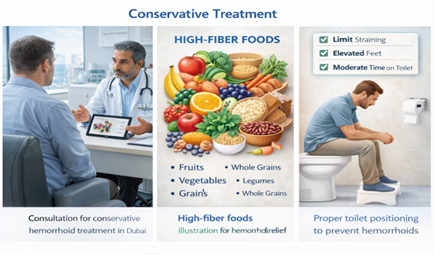
Bathroom habits play a major role in preventing hemorrhoids in Dubai. Small daily changes such as avoiding straining and reducing time on the toilet can significantly lower symptoms and recurrence.
Understanding how hemorrhoids develop and how they are treated is covered fully in our hemorrhoid treatment in Dubai. problem. But the way you use the toilet—how you sit, how long you stay, how you wipe—has a direct impact on whether you develop hemorrhoids.
I’m Professor Dr. Antonio Privitera, a consultant colorectal surgeon with fellowship training at the Mayo Clinic and Royal College of Surgeons (UK), practicing across Dubai. In my consultations, I regularly ask patients about their bathroom habits, and I’m often met with surprise: “Does that really matter?”
Yes. It matters enormously.
Some of the most common causes of hemorrhoids are entirely preventable by changing bathroom habits:
- Sitting on the toilet too long (especially while scrolling your phone)
- Straining during bowel movements
- Delaying when you feel the urge to go
- Poor wiping technique
- Wrong sitting position
This article covers everything you need to know about proper bathroom
habits to prevent hemorrhoids—or manage them if you already have symptoms.
Experiencing symptoms like these? A discreet same-day specialist assessment is available across Dubai.
WhatsApp: +971 55 318 8469 | Phone: +971 55 318 8469
Medcare Discovery Gardens (Dubai)
The #1 Bathroom Mistake: Sitting Too Long
The Problem:
Scenario: You sit on the toilet with your phone. You scroll through Instagram, read news, check work emails, play a game. Before you know it, 10, 15, even 20 minutes have passed.
Why this is terrible for hemorrhoids:
- Sitting on the toilet is THE WORST position for hemorrhoidal veins
- The toilet seat opening creates a ring of pressure precisely where hemorrhoids form
- Blood pools in the hemorrhoidal veins
- Gravity pulls blood downward while the toilet seat restricts flow upward
- Even if you’ve finished your bowel movement, continued sitting damages veins
The evidence: Studies show prolonged toilet sitting is one of the
strongest modifiable risk factors for hemorrhoid development. Yet mos people don’t realize they’re doing it.
The Fix:
5-Minute Rule:
- Set a timer if needed
- Go to the bathroom when you feel the urge
- Sit down, do what you need to do
- If nothing happens in 5 minutes, get up and try later
- Leave your phone outside the bathroom
This is the single most important bathroom habit change you can make.
The Urge to Go: Don’t Delay
The Problem:
Common scenario: You feel the urge to have a bowel movement, but:
- You’re in a meeting
- You’re on a deadline
- You’re in traffic
- You’re in an awkward social situation
- You tell yourself “I’ll go later”
Why delaying is harmful:
- When you delay, your colon continues absorbing water from stool
- Stool becomes harder and drier
- Eventually you have to go, but now the stool is much harder
- You strain to pass the hard stool
- Straining → hemorrhoid development
The habitual delayer: Some people habitually ignore the urge. Over
time:
- The rectum becomes less sensitive to fullness
- You develop chronic constipation
- Bowel movements become unpredictable and difficult
- Hemorrhoids almost inevitably follow
The Fix:
Go when you feel the urge—even if inconvenient.
Practical tips:
- If in a meeting, excuse yourself (people understand bathroom breaks)
- If driving, find a bathroom quickly (gas stations, malls)
- At work, prioritize bathroom breaks over tasks
- At social events, excuse yourself discreetly
Your bowel health is more important than 5 minutes of inconvenience.
Proper Sitting Position: Why It Matters
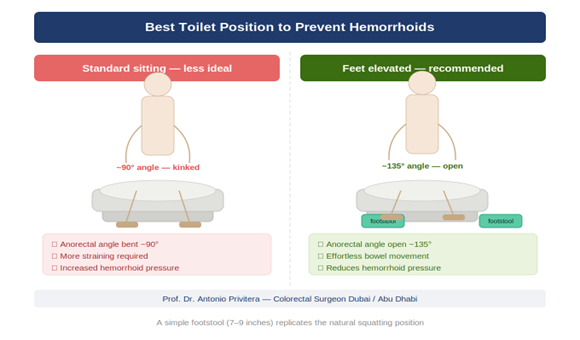
The Anorectal Angle:
Your rectum and anus meet at an angle (the anorectal angle). This angle:
- Is about 90 degrees when standing or sitting with feet flat
- Opens to about 120-130 degrees when squatting
- A more open angle allows stool to pass more easily
Western toilet sitting (feet flat, 90-degree hip angle):
- Anorectal angle is more closed
- Requires more straining to pass stool
- More pressure on hemorrhoidal veins
Squatting position:
- Anorectal angle opens
- Stool passes more easily
- Less straining needed
The Fix: Elevated Feet
Use a small footstool (15-20 cm height):
- Place your feet on the stool while sitting on toilet
- This mimics a squatting position
- Opens the anorectal angle
- Reduces straining
Products available:
- Squatty Potty (popular brand)
- Any small step stool works
- Even a stack of books can work temporarily
Position tips:
- Sit with back straight (don’t hunch)
- Feet elevated on stool
- Knees slightly higher than hips
- Lean forward slightly
- Relax and breathe
Straining: The Direct Cause of Hemorrhoids
What Is Straining?
Straining means:
- Holding your breath and pushing forcefully
- Bearing down with abdominal muscles
- Feeling like you’re “working hard” to have a bowel movement
- Your face turns red, veins in neck bulge
Why straining is so harmful:
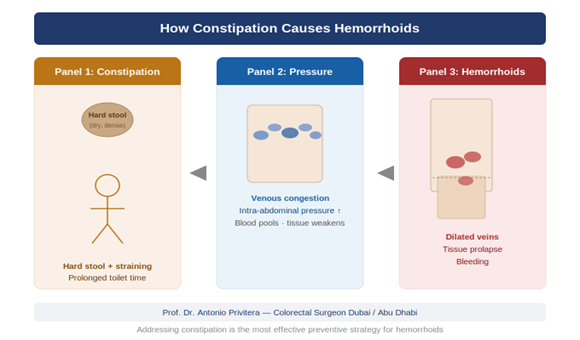
- Dramatically increases intra-abdominal pressure
- Forces blood into hemorrhoidal veins
- Stretches and damages vein walls
- Directly causes hemorrhoid formation
One straining episode won’t cause hemorrhoids, but chronic straining will.
Causes of Straining:
1. Hard stools (constipation)
- Low fiber diet
- Dehydration
- Medications (pain medications, iron supplements)
2. Poor bathroom habits
- Rushing (trying to force a quick bowel movement)
- Ignoring natural urge, then trying to force it later
If symptoms persist or are not improving, a specialist assessment in Dubai can help determine the most appropriate treatment.
3. Misunderstanding of “normal”
- Some people think you’re supposed to “push hard”
- This is wrong—bowel movements should happen naturally with minimal effort
The Fix:
Prevent the need to strain:
- High-fiber diet: 25-35g daily (see Day 14 article)
- Adequate hydration: 2.5-3 liters daily in Dubai
- Fiber supplements: Psyllium if diet isn’t enough
- Regular meal timing: Helps regulate bowel movements
During bowel movements:
- Don’t hold your breath—breathe naturally
- Don’t force it—if nothing happens in 5 minutes, try later
- Relax—tension makes it harder
- Use elevated feet position (opens anorectal angle)
If chronically constipated:
- See doctor about underlying causes
- May need stool softeners temporarily
- Address diet and hydration first
Wiping Technique: Gentle Is Better
The Problem:
Aggressive wiping:
- Scrubbing back and forth repeatedly
- Using rough toilet paper
- Wiping until “perfectly clean”
- Wiping irritated or bleeding hemorrhoids
Why this is harmful:
- Irritates anal skin
- Can traumatize hemorrhoids (causing more bleeding)
- Creates a cycle: irritation → more wiping → more irritation
- Can lead to anal fissures (tears in anal lining)
The Fix:
Gentle Wiping Technique:
1. Pat or dab gently (don’t scrub)
2. Wipe front to back (especially important for women—prevents UTIs)
3. Use soft toilet paper (avoid cheap, rough paper)
4. Stop when mostly clean (you don’t need to be “perfectly” clean)
5. If needed, finish cleaning in shower
Consider Alternatives to Toilet Paper:
Wet wipes:
- More gentle than dry paper
- Get cleaner with less wiping
- Choose unscented, alcohol-free wipes
- Don’t flush (even “flushable” wipes can clog pipes)
Bidet or water spray:
- Very common in Middle East and Asia
- Cleanses with water (most gentle option)
- Reduces need for wiping
- Pat dry gently with soft towel or tissue
Post-bowel movement care:
- If hemorrhoids are present, consider sitz bath after bowel movement
- Pat dry very gently
- Apply hemorrhoid cream if prescribed
Timing and Routine: Creating Healthy Patterns
The Benefit of Routine:
Your bowel has a natural rhythm:
- Responds to circadian rhythms
- Often most active in morning after waking
- Responds to food intake (gastrocolic reflex)
Establishing routine helps:
- Predictable bowel movements
- Less constipation
- Reduced urgency at inconvenient times
How to Establish Routine:
Morning routine:
1. Wake up at consistent time
2. Drink glass of water upon waking
3. Eat breakfast (this stimulates gastrocolic reflex)
4. Allow 20-30 minutes for bowel to activate
5. Go to bathroom even if urge is mild
Don’t force it—if nothing happens, that’s okay. But the routine trains your bowel over time.
Meal timing:
- Regular meal times help regulate bowel movements
- Don’t skip breakfast
- Avoid eating very late at night
For shift workers or travelers:
- Maintaining routine is harder
- Prioritize hydration and fiber
- Use bathroom when you feel urge (don’t delay due to schedule)
Bathroom Habits During Hemorrhoid Flare-Ups
If you currently have symptomatic hemorrhoids:
Extra Care Needed:
Before bowel movement:
- Consider stool softener the night before
- Don’t delay when urge comes
- Allow extra time (but still limit to 5 minutes of sitting)
During bowel movement:
- Elevated feet position (essential—opens angle, reduces straining)
- Breathe slowly and deeply
- Absolutely do not strain
- If internal hemorrhoids prolapse (come out), don’t panic—they go back in after
After bowel movement:
- Wipe VERY gently or use water (bidet/shower)
- Pat dry
- If prolapsed hemorrhoid is out, gently push back in (if Grade III)
- Consider sitz bath (10-15 minutes warm water)
- Apply topical treatment if prescribed
If bleeding:
- Small amount of bright red blood is common with hemorrhoids
- Wipe gently to avoid more bleeding
- Heavy bleeding requires medical evaluation
Common Bathroom Mistakes in Dubai
1. “Phone Time = Toilet Time”
So common in Dubai: Social media, news apps, work emails checked
while on toilet.
Break this habit:
- Bathroom is for bathroom, not entertainment
- Leave phone outside
- Read elsewhere, scroll elsewhere
2. Rushing Due to Busy Schedule
Dubai professional lifestyle: Always rushing, even bathroom break rushed.
The irony: Rushing can cause constipation (didn’t give bowel enoug time), leading to harder stools later, leading to MORE time waste dealing with hemorrhoid problems.
Better approach: Allow 10 minutes when needed (includes preparatio and cleanup, not just 5 minutes sitting).
3. Office Bathroom Avoidance
Privacy concerns: Many people avoid bowel movements at work, waitin until home.
This causes: Delayed bowel movements, harder stools, straining.
Solution: Find the most private bathroom at your workplace, go whe you need to.
4. Dehydration in AC
Dubai-specific: Air conditioning makes you forget to drink water leading to hard stools.
Solution: Drink water throughout day regardless of thirst sensation.
Teaching Children Good Bathroom Habits
Prevention starts young:
Many adult hemorrhoid patients developed poor bathroom habits in childhood:
- Holding bowel movements (at school, during play)
- Not wiping properly
- Straining due to constipation
For parents:
- Teach children to go when they feel the urge
- Don’t shame bathroom needs
- Ensure adequate fiber and water in diet
- Teach proper wiping technique
- Make bathroom time relaxed (not rushed or stressful)
- Use footstool for small children (feet don’t reach floor on adult toilet)
When Good Habits Aren’t Enough
Sometimes despite perfect bathroom habits, hemorrhoids develop due
- Genetic predisposition
- Pregnancy/childbirth
- Aging (weakening of tissues)
- Medical conditions (inflammatory bowel disease, chronic diarrhea)
If you have hemorrhoid symptoms despite good habits:
- See a colorectal surgeon for proper evaluation
- Treatment options range from simple banding to surgery depending on grade
- Don’t delay—early treatment is simpler and more effective
See our comprehensive treatment guide.
This article is written and reviewed by Prof. Dr Antonio Privitera, consultant colorectal surgeon with fellowship training at Mayo Clinic (USA) and the Royal College of Surgeons (UK), specializing in hemorrhoid diagnosis and minimally invasive treatment.
Frequently Asked Questions
1. Is squatting better than sitting on a Western toilet?
Squatting opens the anorectal angle more effectively, making bowel movements easier with less straining. If you have access to squat toilet, it’s beneficial. On Western toilet, use footstool to mimic squatting position.
2. How long is too long to sit on the toilet?
More than 5 minutes is too long. If you haven’t had a bowel movement in 5 minutes, get up and try again later.
3. Is it okay to read on the toilet?
If it means you sit for 10-15 minutes, no. Reading (or phone use) encourages prolonged sitting, which is harmful for hemorrhoidal veins.
4. Should I wipe standing up or sitting down?
Either is fine. What matters is gentle technique, not position. Some people find one position more comfortable or thorough.
5. Are wet wipes better than toilet paper?
Generally yes—more gentle and get cleaner with less wiping. Choose unscented, alcohol-free varieties. Don’t flush them even if labeled “flushable.”
6. What if I can’t have a bowel movement without straining?
This indicates constipation that needs to be addressed. Increase fiber, increase water, consider fiber supplement. If chronic, see doctor—may need stool softener or investigation of underlying cause.
7. Is it normal to have a bowel movement multiple times per day?
Can be normal depending on diet and individual variation. As long as stools are formed (not diarrhea), no straining, and no symptoms, this can be normal. If concerned, discuss with doctor.
8. Should I go at the same time every day?
Ideally, yes. Routine helps regulate bowel function. But don’t force it—if you don’t feel the urge at your “usual” time, don’t strain to produce a bowel movement.
9. Is it bad to hold in a bowel movement occasionally?
Occasionally (once in a while) won’t cause long-term harm. Habitual delaying causes problems. Go as soon as reasonably possible.
10. What’s the best position to sleep for hemorrhoids?
Side-lying with pillow between knees reduces pressure on hemorrhoidal veins. If hemorrhoids are prolapsed/painful, experiment with positions—many find side-lying or stomach-lying more comfortable than back-lying.
References and Medical Sources
Bathroom habit recommendations based on evidence:
1. Anorectal Angle and Defecation Posture – Biomechanics of bowel movements. Sikirov D. Comparison of straining during defecation in three positions: results and implications for human health. Dig Dis Sci. 2003;48(7):1201-5. PubMed
2. Toilet Posture and Hemorrhoid Development – Clinical observations. Sakakibara R, Tsunoyama K, Hosoi H, et al. Influence of body position on defecation in humans. Low Urin Tract Symptoms. 2010;2(1):16-21. PubMed
3. American Society of Colon and Rectal Surgeons Guidelines – Prevention recommendations. Davis BR, Lee-Kong SA, Migaly J, Feingold DL, Steele SR. The American Society of Colon and Rectal Surgeons Clinical Practice Guidelines for the Management of Hemorrhoids. Dis Colon Rectum. 2018;61(3):284-292. PubMed
Medical Review: This content was written and reviewed by Professor training at the Mayo Clinic and Royal College of Surgeons (UK), and European Board Certification in Colorectal Surgery.
Assessment for Hemorrhoid Symptoms
If proper bathroom habits aren’t preventing or relieving symptoms, you need evaluation.
📱 WhatsApp: +971 55 318 8469
📞 Phone: +971 55 318 8469
Dubai Locations
- Medcare Medical Centre, Discovery Gardens
- Medcare Women and Children Hospital
- Medcare Royal Specialty Hospital
- Clemenceau Medical Centre
- Aster Hospital, Qusais
Professor Dr. Antonio Privitera
Fellowship Training: Mayo Clinic | Royal College of Surgeons (UK)
European Board Certified in Colorectal Surgery
About the Author